BASF Coatings Carlyle has completed the sale of BASF’s global coatings business to the investment fund Carlyle in a transaction valued at EUR 7.7 billion, giving rise to the new independent company Surventis, specializing in automotive coatings and surface treatments. The transaction not only represents one of the largest recent deals in the industrial coatings market but also reshapes the competitive landscape of a strategic sector for the automotive industry, corrosion protection, and asset integrity.
The transaction was originally announced on October 10, 2025, and completed after receiving all required regulatory approvals. The total enterprise value of BASF’s Coatings business—including the prior divestment of the decorative paints business—reaches EUR 8.7 billion, at an implied multiple of approximately 13 times 2024 EBITDA before special items.
BASF Coatings Carlyle gives rise to Surventis
The new company Surventis—known as BASF Coatings until June 30—emerges as an independent company with a global portfolio covering coatings for automotive manufacturers (OEM), the automotive repair segment (refinish), and the industrial surface treatment business. Carlyle, as the new majority shareholder, provides capital and portfolio management expertise to accelerate Surventis’s growth as an independent player.
BASF’s 40% retention is not merely a passive financial position: the group will continue to participate in Surventis’s future value creation, with its stake recorded as a financial investment under the equity method in BASF’s financial statements starting July 2026. BASF Chairman Dr. Markus Kamieth noted that the transaction “marks a key milestone in the execution of our Winning Ways strategy, aimed at unlocking the value of our independent businesses.”
Anup Kothari, also a member of BASF’s Executive Board, highlighted that “the new ownership structure provides an excellent foundation for Surventis’s future profitable growth,” while expressing his best wishes to the employees of the former Coatings business in their new phase as an independent company.
Impact on industrial coatings and corrosion protection
For the corrosion protection coatings and asset integrity industry, the creation of Surventis as an independent entity has practical implications. Industrial customers—refineries, petrochemical plants, electrical transmission infrastructure, offshore facilities—who rely on high-performance coating systems developed under the BASF Coatings umbrella will need to evaluate the continuity of supply contracts, technical support, and product development programs under the new corporate structure.
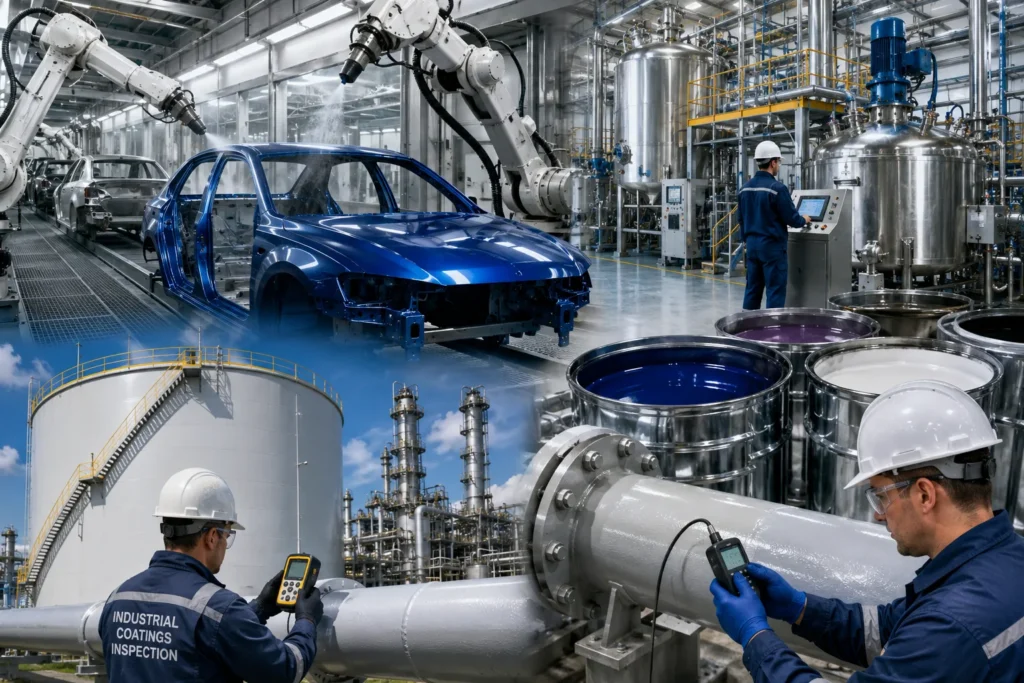
Historically, BASF Coatings has been one of the main suppliers of coating systems for the global automotive sector, with water-based paint technology, high-solid clearcoats, and robotic application systems that define the standard of surface quality in the industry. Its portfolio of surface treatments includes phosphating, metal pretreatment, and functional coatings for demanding mechanical and chemical applications, relevant for sectors such as industrial equipment manufacturing, energy production, and critical infrastructure.
In the petrochemical and process industry segment, high-temperature and chemical-resistant anticorrosive coatings are a strategic input for maintaining the integrity of static equipment—tanks, reactors, heat exchangers, pipelines—whose accelerated degradation due to corrosion represents one of the main causes of unplanned shutdowns and integrity risk. The stability of supply and technical support from coating manufacturers is, in this context, a factor for operational continuity.
The sale strengthens BASF’s industrial strategy
The sale of the Coatings business is consistent with BASF’s strategy to concentrate resources on its most profitable and technologically differentiated segments: Chemicals, Materials, Industrial Solutions, Nutrition & Care, and the autonomous businesses of Surface Technologies and Agricultural Solutions. The group employs approximately 108,000 people and generated sales of around EUR 60 billion in 2025.
The EUR 5.8 billion pre-tax proceeds strengthen BASF’s cash position at a time when the group faces margin pressures derived from high energy costs in Europe and increasing competition from Asian chemical producers. The resources freed up by the divestment could be allocated to debt reduction, acceleration of investments in higher-growth segments, or shareholder return programs.
For the industrial materials market, the reconfiguration of BASF’s portfolio also opens up a competitive space in the high-performance coatings segment that other players—Axalta, PPG, AkzoNobel, Sherwin-Williams—will try to leverage. The entry of Surventis as an independent competitor, backed by Carlyle but without BASF’s distribution and support network, will redefine the sector’s commercial dynamics in the coming years.
Surventis and the future of engineered coatings
Beyond the automotive segment, Surventis’s surface treatment portfolio has direct applications in the protection of components for the energy transition: wind farm structures, support modules for solar panels, turbine components, and energy storage systems require coatings with high resistance to weathering, salt corrosion, and thermal cycling. Surventis’s ability to maintain and expand its technological base in these segments will be a key indicator of its evolution as an independent player.
For companies specializing in operational reliability and coatings inspection, the transition to Surventis represents a moment to review product qualification programs and applicator system approvals. Customers with technical specifications based on BASF Coatings references will need to confirm with Surventis the continuity of formulations and valid approval certificates.
Sources: BASF / European Coatings