
Storage tanks: towards data-driven inspections
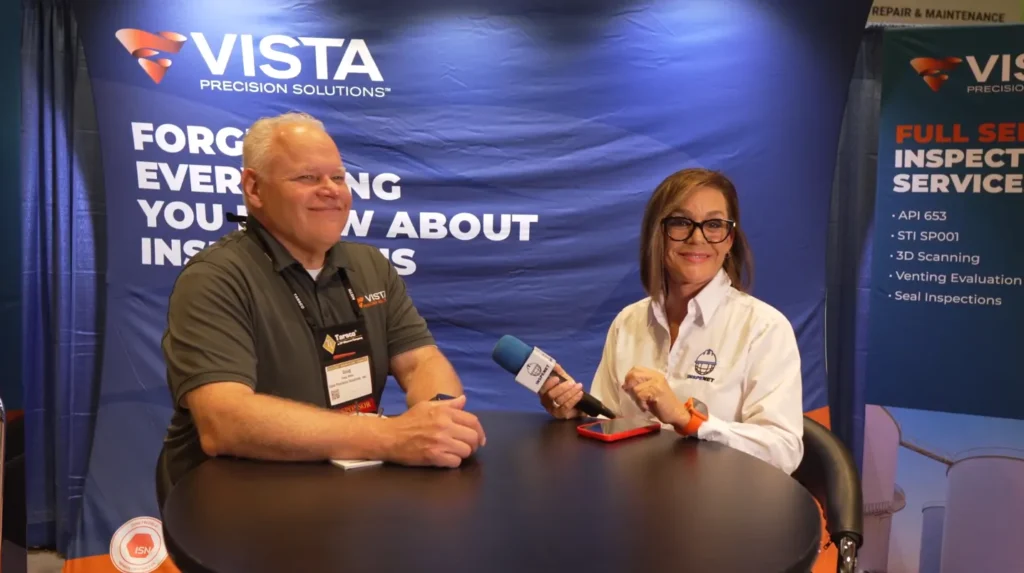
As part of NISTM 2026, Douglas W. Mann, president of Vista Precision Solutions Inc, proposes a clear change in the way the industry approaches storage tanks inspection. In contrast to traditional models based on fixed schedules, the company proposes an approach based on direct measurements and data analysis that redefines operational decision making.
A traditional model that limits efficiency
Currently, many industrial facilities continue to apply periodic inspection schemes established by standard intervals. These models, although widely accepted, do not always respond to the actual condition of the assets. As a result, operators often remove storage tanks from service for scheduled inspections that, in some cases, were not necessary.
This approach has a direct impact on operating costs, with tank downtime leading to production losses, use of technical resources and a temporary reduction in storage capacity. As Mann explains, this practice is still common due to the lack of reliable tools to accurately determine when a tank requires inspection.
From fixed schedule to data-driven analysis
Faced with this reality, Vista Precision Solutions proposes a change of approach, instead of relying exclusively on predefined intervals, the company relies on field data collection and direct measurement of critical parameters in storage tanks. storage tanks.
From this information, it is possible to estimate the time until the next inspection more accurately. This model allows inspection intervals to be extended when tank conditions permit, while maintaining the safety standards required by the industry.
This approach also introduces greater operational flexibility. Decisions are no longer based on general assumptions but on the actual condition of the asset, which improves planning and optimizes the use of resources.
Practical applications in operation
The impact of this change is directly reflected in the daily operation, by avoiding unnecessary withdrawals, operators can keep the storage tanks in service for a longer period of time, which translates into greater efficiency and operational continuity.
In addition, the technology developed by Vista Precision Solutions allows addressing other relevant industry challenges. Among them is the inspection of pressurized buried pipelines a critical element that cannot be assessed by conventional visual methods.
Using specific techniques, the company is able to analyze the integrity of these pipes without the need for excavation. This capability is particularly relevant in leak detection, as operators are often unaware of their existence until a specialized intervention takes place.
The importance of precision instrumentation
This model would not be possible without the use of advanced instrumentation. Mann stresses that the reliability of the results depends directly on the quality of the equipment used. In this regard, Vista Precision Solutions uses calibrated sensors and methods that have been evaluated and validated by third parties.
Accuracy is a critical factor, as measurements are made at extremely small scales. Working at such high levels of accuracy requires highly sensitive equipment and rigorous calibration processes.
The combination of accurate instrumentation and validated methodologies provides consistent data on the condition of storage tanks and other industrial assets.
Challenges that the industry continues to overlook
Despite the technological advances available, there are aspects that continue to be underestimated in the sector. One of them is the right time to perform inspections; the lack of visibility on the real state of the assets leads to conservative decisions that, in many cases, generate inefficiencies.
Another critical issue is the integrity of systems that are not visually accessible, such as buried pipelines. The difficulty in assessing these elements causes certain problems, such as leaks, to remain hidden for long periods of time.
According to Mann, addressing these challenges requires the adoption of tools that allow direct and reliable information to be obtained without resorting to invasive methods. In this sense, the combination of advanced measurement and data analysis is presented as an effective solution to improve asset management.
An evolution in industrial asset management
The approach of Vista Precision Solutions approach reflects a broader trend within the energy and industrial sector. The integration of data into inspection processes is transforming the way critical assets are managed.
Instead of following rigid models, companies are beginning to adopt more dynamic strategies based on the actual behavior of their facilities. This change makes it possible to optimize costs, improve planning and reduce operational risks.
Ultimately, the evolution towards data-driven inspections marks a new path for storage tank management. As these technologies consolidate, the industry is moving towards more efficient models aligned with actual operational needs.
For more content about NISTM 2026, visit our LinkedIn profile.
Source: Inspenet.