Industrial maintenance with drones in critical operations
During the NISTM 2026 event, Apellix presented its technological proposal to transform industrial maintenance using autonomous drones . In this context, Nader Khakpour, the company's sales manager, explained how these solutions are changing the way key tasks are performed in critical infrastructure, especially in sectors such as oil and gas.
Instead of long and complex processes, the company is betting on systems capable of reducing time, improving safety and optimizing resources in operations such as tank cleaning or the application of industrial coatings .
The challenge of maintenance at height in industry
Traditionally, industrial maintenance on large structures has required the use of scaffolding, hoists, and manual labor at height. These methods involve lengthy preparation and execution times, as well as a high level of risk for workers.
In operations such as tank cleaning , teams can take up to two weeks to complete the job using conventional methods. Furthermore, the associated logistics and safety costs significantly increase the economic impact of these tasks.
Faced with this scenario, the need for more agile and secure solutions has encouraged the adoption of new technologies in the sector.
Autonomous drones for cleaning and coating
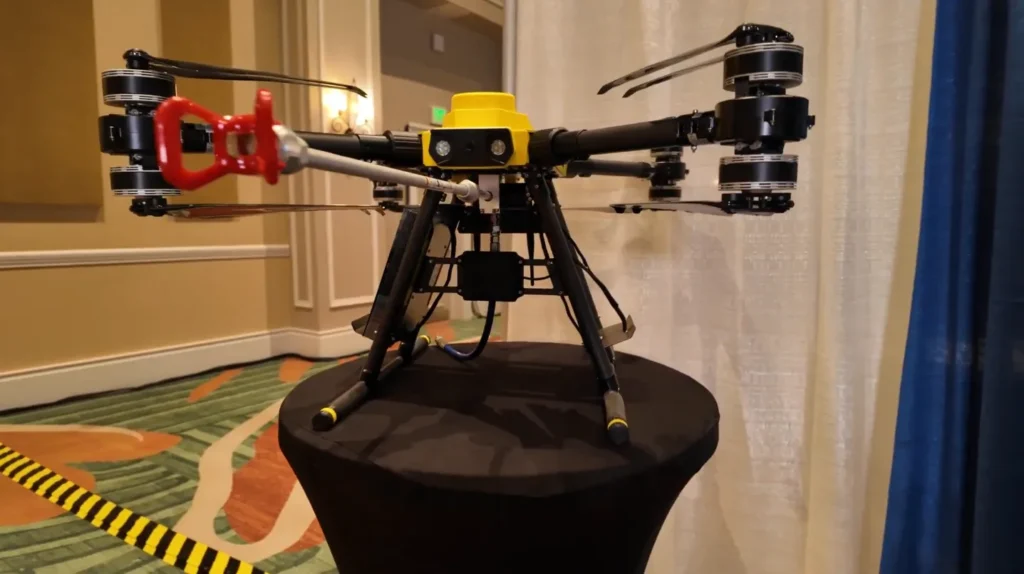
In this context, Apellix has developed industrial drones specifically designed for industrial maintenance tasks. These solutions allow for cleaning, painting, and coating work to be carried out with a high degree of automation.
According to Nader Khakpour, these drones can operate at altitudes of up to 200 feet and have a flight autonomy of 32 minutes. Thanks to their integration with artificial intelligence systems , the devices can be programmed to work autonomously on specific surfaces.
The system allows the operator to define work areas via digital interfaces, after which the drone executes the tasks precisely. This capability is especially relevant in complex structures such as storage tanks.
Regulatory compliance and industrial design
One of the differentiating elements of Apellix technology is its compliance with NDAA regulations, which allows its use in government and military facilities in the United States.
Furthermore, the drones are manufactured with components of American origin and carbon fiber structures, which improves their strength and performance in demanding industrial environments.
The company, founded in 2014 and headquartered in Jacksonville, Florida, specializes in developing aerial robotic systems aimed at eliminating workers' exposure to hazardous environments.
From weeks to hours: productivity improvement
The impact on efficiency is one of the most relevant aspects of using drones in industrial maintenance . Compared to processes that can extend over days or weeks, these solutions allow tasks to be completed in significantly less time.
In the case of industrial painting, Apellix drones can cover between 2,000 and 3,000 square feet per hour . This performance allows for faster projects and reduced asset downtime.
Likewise, the elimination of auxiliary infrastructure such as scaffolding contributes to a direct reduction in operating costs.
Inspection and maintenance in a single operation
Another key feature is the ability to integrate inspection functions within the same process. Drones incorporate cameras that allow for visual assessments while cleaning or coating tasks are being performed.
This facilitates its integration into standards-based inspection programs such as API or RBI methodologies , where monitoring the condition of assets is key.
In this way, companies can combine maintenance and inspection into a single operation, optimizing resources and improving decision-making.
Current challenges and evolution of the sector
Despite the advances, the use of drones in industrial maintenance still presents certain challenges, one of them being the height limitation for certain coating applications, which depends on the operating conditions and the environment.
However, the incorporation of artificial intelligence is improving the accuracy and control of these tasks. The systems developed by Apellix allow for consistent application patterns and adaptability to different geometries.
This technological evolution points towards a scenario in which operations will become increasingly autonomous and efficient.
Equipment designed for industrial operations
In terms of durability, Apellix drones are designed to operate for longer periods than other solutions on the market. While some equipment has a lifespan of approximately two years, these systems can last between four and five years.
The company complements this proposal with technical support and engineering services, which reinforces the reliability of its solutions in industrial environments.
Demonstrations and access to technology
During the interview, Nader Khakpour highlighted the availability of practical demonstrations at the company's Jacksonville facility, where drone cleaning and painting tests are conducted.
These initiatives allow companies to directly assess the potential of this technology and its application in real industrial maintenance operations.
For more content about NISTM 2026, visit our LinkedIn profile.
Source: Inspenet.