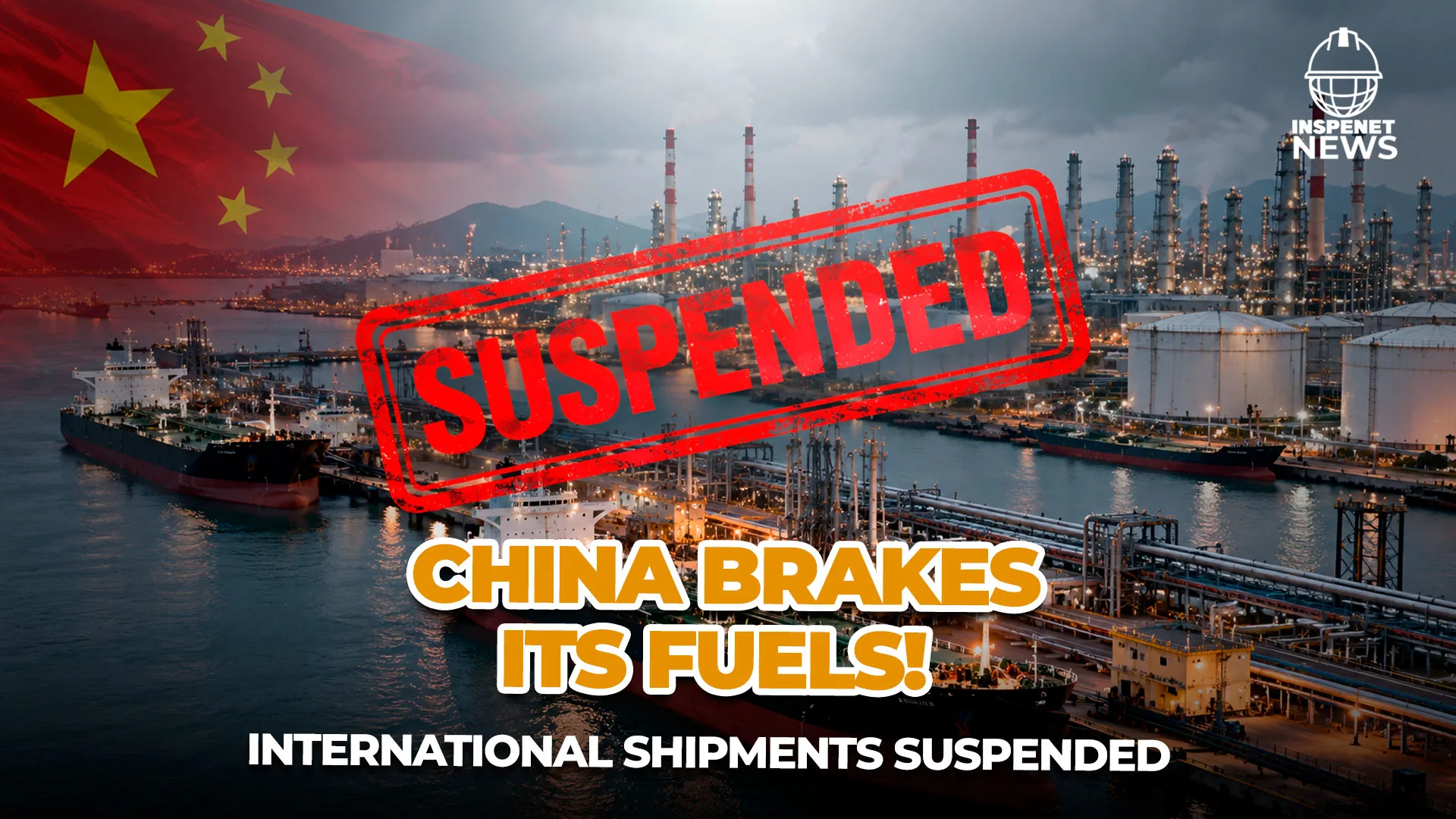
China curbs fuel exports as reserves fall
China has suspended fuel exports scheduled for October as it seeks to bolster domestic stockpiles. The decision affects shipments to markets other than Hong Kong and Macau and leaves open the possibility of a resumption later in the month.
According to people familiar with the situation cited by Reuters, the country's main refineries began the national holiday period without receiving authorization to export petroleum products during October.
However, uncertainty remains about how long the pause will last. Authorities could allow shipments to resume after October 7, when the holiday period ends. The decision would depend on the evolution of national inventories and refinery production.
China had already restricted its international fuel sales in March following disruptions to crude oil supplies from the Middle East. It subsequently eased these restrictions in July and began managing shipments of gasoline, diesel, and jet fuel on a monthly basis.
PetroChina cancels shipments scheduled for October
Meanwhile, some companies have already modified their export schedules, and PetroChina has canceled several shipments of gasoline and jet fuel that were planned for October. Most of those deals had been agreed upon in the preceding weeks.
Zhejiang Petrochemical Corp, for its part, decided not to schedule shipments of petroleum products during the holiday week.
The situation is significant because of the size of the Chinese industry; the country has the largest refining capacity in the world, although its exports are usually lower than those made by India and South Korea within the Asian market.
Beijing prioritizes domestic fuel supplies
On the other hand, the availability of refined products within China helps to explain the restrictions; Beijing has linked the recovery of exports to the return of domestic stocks to levels recorded before the current international tensions.
Kpler estimates that commercial stocks of gasoil and diesel are around 20 million barrels below that benchmark level. For gasoline, the shortfall is around 9 million barrels.
These figures place diesel reserves at the heart of the decision. Although refineries could benefit from high international margins, the Chinese government's priority remains ensuring sufficient product for domestic consumption.
During September, China loaded approximately 1.4 million metric tons of diesel and about 500,000 metric tons of gasoline. These quantities were supplemented by at least 2 million metric tons of jet fuel, including volumes under bonded warehouses destined for Hong Kong and Macau. Total shipments were lower than those of August.
What does China's decision mean for the fuel market?
At the same time, the suspension comes as various problems are reducing the international availability of refined products.
Markets are grappling with the fallout from supply disruptions in the Middle East and attacks on Russian refining facilities. A temporary reduction in Chinese supply is adding another source of pressure.
The reaction has already been felt in Asia. Diesel futures spreads reached their highest level in two weeks amid expectations of reduced availability from China.
This scenario could put pressure on fuel prices in countries that rely on imports. The ultimate impact will depend on the duration of the Chinese restrictions and the ability of other producers to compensate for the missing shipments.
Furthermore, Singapore, Malaysia, Australia, Vietnam, Bangladesh, and the Philippines were among the top destinations for Chinese fuel during September. Therefore, a prolonged pause would force some Asian buyers to seek alternative suppliers.
Diesel faces a tighter international supply
In particular, diesel is among the products most exposed to supply constraints; China has the capacity to increase its processing and take advantage of international margins, but the authorities keep exports conditional on the state of domestic inventories.
The United States has also expressed concern about the global availability of this fuel. US Energy Secretary Chris Wright noted that the market has lost diesel exports from both the Middle East and China.
Meanwhile, Washington has asked Germany and France to release some of their emergency reserves to increase international availability and help moderate prices.
South Korea could cover some of the lost supply
Meanwhile, South Korean refineries are emerging as a potential alternative source for some Asian buyers. However, their ability to rapidly increase sales in the immediate market is limited due to existing long-term supply contracts.
Bangladesh reflects this dependence, obtaining up to a third of its refined product imports from Unipec and PetroChina. Bangladeshi energy authorities have not yet received any notification from the Chinese companies regarding changes in supply, although they are considering turning to other suppliers if necessary.
Therefore, the ability of other Asian refiners to replace Chinese volumes will be one of the factors that will determine market behavior during October.
When could China resume fuel exports?
Finally, October 7 appears to be the first date to watch; once the national holiday period concludes, Beijing could authorize fuel exports again if it considers that domestic stocks offer sufficient margin.
The evolution of diesel and gasoline reserves will be a determining factor. Refinery production levels and the availability of crude oil to maintain operations will also play a role.
Until then, the lack of new Chinese shipments reduces supply options for several Asian buyers. If the restrictions continue after the holidays, the reduced supply could keep pressure on fuel prices and increase the search for alternative suppliers.
News of additional interest
JERA is preparing a mega AI center near Tokyo
JERA, Japan's largest power generator, has joined Dell Technologies and RHAALM to accelerate the development of artificial intelligence infrastructure in the country. The first project will be a 400-megawatt data center in Chiba, near Tokyo, with an estimated investment of $15 billion. Apollo Global Management plans to participate as a financial and investment partner of RHAALM.
The complex will be located next to JERA's thermal power plant in Chiba. RHAALM will develop, build, operate, and finance the facility, while Dell will provide the technology infrastructure for the AI systems. JERA will supply up to 400 MW of power over a period of 15 to 25 years. The facility is expected to begin operating in phases in 2028 and reach full capacity in 2029.
Lynas sets its sights on Brazil's rare earth elements
Lynas Rare Earths has agreed to acquire Australian company Meteoric Resources in a share swap valued at approximately $672 million. The transaction will give Lynas access to the Caldeira project in Brazil and expand its rare earth sources outside of China. The offer consists of 0.0207 new Lynas shares for each Meteoric share and represents a premium of over 68% compared to Meteoric's last closing price.
Lynas plans to work with the existing Meteoric team to develop Caldeira, a project whose capital expenditure could exceed US$500 million. It will also provide up to A$110 million to support the project's progress and will explore establishing processing capacity in Brazil. Market reaction was mixed: Meteoric's shares rose as much as 56%, while Lynas's fell 6.4% amid concerns about the costs and technical challenges of processing ionic clay.
PETRONAS activates backup plan in response to gas pipeline closure
PETRONAS took steps to maintain gas supplies in Malaysia following the temporary suspension of the Songkhla export pipeline. The pipeline belongs to Trans Thai-Malaysia, a joint venture between PETRONAS and PTT. Operations were halted as a precaution after a routine inspection detected an issue requiring attention.
The company is leveraging the flexibility of its integrated supply network to minimize potential disruptions to its customers in Malaysia. It is also working with partners and buyers to maintain system stability. The pipeline will remain shut down until reviews confirm it can safely resume operation.
Coal gains ground on LNG in Bangladesh
Bangladesh is shifting its electricity mix despite investments in importing more liquefied natural gas (LNG). In July, its coal-fired power plants generated 3.92 terawatt-hours of electricity, compared to 3.66 TWh from gas-fired plants. This marked the first time coal had outperformed gas during the summer months in a country where gas once accounted for over 90% of electricity supply.
Price explains much of the shift. Following the geopolitical tensions of 2026, Asian LNG rose from around $11 per million British thermal units to over $25. By comparison, Australian coal is equivalent to about $6.50 and Indonesian coal to about $5. For economies that need abundant and affordable electricity, this difference can be a significant factor in deciding which fuel to use.