Autonomous navigation is progressing successfully in the port of Rotterdam
As Europe seeks to strengthen the efficiency of its logistics chains and accelerate the digitalization of transport, the port of Rotterdam has taken a significant step by demonstrating the potential of autonomous navigation using a vessel capable of moving between terminals in a port environment with constant maritime traffic.
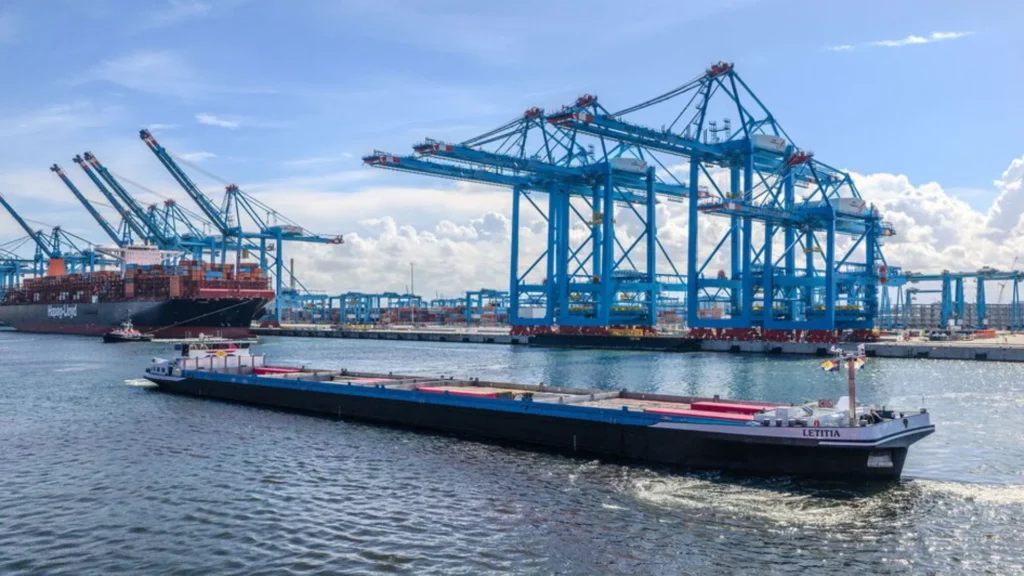
The test was conducted using the MS Letitia , a river transport vessel that navigated different areas of the Dutch port complex, operating with advanced navigation assistance systems. The exercise was part of the activities of the European MAGPIE project, an initiative aimed at promoting technologies that can improve the sustainability and performance of ports.
The MS Letitia completed maneuvers without direct intervention
During the demonstration, the vessel sailed from Amaliahaven to Waalhaven, passing through strategic areas such as Europoort and the Nieuwe Waterweg. Throughout the journey, it executed departure, navigation, and docking maneuvers using automated systems designed to interpret the environment in real time.
Furthermore, the technology was able to detect other vessels along the route and adjust its movements to maintain safe navigation. The system continuously analyzed surrounding traffic and assessed potential risks before making operational decisions.
Although the vessel operated autonomously, the captain remained on board as the ultimate authority responsible for the operation. His presence ensures the possibility of assuming control at any time in the event of unforeseen situations or conditions requiring human intervention.
Autonomous navigation seeks to strengthen river transport
The interest in developing this technology stems from the challenges facing the European logistics sector. The growth in freight movement necessitates finding solutions that increase transport capacity without putting additional strain on land-based infrastructure.
In this context, river transport emerges as an efficient alternative for moving containers, bulk cargo, and liquid products. Its use helps reduce road congestion and promotes more efficient energy use compared to other modes of transport.
Autonomous navigation could further enhance these advantages by facilitating more precise operations, improving route planning, and optimizing vessel utilization in high-demand logistics corridors.
Smart ports are gaining prominence in Europe
At the same time, the demonstration reinforces the European strategy of developing smart ports capable of integrating digital technologies into their daily operations.
Port facilities are becoming spaces where tools related to automation, data analytics, electrification, and connectivity converge. These capabilities allow for more efficient management of cargo flows and a faster response to changes in international trade.
Rotterdam has established itself as one of the main testing centers for this type of development due to its volume of activity and its role within European logistics chains.
MAGPIE accelerates logistics transformation
The MAGPIE project brings together dozens of European partners with the aim of promoting solutions related to clean energy, digitalization and sustainable logistics.
Within this initiative, autonomous navigation is one of the pilot programs designed to evaluate technologies that can later be applied in commercial operations. The results obtained allow for the validation of systems under real-world conditions and accelerate their adoption by port operators and transport companies.
The experience developed in Rotterdam will also serve to refine commercial tools aimed at assisting river vessels, including advanced positioning systems, maneuver visualization and collision prevention.
What can change for the maritime sector?
As these technologies evolve, the sector could benefit from more predictable operations, better coordination between terminals, and more efficient use of port infrastructure.
Furthermore, the combination of automation, smart sensors and decision support opens the door to new ways of managing freight transport on inland waterways.
The recent demonstration in Rotterdam shows that autonomous navigation is progressing from the experimental phase towards applications increasingly closer to everyday logistics activity, a scenario that could redefine the role of river transport within European supply chains.
News of additional interest
US leads new Mediterranean energy hub
The United States, Cyprus, Greece, Israel, and Rice University signed a declaration to create the Eastern Mediterranean Energy Center (EMEC) in Houston. The initiative seeks to strengthen cooperation among the participating countries in areas such as natural gas development, energy infrastructure, and applied research in the sector. The agreement also builds upon objectives set forth in the 2019 Eastern Mediterranean Energy and Security Partnership Act.
The new center will serve as a platform to connect governments, universities, and businesses to exchange technical and scientific knowledge. It will also promote projects related to energy transmission networks, critical infrastructure security, electrical reliability, and the training of specialized talent. Authorities emphasized the growing importance of the Eastern Mediterranean within the international energy market and that this cooperation will allow for better utilization of investment and growth opportunities.
Johan Sverdrup adds oil to his portfolio and prepares for a new expansion
Equinor and its partners are advancing to a new stage of development at the Johan Sverdrup field after confirming increased oil volumes in the Tonjer and Geitungen areas. Results from recent appraisal wells identified additional resources that will serve as the basis for Phase 4 of the project. The company plans to connect these findings to the field's existing infrastructure to accelerate production and optimize costs.
Preliminary estimates place the new resources at between 20 and 30 million barrels of oil equivalent. The plan envisions an offshore development linked to the existing facilities at Johan Sverdrup, considered Norway's largest oil field. The final investment decision is expected in the coming years, and production could begin in 2029.
Amazon reduces its water consumption in data centers
Amazon reported that its data centers achieved a water efficiency of 0.12 liters of water per kilowatt-hour in 2025, a figure that, according to the company, far exceeds the industry average. The company stated that this result is the product of several years of improvements in cooling systems, operational monitoring, and infrastructure design. Since 2021, water efficiency has improved by 52%.
Most of Amazon's data centers use outside air to cool servers and only use water during periods of intense heat. The company has also raised the operating temperature of its equipment to reduce the need for additional cooling. As part of its environmental strategy, Amazon stated that it operates dozens of facilities using recycled water and participates in water resource recovery and conservation projects in the United States, Spain, and Mexico.
Brazil and Belgium make progress on a maritime route for clean fuels
A new international consortium will work on developing a green maritime corridor between the port of Açu, Brazil, and the port of Antwerp-Bruges, Belgium. The initiative brings together port operators, shipping companies, and energy firms to assess the infrastructure, vessels, and business models needed to transport low-emission synthetic fuels, such as e-ammonia and e-methanol.
The project stems from studies that identified Açu as one of the areas with the greatest potential for producing and exporting these fuels, thanks to the availability of renewable energy, support for green hydrogen projects, and favorable investment conditions. The consortium will seek to define a roadmap to connect Brazil's emerging supply of clean fuels with growing European demand.