The New Horizon of Mechanical Integrity
Artificial intelligence and autonomous robotics are transforming how the energy industry manages safety, reliability, and mechanical integrity. In Inspection 4.0, these technologies strengthen the application of API standards through more accurate, continuous, and traceable data.
This evolution does not replace engineering principles or the judgment of certified inspectors. Its value lies in reducing technical uncertainty, improving data quality, and optimizing decisions related to maintenance, risk, and asset life.
The Limits of the Traditional Model
For decades, industrial inspection has relied on periodic campaigns, spot measurements, and manual records. Although this model has supported operational safety, it now shows limitations when facing aging assets, complex facilities, and higher availability demands.
Shutting down units, emptying tanks, or entering confined spaces involves significant costs and operational risks. As a result, the industry is moving toward inspection models with less human intervention, broader coverage, and the ability to assess asset health in near real-time.
Field Reengineering: API 510, 570, and 653
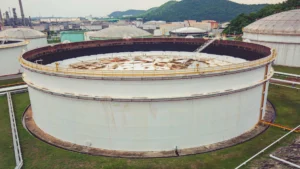
API 510, API 570, and API 653 establish criteria for inspecting pressure vessels, piping systems, and storage tanks. Traditionally, their application has relied on discrete sampling, predefined measurement points, and scheduled evaluations.
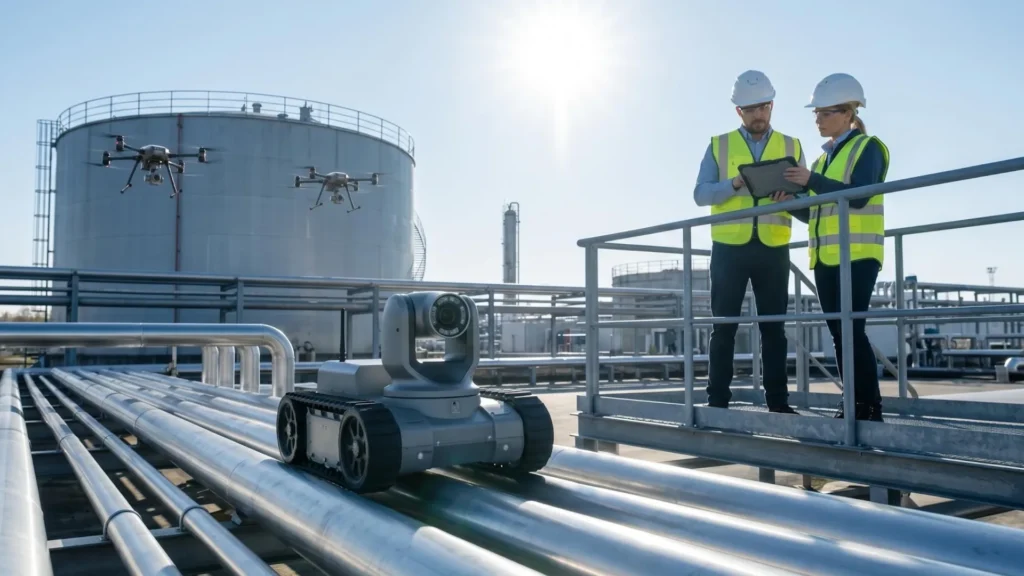
The incorporation of ground robots, autonomous drones, advanced ultrasound, laser scanners, and Phased Array technologies expands inspection capacity. These systems capture large volumes of data without extensive disassembly or frequent entry into hazardous areas.
Flyability documented that DR1 Group reduced downtime by up to 80% and costs by 60% in ballast tank inspections using the Elios 2 drone. The case highlights the value of remote inspection in confined spaces.
API 581: From Static Risk to Prediction
Risk-Based Inspection (RBI), developed under API 581, also (integrates advanced capabilities derived from) artificial intelligence. Previously, risk analysis was typically updated at defined intervals using limited datasets and calculations executed on relatively static platforms.
With AI, permanent sensors, and integration with IDMS platforms, risk can be recalculated more frequently and accurately. Analytical models process operating variables, inspection history, damage mechanisms, and degradation trends.
FlytBase reported that autonomous drone inspection in Shell Petroleum infrastructure reduced manual intervention and improved safety by limiting human exposure in hazardous areas. The case supports Shell’s “rounds by exception” philosophy, where personnel enter high-risk areas only when necessary.
API 579 and Technical Decision-Making
API 579 gains greater value when supported by reliable data from robotics, AI, and digital models. These technologies enable early detection of wall-thickness loss, deformation, localized corrosion, and other deterioration mechanisms.
With this information, engineers can assess defect severity and make more precise decisions on whether to repair, continue operating, reduce pressure, monitor, or retire the asset. Technology does not replace the specialist; it strengthens expert judgment within the applicable regulatory framework.
Operational and Financial Impact
The combination of digital twins, robotics, and artificial intelligence delivers significant benefits for industrial safety and efficiency. Key advantages include lower personnel exposure, reduced downtime, better maintenance planning, and more reliable historical data.
In offshore facilities, CAN USA documented the use of the Elios 3 drone to reduce inspection time by 60% and costs by 30%. In asset management, GE Digital reported improvements of up to 6% in availability and reductions of up to 40% in reactive maintenance through APM solutions.
The New Role of the Inspector
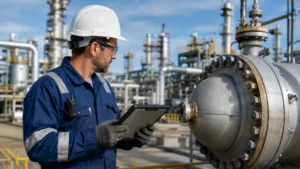
Inspection 4.0 does not displace technical professionals; it transforms their role. Repetitive data collection tasks can be automated, allowing inspectors to focus their expertise on analysis, validation, and critical decision-making.
The future of mechanical integrity will depend on integrating API standards, expert knowledge, and digital technologies. Competitive advantage will not come from inspecting more, but from interpreting data more effectively to protect people, assets, and operational continuity.
References
- Flyability / DR1 Group. Flyability’s Elios Cuts Downtime By 80% In Drilling Rig Ballast Tank Inspection. Available at: https://www.flyability.com/casestudies/ballast-tank-inspection
- FlytBase / Shell Petroleum. How Shell Petroleum is Inspecting Critical Energy Infrastructure using Docks in Rotterdam, Netherlands. Available at: https://www.flytbase. com/case-studies/shell-petroleum-autonomous-drone-inspections-oil-and-gas
- MFE Inspection Solutions / CAN USA Reduces Time for Offshore Drilling & Production Facility Inspections by 60% with the Elios 3. Available at: https://mfe-is.com/can-usa-reduces-time-for-offshore-drilling-amp-production-facility- inspections-by-60-with-the-elios-3/
- GE Digital / Reliabilityweb. APM solutions; up to 6% higher availability and 40% less reactive maintenance. Available at: ge.com/news/taxonomy/term/8717
This article was developed by Mario Toyo of Inspenet and published as part of the eighth issue of Inspenet Brief magazine (July 2026), dedicated to technical content in the energy and industrial sectors.