Table of Contents
- Natural Gas: O&M and Operational Reliability
- Reliability and Asset Management in Natural Gas
- Reliability-Centered O&M: RCM, PdM, and KPIs
- RAM in Natural Gas Systems
- Asset Prioritization by Criticality
- FMEA and FMECA in Natural Gas
- Digitization of Reliability
- Digital Solutions for Operational Reliability
- From Data to Technical Decisions
- Conclusions
- Frequently Asked Questions (FAQs)
In natural gas systems, a single failure in compression, transportation, or process control can jeopardize service continuity, trigger unforeseen costs, and increase exposure to critical events. In this context, reliability engineering and asset management have evolved from support functions to become part of the technical core of the operation. Today, maintenance, inspection, equipment condition, and risk must be considered as a single operational issue, rather than as separate activities.
Natural Gas: O&M and Operational Reliability
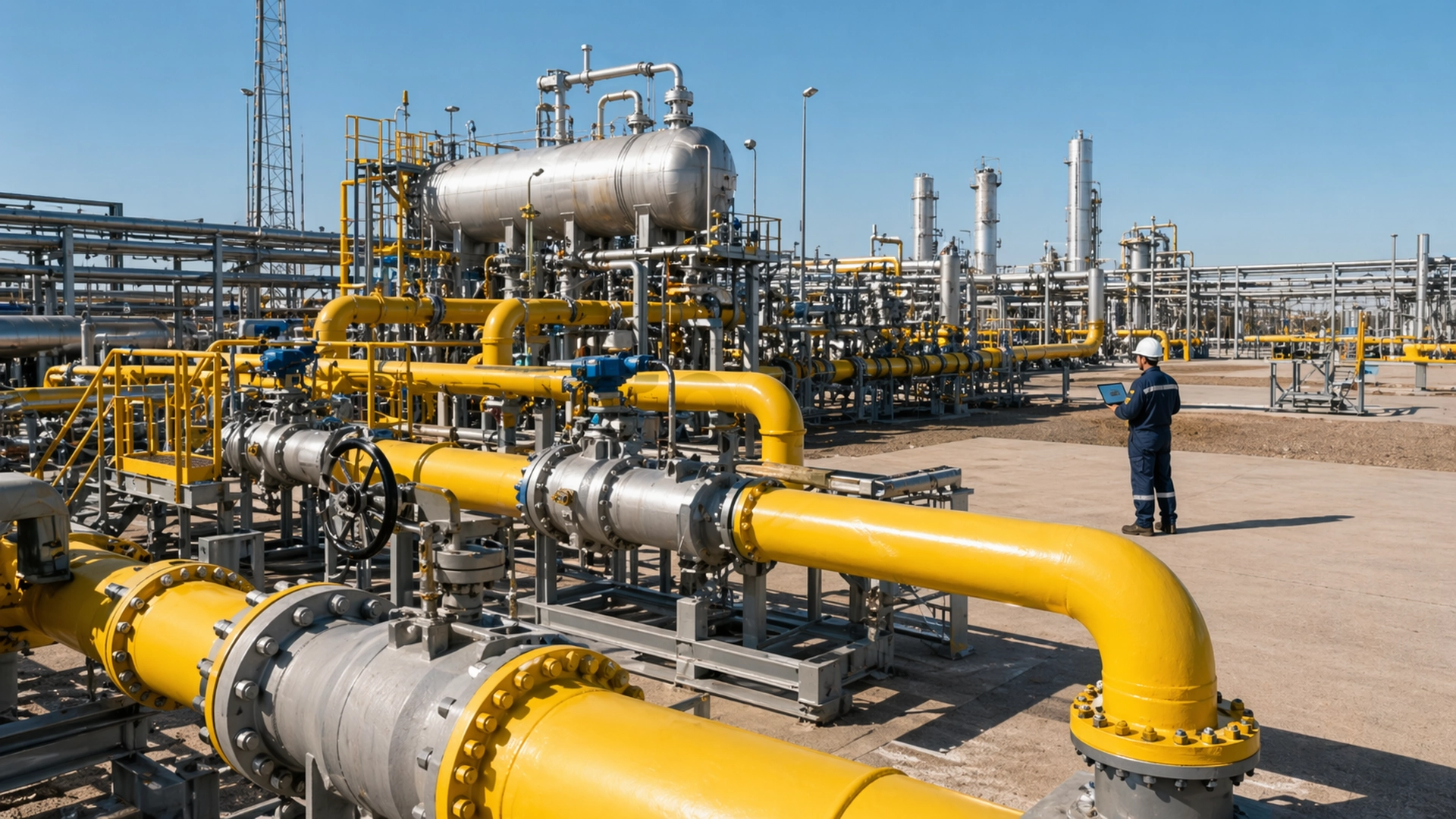
Operation and maintenance at gas sector facilities has shifted from corrective measures to approaches based on reliability, risk, and operational continuity. In compressor stations, transmission networks, processing facilities, and auxiliary systems, a failure is no longer interpreted solely as a one-off breakdown: it can result in loss of capacity, operational imbalance, non-compliance, and increased exposure to process safety risks.
Through reliability engineering, it is possible to understand how equipment behaves under real-world operating conditions, taking into account degradation, failure frequency, maintainability, and functional consequences. With this understanding, maintenance shifts from being solely schedule-driven to being tailored to the asset’s condition, its criticality, and its impact on operations.
This shift improves availability, reduces unscheduled downtime, and better organizes the planning of spare parts, inspections, and maintenance windows. In practice, it means moving from “responding to failures” to “managing deterioration mechanisms and their consequences.”
Reliability and Asset Management in Natural Gas
Asset management in natural gas systems goes beyond simply managing equipment or executing maintenance plans. It is a management system focused on extracting value from assets throughout their entire lifecycle, from engineering and commissioning through operation, modernization, repair, and decommissioning.
This involves making decisions based on criticality, risk, total cost of ownership, and mechanical integrity. Not all assets carry the same weight within the system. An isolation valve, an anti-surge system, a major rotating machine, or a protective loop can have very different consequences in the event of a failure, even if they belong to the same facility.
In these systems, reliability depends on the mechanical integrity of pipes, valves, compressors, relief systems, and other components. Factors such as corrosion, erosion, or fatigue should not be interpreted merely as inspection findings; they must be considered as damage that can affect the system’s operability, containment, and capacity. Therefore, integrating inspection, maintenance, and risk analysis allows for the anticipation of deterioration and supports more sound decisions regarding repair, replacement, or continued service.
When asset management is based on historical data, operational variables, inspections, and technical analysis, it ceases to be an administrative function and becomes an operational control tool. That is where reliability provides the criteria for deciding what to inspect, what to address, how often, and with what priority.
Reliability-Centered O&M: RCM, PdM, and KPIs
RCM in Natural Gas Systems
Reliability-Centered Maintenance (RCM) defines which tasks must be performed to preserve an asset’s function and control the consequences of failure. In natural gas facilities, this requires identifying functions, functional failures, failure modes, and effects on safety, production, the environment, and operational compliance.
Its main benefit is that it allows moving away from generic plans toward strategies differentiated by criticality. This prevents both over-maintenance and the omission of truly necessary tasks. In practical terms, RCM helps determine what should be inspected, what should be condition-monitored, what requires redesign, and what can be allowed to continue operating without creating unacceptable risk.
When integrated with failure history, condition data, and Risk-Based Inspection (RBI), RCM gains even greater value, establishing itself as a useful tool for guiding decisions in the field and in the workshop.
PdM and Monitoring in the Natural Gas Industry
Predictive maintenance (PdM) uses various variables such as vibration, temperature, pressure, lubricant condition, and operational behavior to detect early degradation; in the gas sector, this is particularly useful for rotating equipment, auxiliary systems, and points where even a minor deviation can rapidly escalate into a loss of capacity, an unplanned shutdown, or an unsafe condition.
Condition monitoring is enhanced when structured through Condition Monitoring Locations (CMLs). These points are used to take measurements and also allow for tracking damage mechanisms such as corrosion, erosion, or loss of thickness using criteria consistent over time. Their value lies in the fact that they organize data capture, reduce variation in readings, and improve the technical traceability of the information.
When used properly, CMLs help validate trends, support RBI, and inform decisions regarding repair, continued service, or replacement. This enhances the mechanical integrity of systems and prevents blind intervention.
Operations and Maintenance KPIs
These performance metrics are used to evaluate the effectiveness of O&M and its impact on reliability, availability, and operational stability. Their value lies not in routinely reporting them, but in using them as technical criteria to prioritize resources, justify interventions, and assess whether decisions are actually addressing the underlying problem.
Among the most relevant are MTBF, to track failure frequency and the asset’s inherent reliability; MTTR, to understand the system’s resilience; operational availability, which shows the actual effect of maintenance on service continuity; and the critical failure rate, key to focusing attention on events with the most significant consequences.
When these KPIs are analyzed alongside criticality, equipment condition, and intervention history, they cease to be mere reporting metrics and become decision-making tools.
RAM in Natural Gas Systems
RAM (Reliability, Availability, and Maintainability) analysis allows for the evaluation of the overall performance of natural gas systems in terms of failures, repair times, and loss of operational capacity. Its value lies in demonstrating how the unavailability of a critical asset affects process continuity and the facility’s effective capacity.
Through simulations and reliability models, RAM helps identify bottlenecks, insufficient redundancies, and scenarios of greatest vulnerability. In these types of facilities, this is useful for reviewing equipment configurations, justifying operational reserves, and anticipating where a failure would have the greatest impact on service continuity.
When integrated with mechanical integrity criteria, risk analysis, and data traceability, RAM ceases to be merely a modeling exercise and becomes a real support for design, modernization, and investment decisions.
Asset Prioritization by Criticality
Criticality analysis classifies assets based on the potential impact of their failure on safety, the environment, operational continuity, and business costs. Its usefulness is not limited to ranking equipment; it also establishes a technical basis for allocating resources, defining inspection frequencies, and setting maintenance and integrity priorities.
In gas systems, this analysis typically focuses on critical valves, protection systems, control loops, major rotating equipment, and components whose unavailability compromises flow, pressure, process stability, or safety response. Not all assets require the same level of monitoring, and that is precisely the purpose of this analysis.
When criticality is combined with condition data, RBI, and asset management, the result is a prioritization that is more useful for the field, more technically sound, and less dependent on subjective criteria.
FMEA and FMECA in Natural Gas
The FMEA and FMECA methodologies are used to identify failure modes, assess their effects, and prioritize actions before an event impacts operations. In gas facilities, they are particularly useful for reviewing compressors, valves, control loops, auxiliary equipment, protection systems, and components whose degradation could escalate into a process shutdown or an unsafe condition.
These tools break down the asset into specific functions and require linking each failure to its technical consequence. This improves the quality of the analysis because it prevents focusing solely on symptoms and forces an examination of the mechanism, effect, and severity.
One of their greatest contributions is that they transform scattered knowledge into a structured methodology; when properly applied, this helps reduce the recurrence of failures, strengthen maintenance strategies, and refine inspection and integrity decisions.
Digitization of Reliability
Digitization has transformed asset management at natural gas facilities by integrating operational, maintenance, inspection, and risk information into a single decision-making environment. This improves traceability, reduces information silos, and enables the actual condition of an asset to be linked to its criticality and the damage mechanisms affecting it.
It also facilitates the standardization of technical criteria, historical tracking of failures, and more organized management of mechanical integrity. Instead of relying on scattered records, isolated sheets, or operational memory, the organization can support decisions with more consistent and comparable information.
With this approach, reliability is no longer managed as a sum of separate actions but is treated as a continuous, documented process that is easier to defend technically.
Digital Solutions for Operational Reliability
The digitization of asset management has become a key enabler of operational reliability, as it allows for the integration of inspection, maintenance, risk, and operational condition data within a single decision-making framework. This is particularly useful when a facility needs to link inspection findings to prioritization criteria, planning, and mechanical integrity.
In this area, companies such as AsInt develop solutions focused on asset integrity and mechanical integrity, incorporating capabilities such as Risk-Based Inspection (RBI), condition monitoring locations (CML), asset inspection, and fitness-for-service (FFS) criteria. These capabilities allow for better organization of deterioration assessment, intervention prioritization, and integrity management for critical assets.
To expand on the focus on risk-based inspection, data integration, and decision-making in asset integrity, Inspenet TV presents the following interview with AsInt:

These platforms centralize information and help make decisions based on risk criteria, coordinate interventions, and improve coordination between maintenance, inspection, engineering, and operations. Their greatest value lies in transforming scattered data into technical support that enables more informed interventions with less uncertainty.
From Data to Technical Decisions
One of the biggest challenges in reliability is not a lack of information, but the inability to turn it into useful decisions. Many organizations already have operational logs, inspection reports, process variables, condition findings, and failure histories, but they continue to operate reactively because these data points do not interact with one another.
The real breakthrough occurs when information is organized according to technical criteria and integrated with variables such as criticality, integrity, and risk. At that point, the data acquires strategic value, enabling the definition of priorities, the justification of resources, and the support of decisions regarding operations, maintenance, and management.
In the gas sector, this transition is essential. It is not merely a matter of digitizing for the sake of modernization, but of building solid foundations that enable timely intervention and reduce uncertainty.
Conclusions
Reliability engineering in natural gas systems has evolved from a traditional maintenance approach to a strategic component of comprehensive asset management. Today, it is integrated with disciplines such as mechanical integrity, risk assessment, and condition-based decision-making, enabling a systemic view of operational performance.
The structured application of methodologies such as RCM, PdM, RAM analysis, FMEA/FMECA, RBI, and CML management facilitates the transition from reactive approaches to predictive and prescriptive models for deterioration control. In facilities where failure compromises containment, operational availability, and process safety, operational reliability ceases to be a desirable objective and becomes a fundamental requirement that underpins the continuity, safety, and efficiency of the system.
Frequently Asked Questions (FAQs)
How do you apply RCM to natural gas compressors?
Start by analyzing the compressor’s functions, its functional failures, failure modes, and operational consequences to define maintenance tasks focused on preserving function and controlling risk.
How can downtime in natural gas systems be reduced with PdM?
Through continuous monitoring of vibration, temperature, pressure, and lubricant condition to detect early degradation and schedule intervention before a functional failure occurs.
What does risk-based inspection (RBI) offer in natural gas systems?
It allows inspections to be prioritized based on failure probability and consequence, concentrating resources on assets whose loss would have the greatest impact on safety, continuity, and operating costs.
Why are CMLs important in the gas sector?
Because they help structure the technical monitoring of deterioration at defined points on the asset, improving traceability, historical comparison, and decision-making quality.
How does digitalization help with natural gas asset management?
It integrates inspection, maintenance, risk, and operational data into a single architecture, facilitating technical prioritization, traceability, and more disciplined management of the asset lifecycle.