Table of Contents
- Why sphere columns are a critical point
- What complicates corrosion under fireproofing
- How to inspect sphere columns without removing fireproofing
- PEC and PECA without removing concrete
- Mesh and rebars: How to avoid false positives
- Advanced visualization and decision making
- Case study: Inspection of corrosion under fireproofing in sphere columns
- What decisions residual thickness improves
- Conclusions
- References
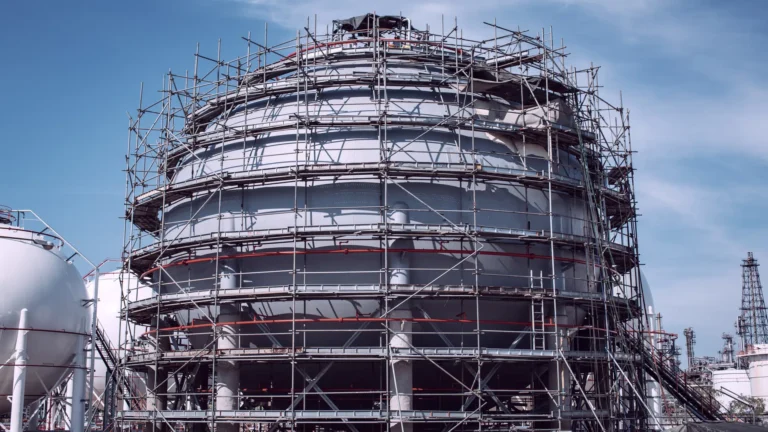
LPG spheres constitute one of the most sensitive assets within pressurized hydrocarbon storage facilities. Their configuration as spherical tanks responds to structural efficiency criteria; however, this same condition creates a critical dependency on the integrity of their support columns. In these areas, protection through fireproofing coatings is a standard practice to mitigate thermal effects in fire scenarios. Nevertheless, from a mechanical integrity perspective, these systems introduce a latent risk associated with corrosion under the fireproofing layer.
The phenomenon of corrosion under fireproofing is not only difficult to detect, but it also evolves silently, favored by moisture retention, the presence of contaminants, and limited system ventilation. Consequently, the ability to assess these structures without removing passive protection becomes a fundamental operational and economic requirement. In this context, the adoption of advanced technologies such as pulsed eddy current array has redefined inspection strategies for LPG spheres.
Why sphere columns are a critical point
From a structural standpoint, columns in spherical tanks are not secondary elements, but essential components in transferring loads to the foundation. The integrity of these columns directly conditions the overall stability of the sphere, especially under operating conditions where internal loads, thermal variations, and environmental effects coexist.
Unlike the spherical shell, which distributes stresses homogeneously, columns are subject to stress concentrations and complex interactions with the environment. The application of fireproofing, although necessary from a fire protection perspective, introduces an interface where electrochemical degradation mechanisms can develop. The combination of structural steel, retained moisture, and available oxygen creates a favorable environment for the initiation and propagation of localized corrosion, often in the form of generalized thickness loss or pitting that evolves without early detection.
What complicates corrosion under fireproofing
The complexity of corrosion under fireproofing lies in its hidden nature and the interaction of multiple variables. Fireproofing, particularly when incorporating concrete or cementitious materials, acts as a physical barrier that prevents direct inspection, but does not necessarily prevent moisture migration. In fact, small cracks or discontinuities in the coating allow water ingress, which becomes trapped in contact with the metal surface.
This phenomenon is aggravated by the presence of metallic reinforcement meshes or rebars, which are part of the coating fixation system. From an inspection standpoint, these elements generate significant interference, especially in electromagnetic techniques, complicating signal interpretation and increasing the risk of false positives or underestimation of damage.
Additionally, variability in coating thickness, operating conditions, and lack of accessibility further turns the evaluation of these areas into a high-level technical challenge.
How to inspect sphere columns without removing fireproofing
Traditionally, inspection of columns in LPG spheres involved partial or total removal of fireproofing, followed by conventional techniques such as ultrasonics. This approach, besides being costly, introduces operational risks and extends intervention times. The need for non-invasive alternatives has driven the development of methods based on electromagnetic principles, among which pulsed eddy current array stands out.
PEC technology enables the induction of a transient electromagnetic field in the material, whose response depends on the thickness and properties of the underlying steel. This ability to “see” through non-conductive coatings makes the technique particularly suitable for detecting corrosion under fireproofing in LPG spheres.
PEC and PECA without removing concrete
The implementation of advanced systems such as Lyft® has marked a turning point in column inspection. This instrument, designed for high-performance PEC applications, allows reliable residual thickness measurements even in the presence of thick coatings.
The use of multichannel probes such as the PECA-6CH introduces a significant improvement in terms of productivity. The ability to acquire data simultaneously at multiple points reduces inspection time and enables more uniform coverage of critical surfaces. This is especially relevant in structures such as spherical tanks, where geometry and accessibility may limit the use of conventional techniques.
From an operational perspective, the combination of Lyft® and PECA-6CH allows extensive inspections without removing concrete, maintaining the integrity of the passive protection system and reducing personnel exposure.
Mesh and rebars: How to avoid false positives
One of the most critical aspects in applying PEC techniques is the correct interpretation of signals in the presence of metallic meshes and reinforcements. These elements generate perturbations in the electromagnetic field that can be mistaken for material loss if adequate processing tools are not used.
The development of specific algorithms for detection in environments with wire mesh and rebar has significantly improved result reliability. These algorithms can discriminate between the response of structural steel and the interference introduced by reinforcements, reducing the probability of erroneous diagnoses. Proper equipment configuration, along with inspector experience, is crucial to ensure evaluation quality.
Advanced visualization and decision making
Data acquisition is only part of the process. Proper interpretation and visualization are essential to transform measurements into engineering decisions. Tools such as SurfacePro 3D allow the representation of thickness distribution in three dimensions, facilitating the identification of corrosion patterns and the delimitation of critical areas.
This type of visualization not only improves understanding of asset condition, but also allows integration into integrity management programs, where residual thickness becomes a key variable for life assessment and intervention planning.
Case study: Inspection of corrosion under fireproofing in sphere columns
Case based on PEC technologies in industry
In the first quarter of 2024, at a hydrocarbon storage terminal located on the Gulf Coast of the United States, specifically in the state of Texas, a structural integrity assessment campaign was conducted on a set of LPG spheres with more than 25 years of continuous service.
The asset had a history of exposure to highly corrosive environments, characterized by high relative humidity, presence of chlorides, and significant thermal variations. The support columns, protected with reinforced concrete-based fireproofing systems, were identified as critical zones within the risk-based inspection (RBI) analysis. The main concern was the potential presence of corrosion under the fireproofing, a mechanism difficult to detect using conventional techniques without removing the coating.
With the objective of performing an integrity assessment without removing passive protection, a strategy based on advanced non-destructive testing technologies developed by Eddyfi Technologies was implemented. The selected solution consisted of applying pulsed eddy current array (PEC) using the Lyft® system, complemented by the PECA-6CH multichannel probe to maximize inspection coverage and efficiency.
The campaign was carried out over a six-week period under normal operating conditions, without requiring shutdown of the spheres. The ability of the PEC system to detect through concrete allowed inspection of the columns without mechanical intervention, keeping the fireproofing system intact. This aspect was key from a safety and cost standpoint, as it avoided personnel exposure to hot work and significantly reduced intervention time.
One of the main technical challenges during inspection was interference from steel mesh and rebar present in the fireproofing coating. To address this condition, advanced signal processing algorithms integrated into the SurfacePro 3D platform were used, allowing discrimination between the electromagnetic response of structural steel and perturbations generated by reinforcement elements. This filtering capability was critical in improving result reliability and avoiding false positives.
The acquired data were processed and visualized through three-dimensional residual thickness models, enabling identification of non-uniform degradation patterns in several columns. In particular, localized areas with thickness losses greater than 30% compared to nominal were detected, concentrated near the soil-air interface, where moisture conditions were more severe.
The information obtained allowed the operator to implement a targeted maintenance plan, prioritizing interventions only in critical areas. As a result, unnecessary fireproofing removal was avoided in approximately 85% of the inspected areas, generating significant cost and execution time reductions.
Additionally, the results were integrated into the asset integrity management model, updating remaining life assessment criteria and adjusting future inspection frequencies. This data-driven approach enabled more accurate decision-making aligned with the real risk of failure.
The following video demonstrates how to use advanced algorithms to inspect support columns without removing the coating or halting operations.
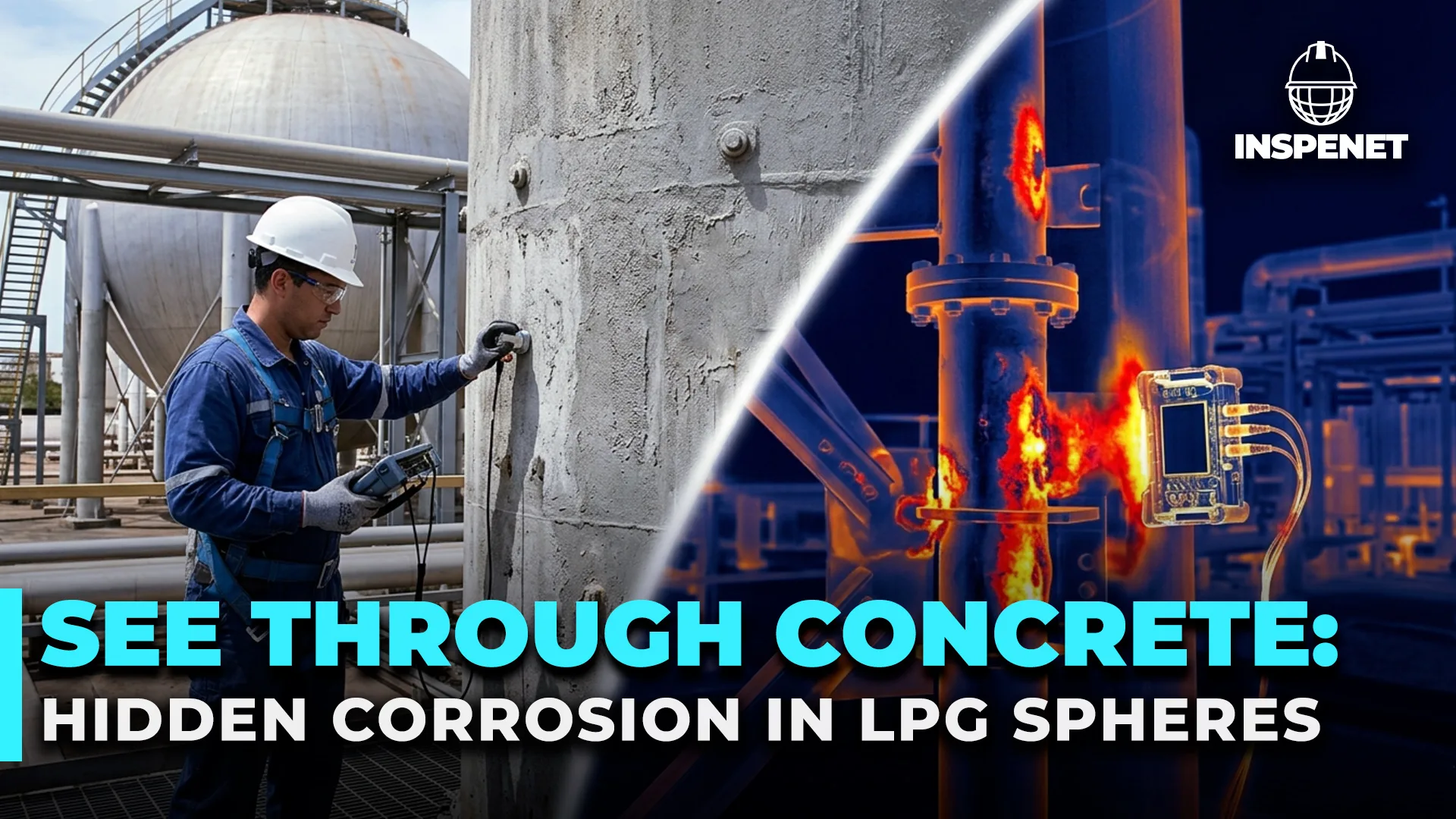
Application of Eddy current techniques in spherical metallic geometries
Gang Hu’s research focuses on the application of these techniques to spherical metal geometries, a significant challenge due to the continuous variation in curvature and its impact on the distribution of the electromagnetic field. Components such as valve balls, bearings, and aerospace structures exhibit these characteristics, making inspection using conventional methods difficult.
The study proposes advanced electromagnetic models to understand how induced currents behave on curved surfaces. It also optimizes probe design and excitation parameters to improve sensitivity in detecting discontinuities such as cracks, corrosion, or inclusions.
One of the main contributions lies in improving result accuracy, reducing false positives, and increasing diagnostic reliability. This has direct implications for industrial safety, enabling identification of potential failures before they evolve into critical events.
In conclusion, the application of eddy current techniques in spherical geometries represents a significant advancement in NDT, expanding its capabilities toward more complex configurations and strengthening its use in sectors where safety and efficiency are priorities.
Overall, this case demonstrates that applying advanced Eddyfi technologies for inspecting corrosion under fireproofing in LPG spheres not only improves detection capability, but also transforms maintenance strategy, shifting from reactive approaches to condition-based predictive models.
What decisions residual thickness improves
Knowledge of residual thickness in LPG sphere columns has direct implications for decision-making. It is not only about identifying whether corrosion exists, but about quantifying its magnitude and evaluating its impact on structural capacity.
This information allows defining repair criteria, establishing intervention priorities, and adjusting condition-based maintenance strategies. In an environment where safety and operational continuity are priorities, measurement accuracy translates into better risk management.
Conclusions
Detection of corrosion under fireproofing in LPG sphere columns represents one of the most complex challenges in mechanical integrity. The hidden nature of the phenomenon, combined with coating materials and metallic reinforcements, demands advanced technological solutions and a high level of technical specialization.
The application of pulsed eddy current array, together with tools such as Lyft®, PECA-6CH, and analysis platforms like SurfacePro 3D, enables efficient and non-invasive solutions. Experience from real cases, such as those developed with Eddyfi technology, demonstrates that it is possible to significantly improve detection, reduce costs, and increase evaluation reliability.
Ultimately, adopting these technologies responds not only to a technical need, but to a strategic requirement in managing critical assets within the energy industry.
References
- American Petroleum Institute. (2021). API RP 579-1/ASME FFS-1: Fitness-for-service. API Publishing.
- NACE International. (2018). SP0198: Control of corrosion under thermal insulation and fireproofing materials. NACE.
- ASME. (2021). ASME Boiler and Pressure Vessel Code (BPVC), Section V: Nondestructive Examination. ASME.
- Eddyfi Technologies. (2023). Pulsed eddy current (PEC) technology for corrosion under insulation and fireproofing inspection. Eddyfi Technologies.
- Hellier, C. (2013). Handbook of nondestructive evaluation (2nd ed.). McGraw-Hill Education.