Table of Contents
- Thermal decarbonization in the energy transition
- What are low-temperature networks and how do they work?
- How Low-Temperature district heating networks support Net Zero
- Thermal Advantages of Operating at Lower Supply Temperatures
- Integration of Heat pumps in urban thermal networks
- Design keys for heat decarbonization
- How to improve efficiency and flexibility in thermal networks
- Design and control challenges in decarbonized district heating
- Future trends in thermal networks for Net Zero
- Conclusions
- References
- Frequently Asked Questions (FAQs)
The global energy transition has placed thermal decarbonization at the forefront as one of the most complex challenges in achieving Net Zero emissions targets. While electrification is advancing rapidly in sectors such as transportation and power generation, the supply of heat for residential, commercial, and industrial buildings continues to represent a significant share of global energy consumption and greenhouse gas emissions.
In this context, low-temperature heat networks are emerging as a strategic solution for transforming traditional urban heating systems into more efficient, flexible, and sustainable infrastructures. These networks enable the integration of renewable energy sources, the recovery of waste heat, and the maximization of technologies such as heat pumps, directly contributing to carbon emission reductions.
Thermal decarbonization in the energy transition
Heat accounts for nearly half of global energy consumption. Historically, much of this demand has been met through fossil fuels such as natural gas, coal, and petroleum derivatives.
The need to reduce emissions has driven the development of new Net Zero engineering strategies, among which fourth- and fifth-generation thermal networks stand out. These systems are characterized by operating at significantly lower temperatures than those used in conventional district heating systems.
These new configurations reduce energy losses, increase equipment efficiency, and facilitate the integration of low-enthalpy renewable energy sources.
What are low-temperature networks and how do they work?
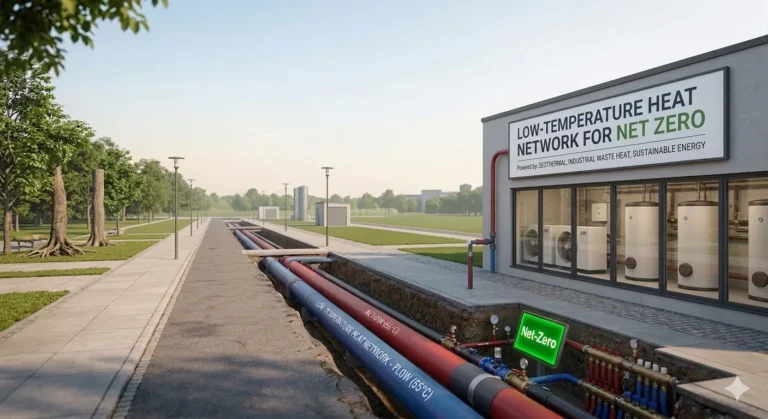
LTDHN, which stands for Low-Temperature District Heating Networks, consists of an energy system in which heat is produced centrally and distributed to multiple buildings, residential, public, offices,through a network of insulated underground pipes that transport hot water or steam. The purpose is to provide heating and domestic hot water in an efficient and sustainable manner, unlike individual and domestic systems, eliminating the need for boilers in each building and increasing overall energy efficiency.
Low-temperature heat networks distribute thermal energy through water circuits that typically operate between 10 °C and 70 °C, depending on the system architecture and the needs of the end users. Unlike traditional networks, which usually work with temperatures above 90 °C, modern
Their operation is based on three fundamental elements:
- Renewable or recovered thermal energy sources.
- Highly efficient distribution networks.
- Temperature-boosting systems using heat pumps.
Energy sources may include:
- Shallow geothermal energy.
- Industrial waste heat.
- Wastewater treatment plants.
- Data centers.
- Solar thermal energy.
- Environmental sources such as air, soil, or water bodies.
Low-temperature heat networks distribute thermal energy through water circuits that typically operate between 10 °C and 70 °C, depending on the system architecture and the needs of the end users. Unlike traditional networks, which usually work with temperatures above 90 °C, modern networks significantly reduce thermal losses during transport and improve overall energy efficiency.
LTDHN Infrastructure for Net Zero Emissions
Low-Temperature District Heating Networks (LTDHN) represent a key model for the decarbonization of cities. Through an intelligent closed circuit, in which the red pipe distributes hot water at about 55°C and the blue pipe returns it for reheating, the system integrates three fundamental pillars: The following image presents a diagram showing how these networks operate for Net Zero.
The diagram illustrates the operation of a Low-Temperature District Heating Network (LTDHN).
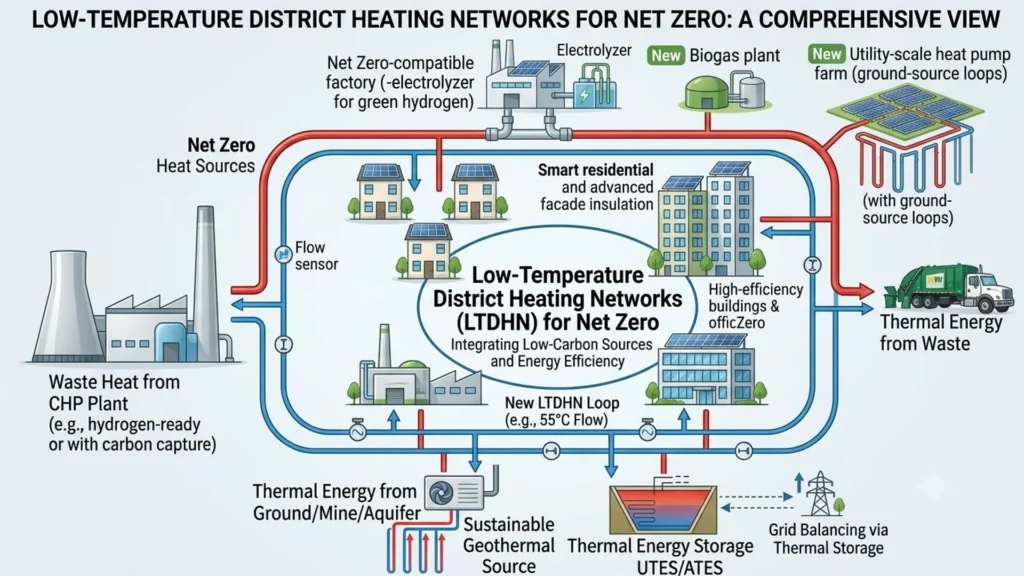
The system integrates three fundamental pillars:
- Geothermal storage and stabilization: At the base, underground thermal energy storage systems (UTES/ATES) stand out, which store seasonal heat surpluses. Furthermore, the complex functions as a stabilizer for the general electrical grid (Grid Balancing), converting peak renewable electricity into storable heat, all monitored in real time through flow sensors and digital valves.
- Clean and circular supply: The network takes advantage of renewable sources and waste heat that would otherwise be lost. This includes heat from cogeneration plants with carbon capture, industries with green hydrogen electrolyzers, biogas plants, urban waste-to-energy valuation, and geothermal systems backed by large solar heat pump farms.
- High-efficiency demand: The heat is distributed to modern districts composed of smart homes and zero-emission offices (“officeZero”). These buildings feature advanced thermal insulation on their facades and low-temperature heating systems (such as underfloor heating), reducing the required energy consumption to a minimum.
How Low-Temperature district heating networks support Net Zero
The primary contribution of these infrastructures to climate goals lies in their ability to reduce dependence on fossil fuels and facilitate the electrification of the heating sector.
Modern thermal networks contribute to Net Zero through:
- Large-scale integration of renewable energy.
- Utilization of urban and industrial waste heat.
- Reduction of distribution energy losses.
- Lower consumption of fossil fuels.
- Greater operational flexibility in response to demand variations.
Additionally, they can function as energy platforms capable of connecting multiple distributed thermal sources, creating more resilient and sustainable urban energy ecosystems.
Thermal Advantages of Operating at Lower Supply Temperatures
One of the most relevant aspects of modern district heating is the reduction of supply temperature. From a thermodynamic perspective, operating at lower temperatures offers multiple benefits:
- Reduced thermal losses: Heat losses in pipelines are proportional to the temperature difference between the fluid and the surrounding environment. By reducing this difference, energy losses decrease significantly.
- Higher heat pump efficiency: Heat pumps achieve higher Coefficients of Performance (COP) when the temperature difference between the heat source and the delivery temperature is smaller.
- Greater utilization of renewable sources: Many renewable energy sources available in urban environments operate at moderate temperatures. Low-temperature networks allow them to be used directly or with minimal temperature-lift requirements.
- Emission reduction: The combination of electrification and energy efficiency substantially reduces the carbon footprint of heating systems.
Integration of Heat pumps in urban thermal networks
Heat pumps are one of the most important components within thermal decarbonization strategies.
These technologies capture thermal energy from environmental or residual sources and raise it to levels suitable for heating or domestic hot water production.
In urban thermal networks, they can be implemented in different configurations:
- Centralized heat pumps in energy plants.
- Distributed heat pumps in customer substations.
- Hybrid systems combined with thermal storage.
- Integration with geothermal or solar sources.
Their high energy efficiency allows them to generate between three and five units of useful heat for every unit of electricity consumed, making them a fundamental tool for achieving Net Zero objectives.
Design keys for heat decarbonization
Designing a low-temperature district heating network requires an integrated approach that combines hydraulic, thermal, electrical, and digital considerations.
Among the most important factors are:
- Demand characterization: It is necessary to understand hourly, seasonal, and annual thermal consumption profiles in order to properly size the infrastructure.
- Selection of energy sources: Technical and economic feasibility depends on the availability of renewable resources or waste heat in the surrounding area.
- Hydraulic optimization: Pipeline design must minimize pressure losses and pumping energy consumption.
- Thermal storage: The incorporation of storage systems improves operational flexibility and enables better management of renewable energy variability.
- Digitalization and monitoring: Modern systems use sensors, advanced analytics, and optimization algorithms to continuously adjust operating conditions.
How to improve efficiency and flexibility in thermal networks
Technological evolution is driving increasingly intelligent and adaptive networks.
The main strategies for improving efficiency and flexibility include:
- Artificial intelligence-based predictive control.
- Integration of seasonal thermal storage.
- Active demand management.
- Interconnection of multiple energy sources.
- Real-time energy optimization.
- Implementation of digital twins.
These tools enable dynamic adaptation of operations to climatic conditions, renewable energy availability, and user behavior.
Design and control challenges in decarbonized district heating
Despite their benefits, the implementation of low-temperature district heating networks faces significant challenges.
- Adaptation of existing building stock: Many buildings were designed for high-temperature heating systems and may therefore require insulation improvements or replacement of heat emitters.
- Operational complexity: The simultaneous integration of multiple energy sources increases control complexity.
- Initial investments: The development of urban thermal infrastructure requires significant long-term investments.
- Demand management: Variability in thermal demand requires advanced control and storage strategies.
- Regulatory framework: In many countries, regulatory and market barriers still exist that hinder the large-scale deployment of modern thermal networks.
Future trends in thermal networks for Net Zero
District heating networks continue to evolve toward increasingly intelligent and sustainable models.
Key trends include:
- Fifth-generation thermal networks.
- Large-scale renewable energy integration.
- Sector coupling between electricity and heat.
- Long-duration thermal storage.
- Artificial intelligence for predictive control.
- Digital twins for operational optimization.
- Local thermal energy exchange markets.
These innovations will transform cities into more efficient, resilient, and climate-neutral energy ecosystems.
Conclusions
Low-temperature district heating networks represent one of the most promising technologies for accelerating thermal decarbonization and advancing toward global Net Zero goals. Their ability to integrate renewable energy, utilize waste heat, and maximize the performance of heat pumps makes them a key element of the urban energy transition.
As digital technologies, thermal storage, and intelligent control systems continue to evolve, these infrastructures will strengthen their role as a strategic solution for building more efficient, sustainable, and resilient cities capable of addressing future climate challenges.
References
- International Energy Agency. District Heating and Cooling in Energy Transitions.
- Euroheat & Power. Guidelines for Fourth and Fifth Generation District Heating Systems.
- International Renewable Energy Agency. Renewable Energy for Heating and Cooling.
- United Nations Environment Programme. Global Status Report for Buildings and Construction.
Frequently Asked Questions (FAQs)
How do low-temperature district heating networks support Net Zero?
They reduce the use of fossil fuels, facilitate renewable energy integration, enable waste heat recovery, and improve the energy efficiency of urban heating systems.
What are the main advantages of operating at lower temperatures?
Lower thermal losses, higher heat pump efficiency, improved utilization of renewable energy sources, and reduced carbon emissions.
What role do heat pumps play in these networks?
They act as highly efficient temperature-lift systems, enabling the use of low-temperature heat sources and supplying useful energy to buildings and industrial processes.
What challenges does decarbonized district heating face?
The main challenges include adapting existing buildings, managing control complexity, financing infrastructure investments, and establishing appropriate regulatory frameworks.
What is the future of urban thermal networks?
The trend points toward fifth-generation smart networks, renewable energy integration, advanced thermal storage, artificial intelligence, and predictive energy management.