Table of Contents
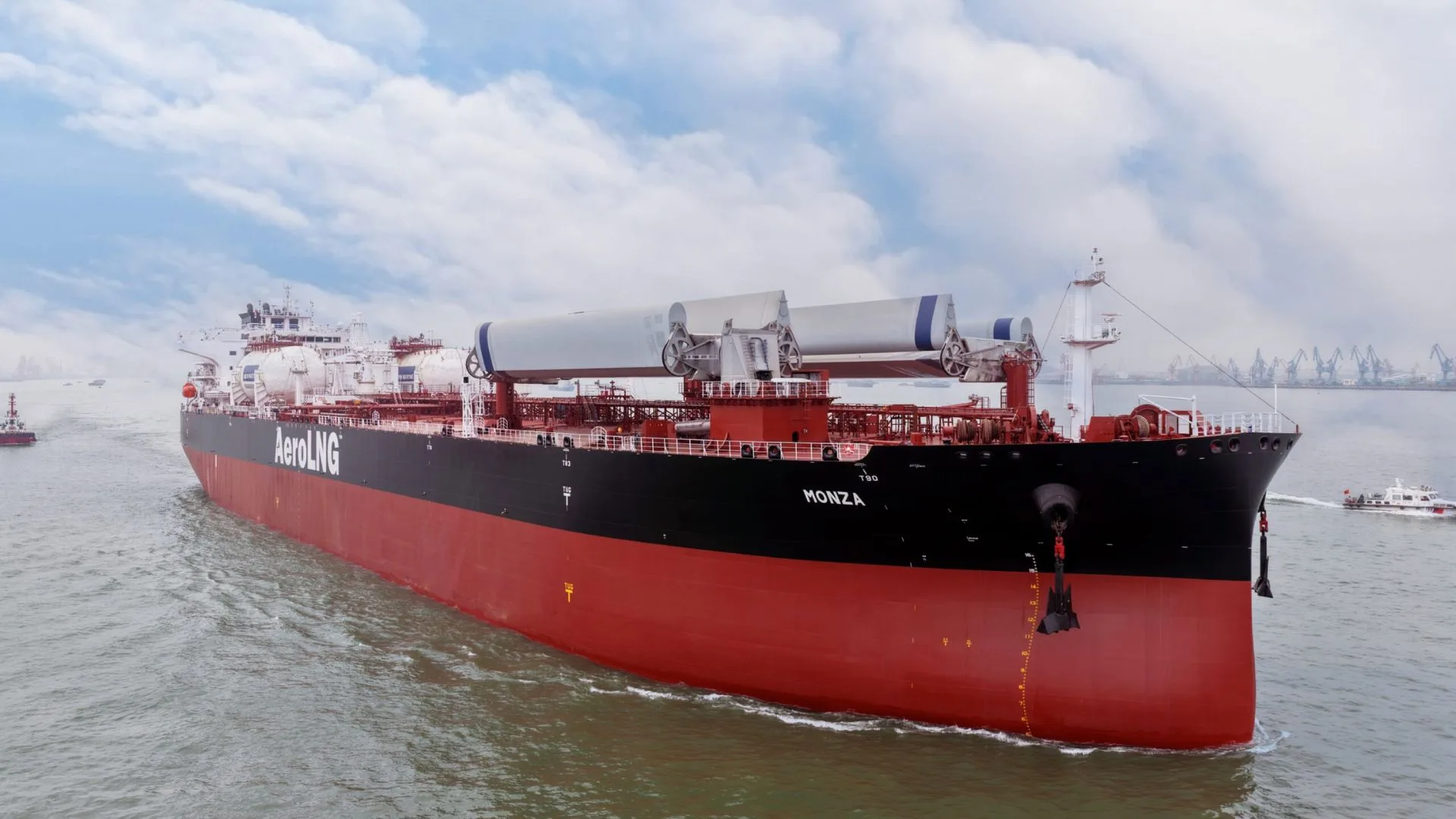
Following the successful integration of wind systems in previous vessels, the tanker Monza has been officially delivered to Union Maritime. This vessel, a dual-fuel LR2 built at the Yangzijiang shipyard, stands out for integrating two 37.5-meter WindWings® sails. Furthermore, the incorporation of this technology by BAR Technologies is not an isolated event, but part of the world’s first series of tankers to merge LNG propulsion with three-element rigid sail systems.
The autonomy of the tanker Monza in the face of IMO uncertainty
The commissioning of this unit occurs within a context of intense debate within the International Maritime Organization. While the entity seeks consensus on carbon pricing and the Net-Zero Framework, shipowners face increasing pressure. Wind-assisted propulsion emerges as a fundamental tool, as it offers immediate emissions reduction. This system allows companies to meet FuelEU Maritime requirements without depending on synthetic fuel infrastructure, which remains uncertain.
Data obtained from previous commercial missions support the technical viability of WindWings®. The patented design captures significantly higher lift than conventional sails and operates fully automatically. By utilizing an inexhaustible and free energy source, the Monza optimizes its performance in real time according to wind conditions. Additionally, the collaboration between designers, shipyards, and classification societies such as Lloyd’s Register ensures that these innovations meet the industry’s most demanding safety standards.
The delivery of this third vessel confirms that the technology has moved beyond the testing phase to become a manufacturing standard. It is no longer a matter of isolated experiments at sea, but of series production that allows for the accurate prediction of operational benefits. By integrating these low-emission solutions into conventional shipbuilding, the sector demonstrates its ability to take proactive measures. The Union Maritime fleet thus positions itself at the forefront of decarbonization, proving that fuel flexibility and wind power are key to future operational stability.
Source and photo: BAR Technologies