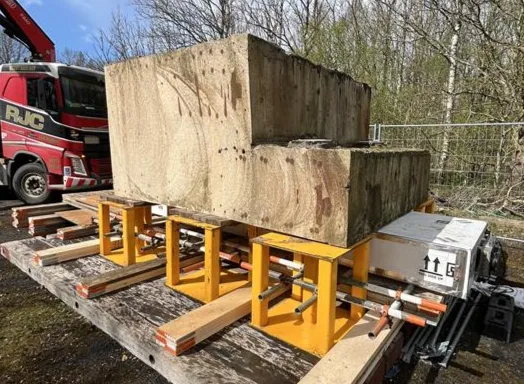
The National Highways program is launching an unprecedented technical challenge in advanced structural inspection , Structures Moonshot: Unprecedented Structural Inspection. It seeks to resolve significant uncertainties in aging bridges.
The approach combines non-destructive testing and physical validation. This eliminates typical assumptions and allows for a direct correlation between measurement and actual structural integrity.
This analysis reveals a key finding: END techniques will be validated against actual dissection. This approach bridges the historical gap between indirect diagnosis and physical evidence.
The challenge: hidden three-dimensional cracks
Half-lap joints concentrate complex stresses. Crack propagation in inside corners remains difficult to model and detect.
Traditional inspections only capture superficial information. This limits the ability to assess structural integrity in depth and with volumetric accuracy.
Structures Moonshot requires identifying the geometry, orientation, and continuity of cracks in 3D. This involves advanced spatial resolution and penetration capabilities in reinforced concrete.
Huntingdon: a full-scale laboratory
The sample comes from the A14 Huntingdon viaduct. It is a real element, not a test tube, which increases the complexity and value of the results.
This environment allows for the validation of technologies under operational conditions. Factors such as material heterogeneity and structural noise will be present.
After the tests, the sample will be dissected. This will allow for direct comparison of NDT data with actual damage, generating a unique validation basis.
Structures Moonshot: Advanced NDT technological convergence
The project encourages multidisciplinary approaches, ranging from advanced ultrasound to data-driven techniques and applied artificial intelligence.
Methods capable of operating in the field are prioritized. Real-world applicability takes precedence over laboratory accuracy as the dominant criterion.
The technical analysis is clear: the future of NDT will be hybrid. It will integrate sensors, physical modeling, and advanced analytics for complete structural characterization.
Source and photo: https://nationalhighways.co.uk/