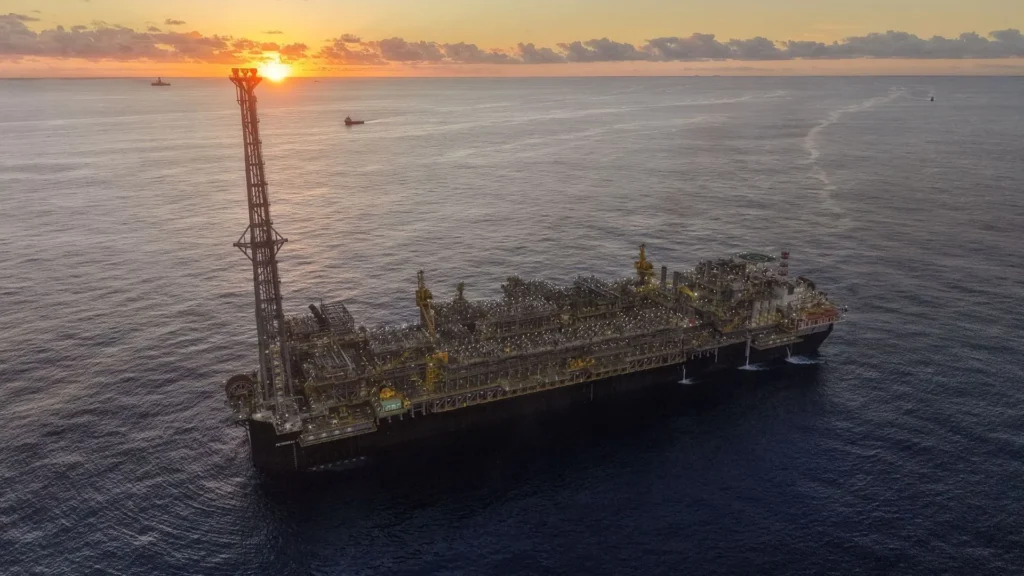
Petrobras began oil production on the P-79 platform, located in the pre-salt of the Santos Basin. The startup was completed several months ahead of schedule according to its business plans, consolidating the progress of the Búzios 8 project.
Thus, the unit becomes the eighth active platform in the Búzios field, considered the largest in reserves in the country. With this addition, the installed capacity reaches approximately 1.33 million barrels per day, positioning the asset as one of the main offshore production hubs globally.
Increased Capacity and Gas Expansion
In operational terms, the P-79 platform has a production capacity of 180,000 barrels of oil per day. Additionally, it incorporates gas compression systems of up to 7.2 million cubic meters per day.
Furthermore, the project includes gas export to the mainland through its connection to the Route 3 gas pipeline. This infrastructure will enable an increase in national supply of up to 3 million m³ per day.
As wells are connected, production will increase progressively until reaching maximum output.
Technology and Efficiency in Petrobras P-79
From a technological standpoint, the P-79 is a floating production unit of the FPSO type, designed to produce, store, and transfer oil. Its hull incorporates improvements aimed at reducing emissions and optimizing energy efficiency.
Likewise, the Búzios 8 development includes 14 wells, both producers and injectors, equipped with intelligent completion systems. These enable more precise production management and greater reservoir efficiency.
The platform also integrates rigid and flexible pipeline systems that facilitate production, injection, and gas export, adapting to operating conditions in ultra-deep waters.
Advanced Engineering and Early Execution
Another relevant aspect is the logistical strategy implemented by Petrobras. The unit arrived in Brazil from South Korea with operating systems already in an advanced commissioning phase.
As a result, a stopover in protected waters was avoided, which improved safety and enabled accelerated entry into operation. This approach demonstrates the company’s capability to execute complex projects with high technical standards.
The Growth of the Búzios Field
Currently, the Búzios field is located approximately 180 kilometers off the coast of Rio de Janeiro, at depths exceeding 2,000 meters. Discovered in 2010, it has shown sustained growth in its production.
In parallel, Petrobras continues to expand its development with new units under construction and projects in the bidding phase. The complex is expected to reach a total of 12 FPSO platforms in the coming years.
Thus, the consortium led by Petrobras together with CNOOC, CNODC, and PPSA reinforces its role in Brazil’s energy security through the expansion of pre-salt production.
Source and photo: Petrobras