The development of logistics chains for carbon capture and storage (CCS) is accelerating the need for new specialized maritime solutions. In this context, large-scale liquefied CO₂ transport is positioned as an essential link to connect industrial sources with offshore geological storage sites.
Mitsui OSK Lines (MOL) has taken a significant step by announcing the acquisition of Approval in Principle (AiP) for a new liquefied CO₂ carrier vessel. This conceptual development aligns with the maritime sector’s global decarbonization strategy, integrating wind-assisted propulsion technologies to reduce fuel consumption.
The project reflects a convergence between advanced naval engineering and industrial climate objectives. Collaboration with international partners allows MOL to position itself at the technological forefront of carbon transport, anticipating future logistics corridors for negative emissions or climate neutrality.
MOL: Vessel Design and Conceptual Safety Validation
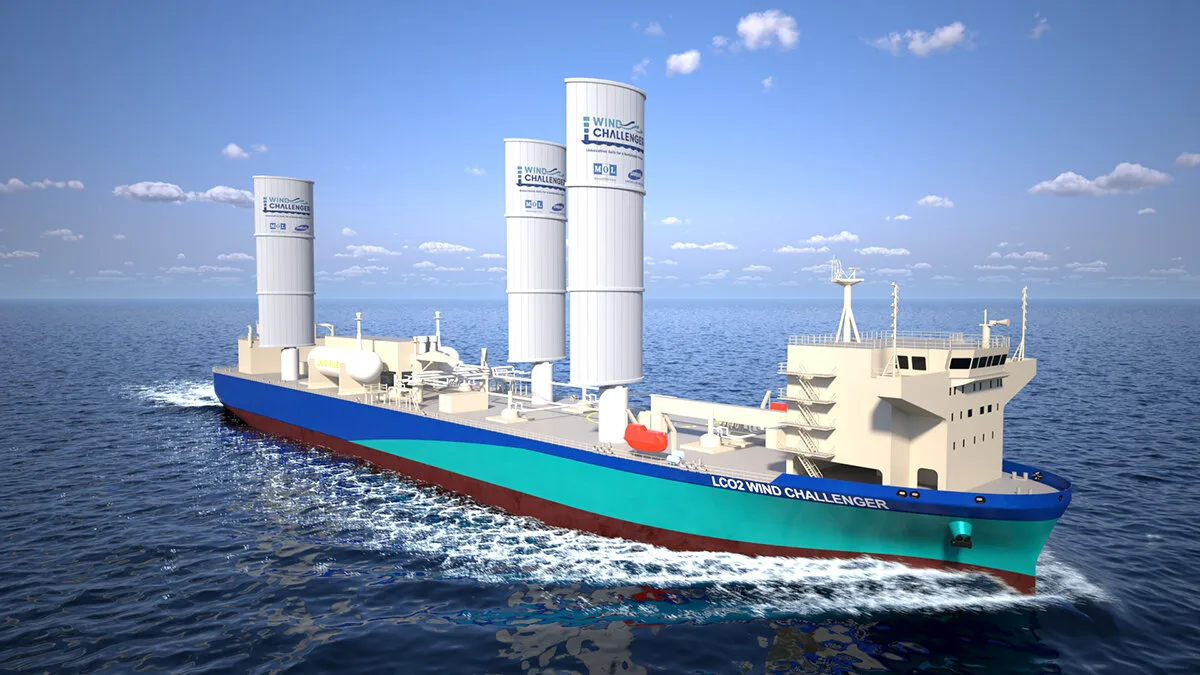
The approved design contemplates a vessel with an approximate capacity of 40,000 m³ of liquefied CO₂, optimized for large-scale cross-border transport. The configuration includes the relocation of the superstructure forward to improve operational visibility and allow for the installation of rigid sail systems.
The AiP approval was issued by ClassNK, following a technical feasibility and regulatory compliance assessment process. This type of approval does not certify the final vessel but validates that the concept presents no significant safety or regulatory impediments at this design stage.
The project was developed jointly with Samsung Heavy Industries, integrating risk analysis methodologies such as HAZID. This approach allows for the identification of potential hazards in early phases, especially relevant in hybrid systems that combine cryogenic transport and wind-assisted propulsion.
Wind Challenger: Integrating Wind Power into Cargo Vessels
The Wind Challenger system represents a wind-assisted propulsion technology based on telescopic rigid sails. These structures can automatically extend, retract, and orient themselves, optimizing wind utilization without compromising the vessel’s maneuverability.
In the approved design, the vessel incorporates three tall Wind Challenger units, capable of generating significant assistance to the main propulsion. This configuration aims to reduce fossil fuel consumption and, consequently, greenhouse gas emissions during intercontinental routes.
From a naval engineering perspective, the integration of rigid sails implies structural and operational challenges, including stability, load distribution, and safety in adverse weather conditions.
Impact on Maritime Decarbonization and CCS
The application of wind propulsion in liquefied CO₂ vessels introduces an additional dimension to the CCS value chain. The goal is not only to capture and store carbon but also to reduce emissions associated with CO₂ transport itself, improving the overall system balance.
MOL has set a target to achieve net-zero greenhouse gas emissions by 2050, as part of its long-term environmental strategy. The expansion of technologies like Wind Challenger is part of a roadmap that includes dozens of equipped vessels in the next decade.
This type of innovation positions maritime transport as a key enabler of the energy transition. The combination of carbon capture, advanced maritime logistics, and wind-assisted propulsion can redefine efficiency standards in the sector, significantly reducing the carbon footprint of global industrial chains.
Source and photo: https://www.mol.co.jp/en/pr/2026/26034.html