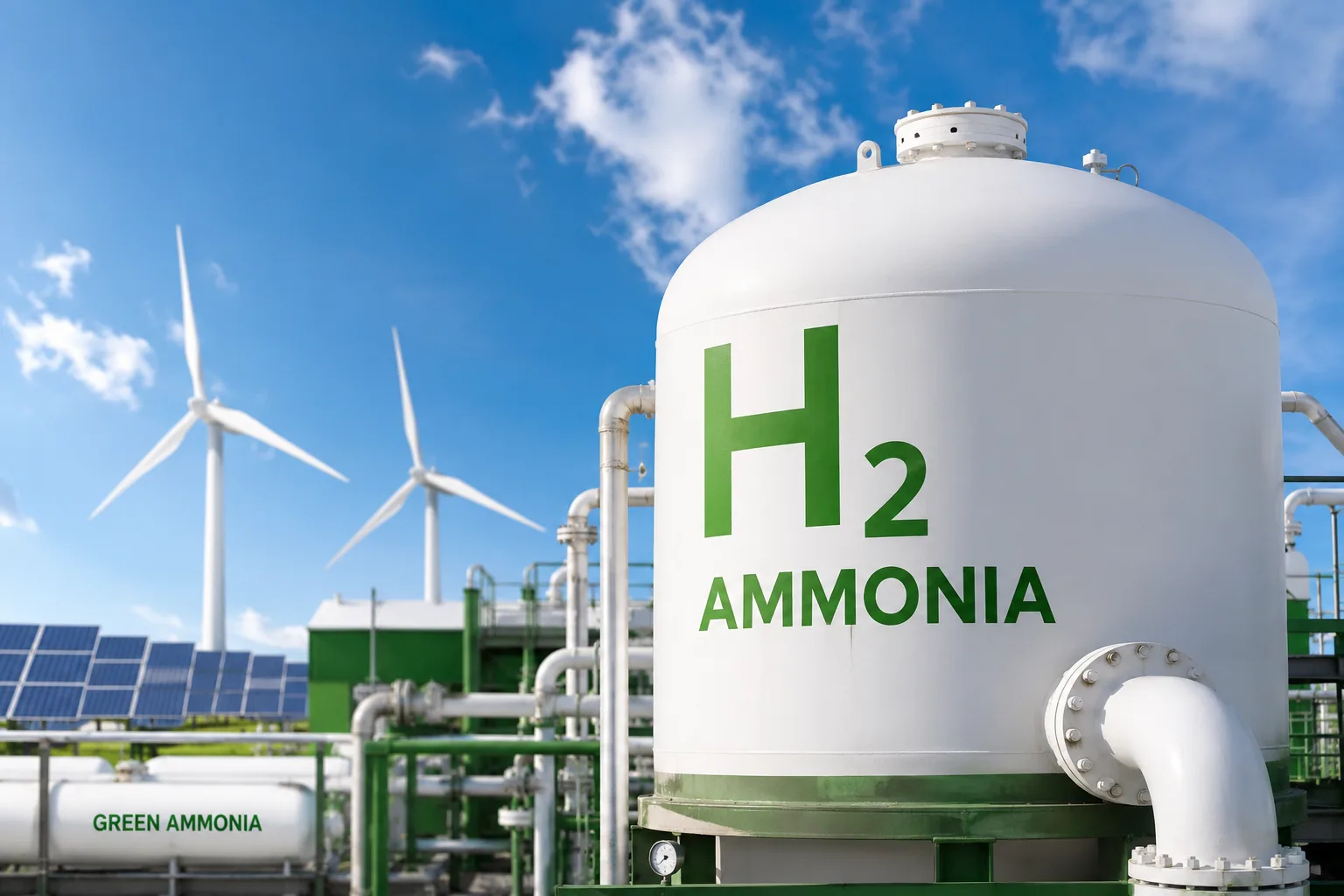
Green ammonia certificates are becoming a key mechanism for accelerating the trade of low-carbon fuels and feedstocks during the energy transition. They enable companies and industries to demonstrate that their energy consumption is supported by sustainable production, even when the physical product is not delivered directly to their facilities.
This trend is reflected in the recent agreement between PepsiCo and Envision Energy, under which the global food and beverage company will purchase environmental attributes associated with green ammonia production in China. Beyond the commercial scope of the transaction, the agreement highlights the growing importance of certification systems in supporting the development of a global market for hydrogen and other low-carbon derivatives.
Green ammonia certificates drive new business models
As demand for clean fuels continues to grow, the industry faces a major logistical challenge. Transporting hydrogen and green ammonia across continents still involves high infrastructure, storage, and distribution costs, factors that limit the growth of international trade during the early stages of market development.
In this context, these certification mechanisms are emerging as an alternative way to connect producers and buyers without relying on the physical delivery of every tonne produced. Instead of receiving the actual fuel, the buyer acquires a verified environmental credential confirming that an equivalent quantity was produced under specific environmental standards.
This model makes it possible to recognize the environmental value of renewable production while international transportation infrastructure continues to evolve. According to many industry experts, it represents a transitional mechanism that can accelerate investment in new projects and create favorable market signals to expand the production of low-carbon fuels.
The PepsiCo–Envision agreement reflects this trend
As part of this trend, Envision Energy will supply PepsiCo with verified environmental attributes linked to the mentioned type of ammonia produced at its Chifeng Net-Zero Industrial Park in Inner Mongolia, China. The agreement began with the allocation of the first 1,000 tonnes of environmental attributes and will remain in effect until 2030 for an additional volume that the companies have not publicly disclosed. The production comes from a 500 MW facility that currently produces approximately 320,000 tonnes of this product per year.
Envision has also announced plans to expand the plant’s capacity to 1.5 million tonnes per year by 2028, reinforcing its strategy to become one of the world’s leading producers of this low-carbon fuel.
Meanwhile, PepsiCo continues to incorporate sustainable feedstocks into its agricultural supply chain. The company has also acquired environmental attributes associated with low-carbon ammonia produced by the U.S.-based company TalusAg, which will be used in fertilizers supporting its global agricultural operations.
The book-and-claim model gains momentum
The agreement is based on a mechanism known as book-and-claim, which has been widely discussed across the hydrogen and renewable fuels sectors.
Unlike a conventional supply agreement, this model separates the physical flow of the product from the environmental attribute associated with its production. In other words, the buyer does not necessarily receive the same ammonia produced at a specific facility but instead receives a verifiable certificate confirming that an equivalent quantity was produced using low-carbon processes.
This system aims to facilitate market growth during a stage in which international supply chains remain limited. By eliminating the need to transport the physical product over long distances, producers can commercialize the environmental value of their production while new logistics routes for the global trade of hydrogen and its derivatives continue to develop.
However, the expansion of this model also raises important challenges related to transparency, traceability, and comparability among different certification systems.
Standardization will be critical for market growth
Several international organizations consider certification to be one of the fundamental pillars for establishing a global market for clean hydrogen and green ammonia.
However, industry experts also warn that differences still exist among the methodologies used to calculate emissions, verify production processes, and issue environmental certificates. These differences can make it more difficult to compare projects developed in different regions and create uncertainty for buyers and investors.
For this reason, organizations such as the Ammonia Energy Association (AEA) are promoting initiatives to develop common methodologies that improve the credibility of these mechanisms and facilitate the international trade of low-carbon products.
The adoption of harmonized standards could also enhance interoperability among regional markets and increase the confidence of industries seeking to incorporate clean fuels into their decarbonization strategies.
Green ammonia certificates support the energy transition
The agreement between PepsiCo and Envision Energy goes beyond a specific commercial transaction. It demonstrates how the energy transition is driving new mechanisms to encourage the production of sustainable fuels even before a fully developed global infrastructure for their transportation and distribution is in place.
As demand for low-carbon hydrogen and green ammonia continues to grow, green ammonia certificates could play an increasingly important role as a mechanism for connecting producers, consumers, and investors during the early stages of market expansion.
Although the development of more robust international standards will remain essential to ensure transparency and build confidence in these systems, initiatives such as the one undertaken by Envision Energy and PepsiCo demonstrate that environmental certification is becoming a strategic component for accelerating the decarbonization of energy-intensive industrial sectors.
Sources: gasworld