Table of Contents
Ford Energy and EDF Power Solutions North America signed a five-year framework agreement that will allow the Ford Motor Company subsidiary to supply up to 4 GWh per year of BESS battery energy storage systems. In total, the agreement’s potential volume could reach 20 GWh over its term.
The agreement aims to strengthen EDF Power Solutions’ utility-scale storage project pipeline in North America, with deliveries expected to begin in 2028. It also marks a new phase for Ford Energy in the BESS solutions market, where demand is growing due to the expansion of renewables, data centers, and the need for backup on the power grid.
BESS batteries for utility-scale renewable projects
Under the terms of the agreement, EDF Power Solutions will be able to purchase Ford Energy DC Block systems to support renewable integration projects, grid stability, and commercial storage. Annual capacity of up to 4 GWh provides long-term supply visibility in a market where equipment availability, traceability, and technical support are increasingly important.
In addition, the agreement reflects the pressure facing energy infrastructure in the United States. Rising electricity demand, driven by data centers, industrial electrification, and new loads associated with artificial intelligence, is accelerating the need for stationary batteries capable of storing energy and delivering it when the grid requires it.
Ford Energy enters with domestic manufacturing and a life-cycle approach
Ford Energy, a wholly owned subsidiary of Ford Motor Company, will assemble battery energy storage systems in the United States for utility-scale customers, data centers, commercial businesses, and industries. The company aims to bring its industrial expertise to the energy storage market, with operations spanning cell production, electrode coils, modules, containers, sales, and technical support.
Likewise, the company emphasizes that its offering is not limited to supplying hardware. Its approach includes traceability, life-cycle support, and industrial-scale manufacturing—three factors that are relevant for grid operators and large developers that require operational continuity in renewable storage projects.
EDF Power Solutions expands its energy portfolio in North America
EDF Power Solutions North America is part of the EDF Group and has operated in the United States, Canada, and Mexico since 1987. The company develops, builds, and operates low-carbon power generation facilities, as well as flexible generation solutions and electric power transmission.
Currently, its activities span onshore and offshore wind, solar, battery storage, pumped-storage hydropower, smart electric vehicle charging, microgrids, green hydrogen, and transmission. Its regional portfolio includes 26 GW of developed projects and 17 GW under service contracts.
DC Block: 20-foot containers with LFP batteries
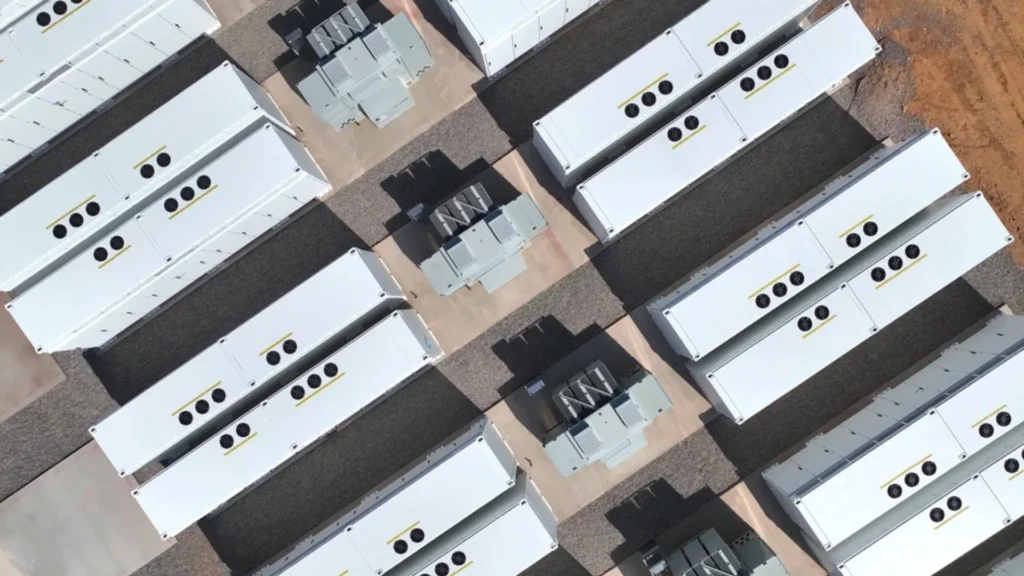
The Ford Energy DC Block system is a standardized 20-foot container solution, with a nameplate capacity of 5.45 MWh per unit. It uses 512 Ah prismatic lithium iron phosphate cells, an LFP chemistry valued for its thermal stability and service life in stationary applications.
In addition, the system will be available in 2- and 4-hour discharge configurations, with an operating range of 1040 to 1500 VDC and integrated thermal management via liquid cooling. These features position it for utility-scale storage applications, especially where thermal control, modularity, and sustained performance are required.
Applications for stability, backup, and microgrids
DC Block systems are designed for frequency regulation, voltage support, energy arbitrage, peak shaving, demand response, backup power, and microgrid integration. With this, Ford Energy aims to serve a segment where batteries are shifting from complementary assets to becoming critical infrastructure for the energy transition.
Meanwhile, EDF Power Solutions secures a supply pathway to advance storage projects linked to renewables and grid resilience. The combination of annual capacity, domestic manufacturing, and technical support could help reduce supply-chain risks in projects that require long-term planning.
Source: Ford
Photo: Shutterstock