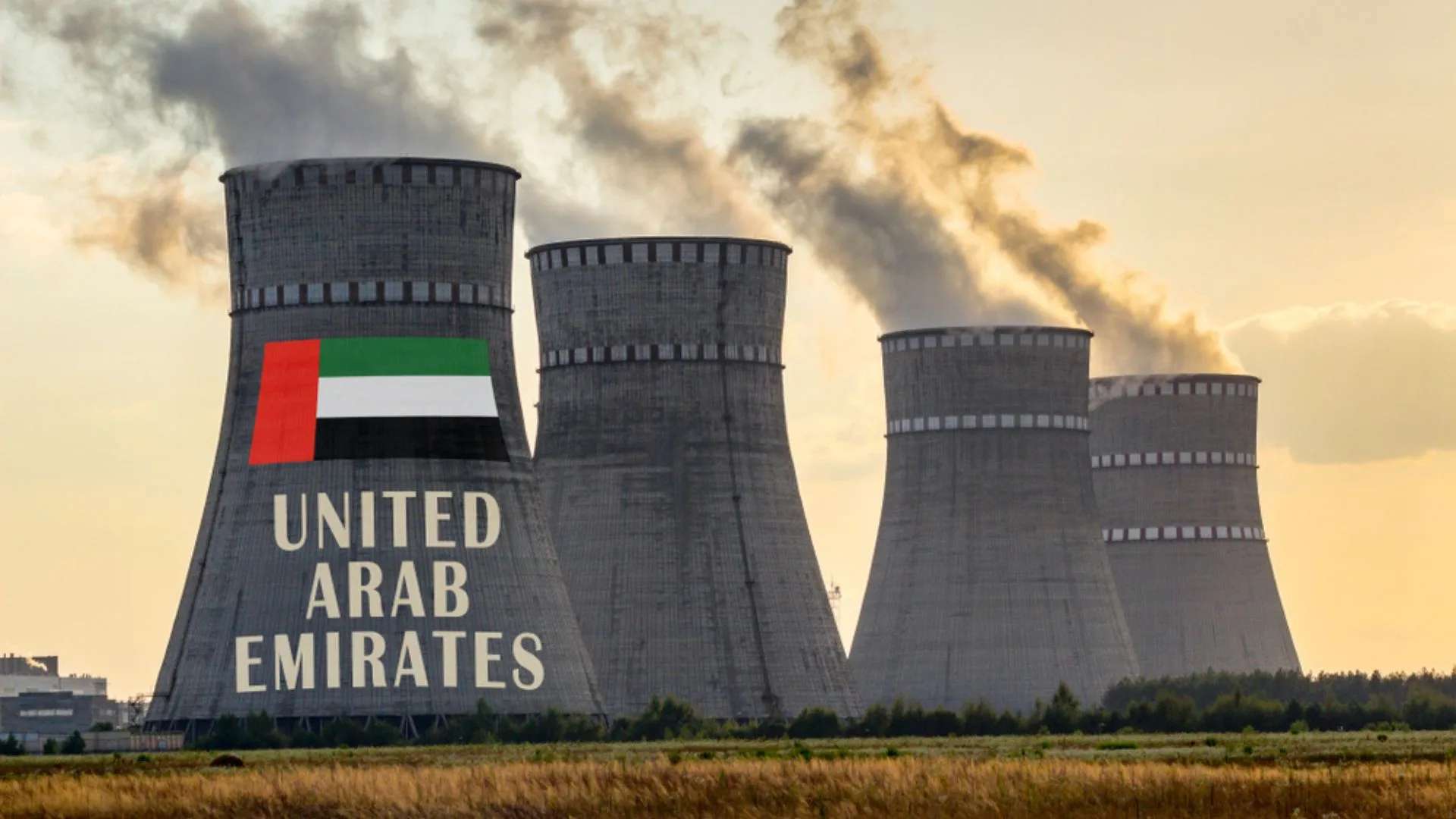
Barakah nuclear UAE electricity: the Barakah nuclear power plant, located in the Al Dhafra region of the Emirate of Abu Dhabi, operates its four APR-1400 reactors with a total capacity of 5,600 MW and generates approximately 40 TWh of electricity per year. This production is equivalent to 25% of the United Arab Emirates’ electricity needs, positioning Barakah as the country’s largest single source of electricity, according to data from the Emirates Nuclear Energy Corporation (ENEC).
Barakah nuclear UAE: first plant in the Arabian Peninsula
The journey of Barakah nuclear UAE electricity from the investment decision to full operation took more than a decade. Unit 1 was connected to the grid in August 2020; Unit 2 in September 2021; Unit 3 in October 2022; and Unit 4 reached commercial operation in September 2024, completing the infrastructure. The UAE was the first country in the Arab world and the Arabian Peninsula to launch a commercial nuclear power plant, relying on APR-1400 technology supplied by the South Korean consortium Korea Electric Power Corp (KEPCO), which built the four reactors for an estimated $20 billion.
Before the commissioning of Barakah, more than 95% of the UAE’s electricity came from fossil fuels. The plant now avoids the emission of more than 22 million tons of CO₂ per year, according to ENEC data, representing the pillar of the Emirati power sector’s decarbonization policy.
More than 42 IAEA reviews support the operation of Barakah nuclear UAE electricity
The construction and operation of Barakah has been accompanied by more than 42 evaluations and peer reviews by the International Atomic Energy Agency (IAEA) and the World Association of Nuclear Operators (WANO), making it the nuclear plant with the highest density of international oversight of its generation. “The IAEA has provided technical assistance to the UAE at every stage of the nuclear program, from planning to operation,” the agency noted in public communications related to the project.
The robustness of this oversight was tested on May 17, 2026, when an unmanned aerial vehicle from Iraq struck an electrical generator outside the plant’s inner perimeter, causing a fire that was controlled without casualties or the release of radioactive material. The IAEA reported the incident to the UN Security Council on May 20. Emirati presidential advisor Anwar Gargash directly blamed Iran or its regional proxies for the attack.
Nuclear as a pillar of the energy transition in the Middle East
The Barakah nuclear UAE electricity model is being observed by other countries in the region studying their own nuclear programs. Barakah’s carbon-free generation adds to solar energy—which contributed 14.4 TWh to the UAE’s electricity mix in 2023—within the framework of the country’s 2050 energy diversification goals. Natural gas remains dominant with 119 TWh annually, but the nuclear-solar combination has reduced the share of fossil fuels in generation from 95% to less than 75% in five years.
The evaluation of Barakah nuclear UAE electricity demonstrates that a non-nuclear producing country can build and operate a plant of this scale with its own regulatory framework—the Federal Authority for Nuclear Regulation (FANR)—and sustained international technical support, in a model that the IAEA actively promotes as a reference for emerging markets.
The analysis of nuclear generation and its role in the energy transition can be found in the Inspenet Power Generation hub. The regional energy context of the Middle East is addressed in the Inspenet Energy hub.
Sources: ENEC – Barakah Nuclear Energy Plant | World Nuclear Association – UAE | American Nuclear Society – attack on Barakah
Photo: Shutterstock