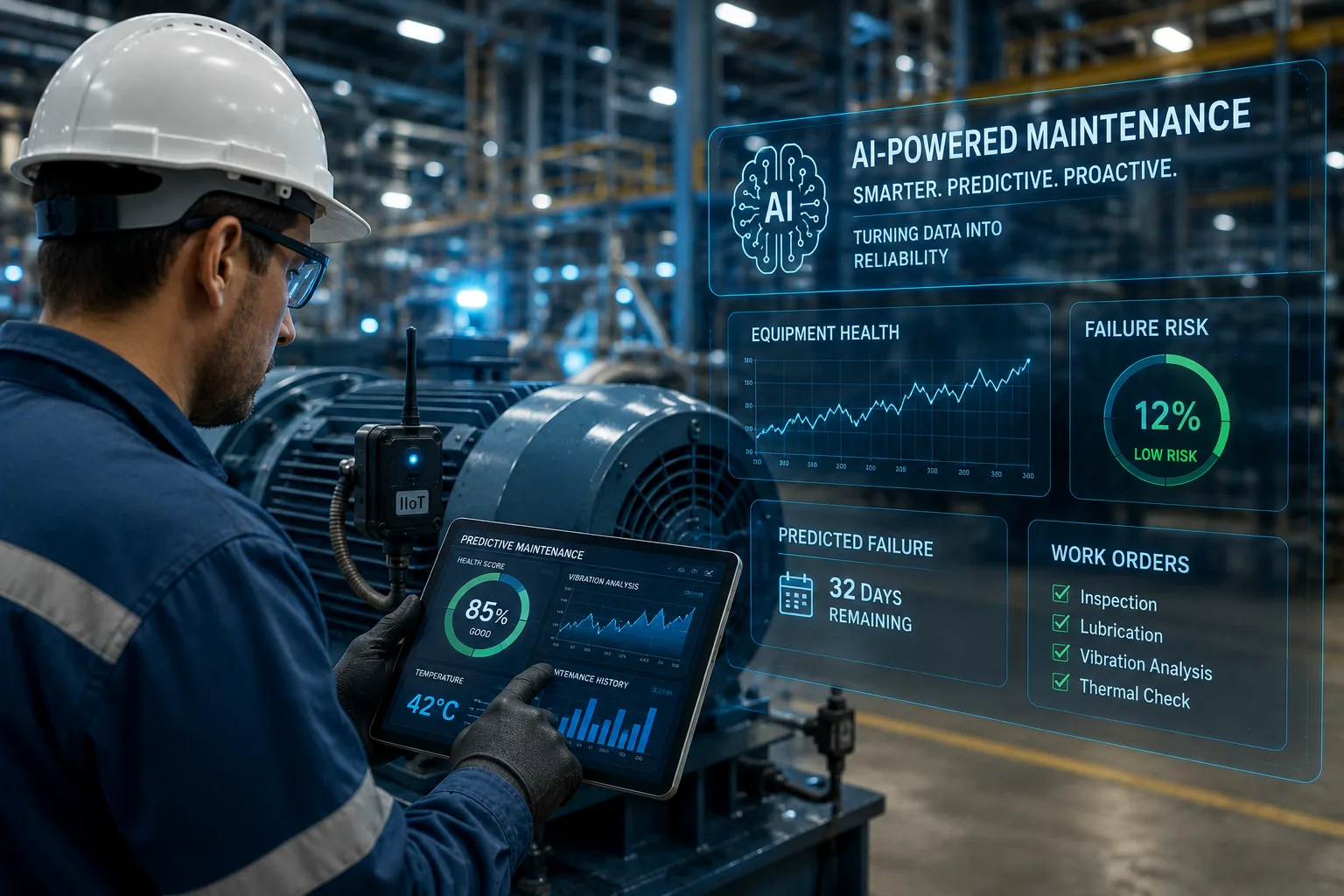
Artificial intelligence in industrial maintenance is consolidating its adoption in the industry: 58% of organizations already use it, according to the State of Industrial Maintenance Report 2026 prepared by MaintainX based on a survey of 2,234 maintenance and operations leaders.
The study also reveals that 75% of organizations that adopted artificial intelligence in their maintenance operations reported a return on investment (ROI) in less than six months. At the same time, 39% of respondents indicated that the cost of unplanned downtime increased over the past year, reinforcing the urgency to digitize and optimize maintenance programs.
Artificial Intelligence in Industrial Maintenance: Accelerated Adoption and ROI in Six Months
The speed of adoption is one of the most relevant data points in the report. In a historically conservative sector regarding technology, the fact that more than half of organizations already use artificial intelligence in industrial maintenance marks a turning point. The most frequent applications include automatic work order planning, predictive fault diagnosis, analysis of asset condition patterns, and automation of operational reports.
The return on investment in less than six months reported by 75% of adopters is mainly explained by the reduction of unplanned shutdowns, the optimization of spare parts inventories, and the improvement in the utilization of maintenance personnel. These results are prompting organizations that have not yet adopted AI to accelerate their evaluation and implementation processes.
“Artificial intelligence is not replacing maintenance technicians — it is amplifying their decision-making capacity and allowing them to focus on higher-value tasks,” said a MaintainX executive quoted in the State of Industrial Maintenance 2026 report.
Artificial Intelligence in Industrial Maintenance and Asset Integrity: The Strategic Link
Beyond operational efficiency, artificial intelligence in industrial maintenance is strengthening asset integrity programs. Predictive analytics models allow anticipating degradation in critical equipment, optimizing risk-based inspection (RBI) intervals, and reducing the probability of catastrophic failures in industrial facilities.
The integration of CMMS platforms, IoT sensors, and artificial intelligence engines is creating digital maintenance ecosystems where asset condition data is processed in real time to generate actionable recommendations. This model is especially valuable in sectors such as oil and gas, petrochemicals, power generation, and heavy manufacturing, where the cost of an unplanned failure can exceed several million dollars per hour of downtime.
Operational reliability is thus consolidated as the main tangible benefit of AI in maintenance: more asset availability, fewer unplanned interruptions, and greater predictability in production schedules.
Persistent Challenges
The report also identifies obstacles hindering broader adoption. The shortage of skilled personnel remains the main operational challenge for maintenance departments, followed by the difficulty of integrating new digital platforms with legacy systems and cultural resistance to change within organizations.
“Technology advances faster than organizations’ ability to absorb it. The success of AI in maintenance depends as much on the chosen platform as on the preparation of the human team that operates it,” indicated an industrial digital transformation specialist cited by MaintainX.
For industrial asset operators, the message of the State of Industrial Maintenance Report 2026 is clear: artificial intelligence is no longer a future option but a present competitive advantage. Organizations that delay its adoption will face increasing downtime costs and an operational gap that will become increasingly difficult to close.
Predictive Maintenance Enters a New Stage
The rapid adoption of artificial intelligence is transforming predictive maintenance from an approach based on historical analysis to a model capable of anticipating failures with greater precision through continuous processing of operational data. By combining information from IoT sensors, SCADA systems, CMMS platforms, and machine learning models, organizations can identify anomalies before they evolve into critical events, optimizing intervention planning and significantly reducing the risk of unplanned shutdowns.
This evolution also redefines industrial asset management. Beyond automating tasks, artificial intelligence is consolidating itself as a strategic tool to improve operational reliability, extend equipment lifespan, and support data-driven maintenance decisions. In a context where the cost of downtime continues to rise and the availability of specialized personnel remains a challenge, organizations that integrate these technologies will be better prepared to operate safer, more efficient, and more competitive facilities.
Sources: Automate.org / MaintainX