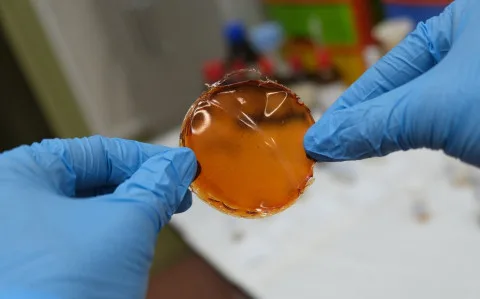
A team from the Spanish National Research Council (CSIC), led by the Institute of Materials Science of Madrid (ICMM), has developed a gas separation membrane capable of multiplying hydrogen purification efficiency by nearly ten, a significant technical advancement for the global energy transition.
The finding, published in the Journal of Membrane Science, positions this technology at the forefront of materials engineering applied to industrial processes. The improvement impacts not only performance, but also sustainability and reduction of operational costs.
The most revealing data from the study is compelling: hydrogen permeability increases by more than 800%, far exceeding the limitations of current commercial membranes, which redefines efficiency standards in gas separation.
Materials Engineering and Leap in Industrial Performance
The development is based on the modification of traditional polysulfone membranes, a polymer widely used in industrial applications. The team incorporated a porous component designed to improve molecular discrimination, allowing preferential passage of smaller molecules such as hydrogen.
This approach successfully addresses one of the greatest technical challenges: balancing permeability and selectivity. While many solutions increase one of these parameters at the expense of the other, this new membrane manages to improve both simultaneously, with a 30% increase in selectivity.
From an operational standpoint, this translates into more efficient processes, lower energy consumption, and higher purity of the hydrogen obtained—factors of interest to intensive industries such as petrochemicals or clean fuel production.
Mechanochemistry: The Disruptive Factor in the Process
Beyond performance, the innovation lies in the synthesis technique used: mechanochemistry. This method allows the porous material to be manufactured in just three hours, compared to the three days required by conventional processes.
This time reduction is significant. It represents a drastic reduction in energy consumption, solvent use, and waste generation, aligning with the principles of green chemistry and industrial sustainability.
The combination of high operational efficiency and low manufacturing impact makes this membrane a comprehensive solution, not only from a technical standpoint, but also environmental and economic.
Potential Impact on Industry and Energy Transition
Hydrogen is considered one of the energy vectors as a decisive variable for decarbonizing industrial sectors that are difficult to electrify. However, its purification continues to face logistical limitations in the manufacturing phase from technological and economic perspectives.
In this context, the CSIC advancement opens the door to more efficient and scalable production systems, especially in refineries and petrochemical plants where demand for high-purity hydrogen is growing.
Although the technology must still validate its industrial scalability, its potential is significant. If implemented on a large scale, it could redefine the hydrogen economy, accelerating its adoption as a pillar of the global energy transition.
Source: https://www.icmm.csic.es/
Photo: Shutterstock