
Tank construction where communication and time make all the difference
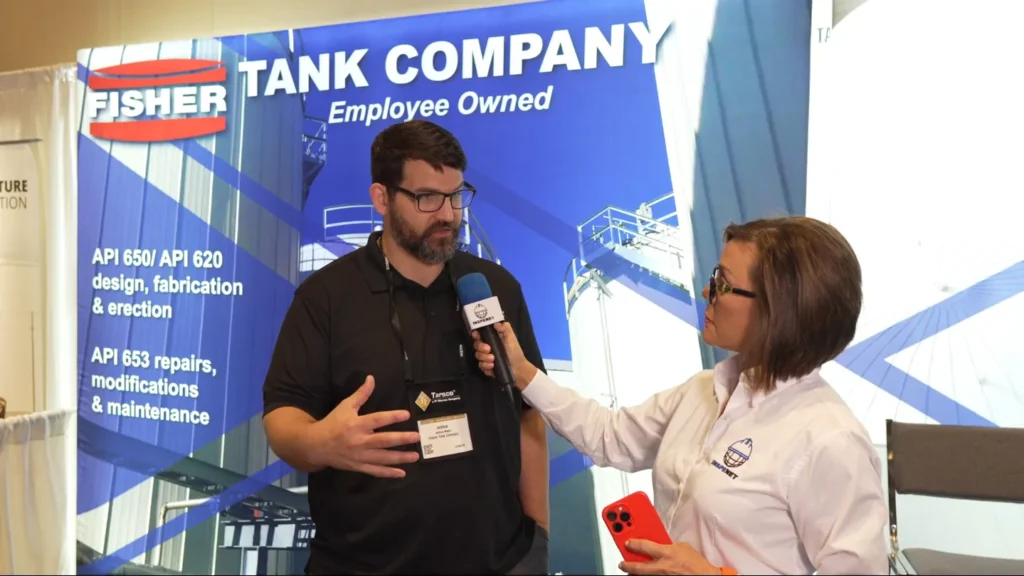
Efficiency in tank construction increasingly depends on factors beyond engineering. During the NISTM 2026 event, Joshua Magni, Business Development at Fisher Tank Company, explains how team coordination and project timelines are redefining industrial projects.
A sector where improvement is constant.
Firstly, the tank construction sector is not characterized by disruptive changes in products, but by a continuous evolution in processes.
Tanks have been tanks for a long time, which puts the focus on optimizing how they are designed and built.
Joshua Magni explains.
In this context, aspects such as safety, quality, and meeting deadlines remain fundamental pillars. The industry is progressing through incremental improvements that seek greater consistency in execution and a reduction in operational risks. Likewise, these improvements respond to a growing demand for reliability in industrial environments where any failure can be costly.
Communication as the core of the project
On the other hand, one of the most relevant messages of the interview is the importance of communication. Magni emphasizes that it is a frequently underestimated factor, even though it is crucial for the success of any tank construction project.
Coordination between project managers, construction teams, the sales department, and the manufacturing area allows for the alignment of objectives and the prevention of deviations. According to the interviewee, completing this communication loop ensures that everyone involved works under the same vision: one team, one project.
Consequently, fluid communication reduces errors , improves efficiency, and facilitates real-time decision-making. In complex projects involving multiple stakeholders, this becomes a key differentiator against the competition.
Design and materials: decisions that determine useful life
Regarding technical factors, the durability and reliability of a tank depend on multiple variables. These include the selection of materials, the type of steel used, and the foundation solutions implemented.
Furthermore, elements such as cathodic protection play a significant role in corrosion prevention . These initial decisions influence the tank's long-term performance and maintenance costs. Likewise, planning an appropriate maintenance program is essential to extending the installation's lifespan.
Magni insists that there is no single determining factor, but rather a combination of technical decisions that, together, define the final quality of the project. This comprehensive approach is especially relevant in the construction of tanks intended for critical sectors such as energy or refining.
Time as an economic variable
However, beyond design, time stands out as one of the most influential variables in decision-making. In tank construction, the moment a facility enters service has a direct impact on the client's profitability.
Magni raises a key question: how much revenue is lost by a facility that is not yet operational? This approach highlights the importance of speed of execution as a strategic factor. In this respect, tanks built on-site allow full capacity to be brought online in a shorter timeframe.
In contrast, other alternatives may involve lower initial costs, but a slower start-up time. This creates a trade-off between investment and return that clients must carefully evaluate. Thus, time ceases to be merely a technical variable and becomes a decisive financial factor.
Each tank is a unique project
The diversity of designs and requirements means that each project is different. Factors such as size, type of structure, or the incorporation of specific solutions make it impossible to establish a standard construction time for tanks.
Magni points out that each tank has its own characteristics , from double-walled configurations to floating roofs. This variability necessitates adapting the processes and reinforces the need for detailed planning from the initial stages.
In this scenario, accumulated experience and adaptability become competitive advantages. Companies with a proven track record in the sector can better manage complexity and offer solutions tailored to each client.
A consolidated vision in the sector
Finally, Fisher Tank Company positions itself as a player with extensive experience in the market. Founded in 1948, the company has developed its activity in the design, manufacture, and construction of welded steel tanks, consolidating its presence in multiple industrial sectors.
Joshua Magni's shared vision reflects a clear trend in tank construction: success no longer depends solely on engineering, but on the integration of communication, technical decisions, and time management. In an environment where efficiency and reliability are essential, these factors make all the difference in project execution.
For more content about NISTM 2026, visit our LinkedIn profile.
Source: Inspenet.