Cathodic protection and corrosion control in industrial terminals
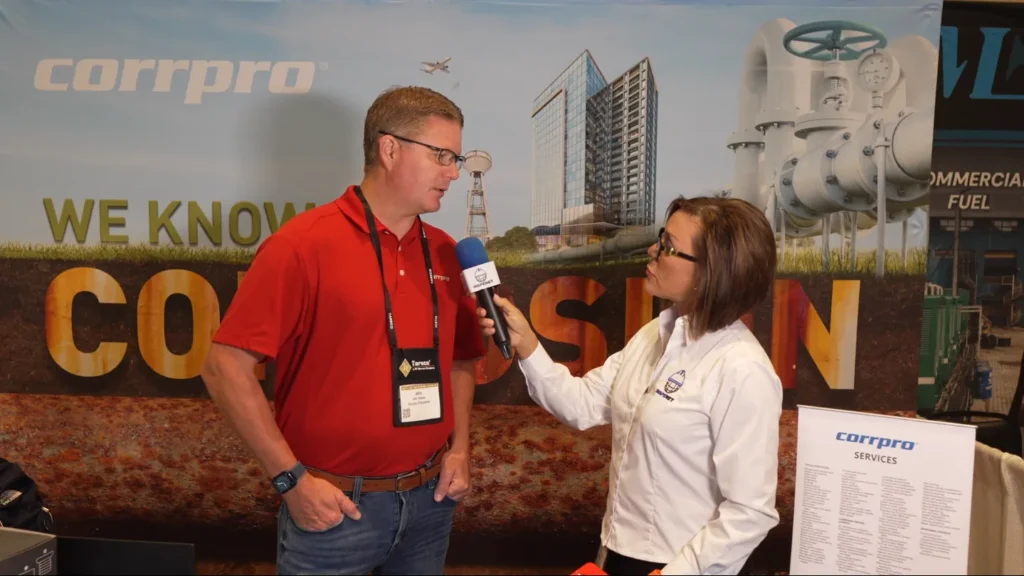
At NISTM 2026, one of the most important events for the liquid storage industry, asset integrity is once again at the heart of the technical discussion, with particular attention to solutions such as cathodic protection . In this context, John Wallace, Business Development at Corrpro Companies, Inc., shared his perspective on the current challenges in corrosion management at terminals .
Drawing on his experience, Wallace addressed a recurring problem in the sector: the difficulty of monitoring infrastructure that is not visible, such as tank bottoms and buried pipelines. This reality influences decision-making and increases operational risk if not managed properly.
Corrpro and his role within Azuria
Corrpro Companies is part of the Azuria Water Solutions group, an organization with over 50 years of experience in technological solutions for water infrastructure and industrial assets. Within this ecosystem, the company specializes in comprehensive cathodic protection solutions, with a clear focus on asset integrity.
Their proposal is based on offering turnkey services that cover everything from inspection to implementation and maintenance of systems designed to protect tanks, tank bottoms, and associated pipeline networks at terminals. This comprehensive approach allows operators to have a complete overview of the condition of their assets.
The challenge of invisible corrosion
One of the most relevant points of the interview revolves around a simple but critical concept: what is not seen, is not managed. In the case of buried or difficult-to-access infrastructure, this premise translates into a false sense of security.
Corrosion can progress without visible signs until it reaches critical levels. As Wallace explained, many operators don't act until the problem is already evident, increasing costs and operational impact. This scenario highlights the need to adopt more proactive strategies based on real https://inspenet.comdata.
Field inspection and continuous monitoring
Faced with this challenge, cathodic protection emerges as an important tool for monitoring the condition of assets . In this regard, Corrpro advocates for a model based on the presence of specialized technicians in the field, responsible for carrying out periodic measurements and evaluations.
These professionals inspect terminals and collect data that identifies corrosion levels in both pipelines and tank bottoms. From this information, detailed reports are generated that provide a clear picture of the actual condition of the infrastructure.
Furthermore, year-on-year comparative analysis allows for the detection of trends and the evaluation of whether cathodic protection systems are maintaining their effectiveness or, conversely, declining in performance. This continuous monitoring is essential for anticipating failures and planning interventions.
When does a system cease to be efficient?
Another important aspect addressed by Wallace is the ability to determine when a cathodic protection system ceases to function. Far from being a one-off decision, this process is based on the analysis of data accumulated over time.
When indicators show a progressive decline in system effectiveness, operators can identify that the required corrosion control standards are no longer being met. This point signals the need for action, whether through adjustments, maintenance, or system replacement.
The advantage of this approach is that decisions are based on technical evidence and not on assumptions, which reduces uncertainty and improves risk management.
Digitization and real-time monitoring
Alongside fieldwork, digitalization is playing an increasingly important role in asset integrity management. Corrpro integrates collected data into cloud-based digital platforms, enabling clients to access up-to-date information in real time.
This type of solution facilitates the continuous monitoring of cathodic protection systems and improves response capabilities to potential incidents. It also allows for the centralization of information and its use as a basis for more efficient maintenance strategies.
The availability of real-time data transforms the way companies manage their assets, moving from a reactive approach to a more predictive and analytics-based one.
Measure what is unseen to protect assets
The main message from John Wallace's presentation is clear: asset integrity depends on the ability to measure what is invisible. In an environment where much of the critical infrastructure remains hidden, relying on perception can be costly.
Cathodic protection, combined with field inspection and digital tools, helps close this information gap. This allows operators to make more informed decisions and reduce the risk associated with corrosion.
Outlook for the sector
As the industry moves towards more digital models, data integration and continuous monitoring are becoming cornerstones of asset management. In this context, solutions like those offered by Corrpro are reinforcing their relevance within the sector.
The combination of technical expertise, field presence, and digital capabilities positions companies as active participants in the evolution of maintenance strategies for industrial terminals. The challenge now lies in continuing to advance the adoption of these tools and raising awareness about the importance of acting before problems become apparent.
For more content about NISTM 2026, visit our LinkedIn profile.
Source: Inspenet.