Caldwell Tanks responds to data center boom
The expansion of data centers is creating new challenges for industrial infrastructure in the United States and other strategic markets. The accelerated growth of artificial intelligence, cloud computing, and high-capacity digital systems is increasing the need for more efficient cooling solutions and storage systems capable of supporting critical operations over extended periods.
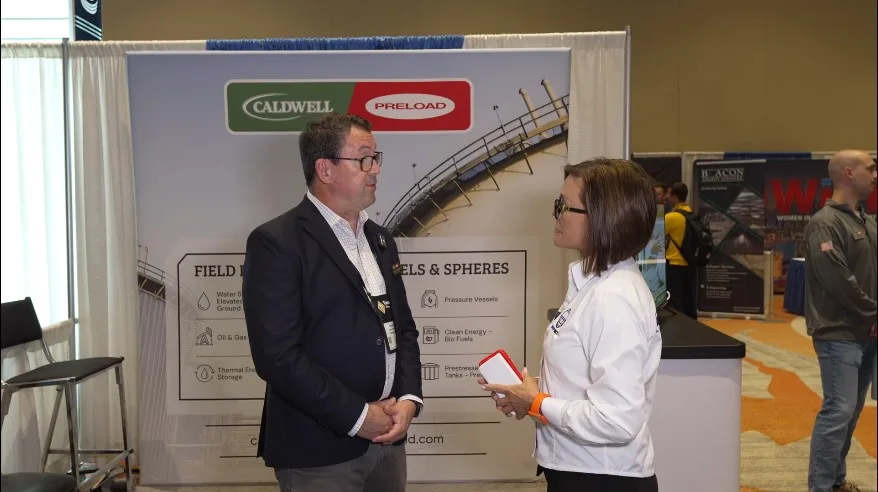
In this scenario, companies specializing in industrial storage are beginning to adapt their designs and capabilities to respond to increasingly complex demand. During NISTM 2026, Shannon McKamey, Business Development Manager at Caldwell Tanks, explained how the company is observing a significant evolution in the technical specifications requested by clients linked to technological and energy infrastructure.
The U.S. company, founded in 1887 and headquartered in Louisville, Kentucky, is focusing part of its expertise in field erected tanks and thermal energy storage to respond to data center growth and their industrial refrigeration needs.
Caldwell Tanks Strengthens Its Presence in Industrial Storage
Caldwell Tanks is recognized as the oldest elevated water storage tank company in the United States. Over more than a century, the company has developed solutions for industrial, chemical, energy, and water treatment sectors.
As McKamey explained during the interview, the company operates under a turnkey approach that encompasses design, fabrication, transportation, and construction of industrial tanks directly in the field. The company also develops solutions for chemical storage, flat-bottom tanks, and industrial water applications.
Additionally, Caldwell operates alongside its affiliate Preload, which specializes in concrete solutions and large-scale storage. This combination enables the organization to serve projects related to energy, industrial processes, and thermal storage systems.
The executive emphasized that the company can adapt to different levels of complexity according to client needs. Some projects arrive with completely defined specifications while others begin only with an operational problem that needs to be solved.
"Sometimes our clients know exactly what they need and other times they need us to work with them to develop a storage solution," McKamey explained.
This consultative model has become an important part of current industrial business, especially in markets where requirements change rapidly due to new technologies or increases in energy capacity.
Data Centers Transform Industrial Storage
One of the most relevant aspects of the interview was the relationship between data center growth and the evolution of industrial storage.
McKamey noted that Caldwell Tanks is seeing an increase in requests related to thermal energy storage tanks intended for data center cooling systems. These facilities require enormous amounts of energy to keep their servers and processing equipment operational, making thermal control a critical component.
Thermal storage systems allow cooling energy to be accumulated for later use during the most intensive operating cycles. This helps stabilize energy consumption and improve facility efficiency.
The expansion of artificial intelligence and data processing centers is accelerating the construction of new technological infrastructure in different regions of the country. As a result, industrial storage companies are beginning to receive technical specifications that just a few years ago were not common within the sector.
We are seeing many requests for data centers and thermal storage tanks.
McKamey commented during the conversation.
This change is also modifying the way some industrial projects are designed. Factors such as cooling capacity, thermal stability, and energy efficiency now carry greater weight within the initial engineering stages.
For companies like Caldwell Tanks, this represents a natural evolution of the industrial market. Demand no longer comes solely from traditional sectors such as oil, chemicals, or water. It now also comes from technology industries that require robust infrastructure to sustain large-scale digital operations.
Customized Engineering for Complex Industrial Projects
Another highlight of the interview was the importance of adapting each project to the client's actual needs.
McKamey explained that some industrial developments start from very precise information, including complete specifications and detailed technical requirements. However, other projects begin with much less defined scenarios.
In those cases, joint work between the company and the client's operational teams is essential to build an efficient solution.
The executive noted that many companies know the operational problem they need to solve, but have not yet defined what type of tank or configuration will be most suitable for their process.
This situation requires developing a collaborative engineering stage where capacities, tank styles, thermal requirements, and operating conditions are analyzed before advancing to fabrication.
The growth of sectors such as data centers is also increasing the need for more specific and customized designs. Each facility may have different requirements related to storage capacity, thermal cycles, energy demand, or integration with cooling systems.
As a result, industrial design becomes increasingly dynamic and dependent on technical communication between all parties involved.
Coatings, Corrosion, and Operational Protection
Corrosion protection and coating performance continue to be determining factors within industrial storage.
During the interview, McKamey explained that Caldwell Tanks subcontracts specialized areas such as coatings, cathodic protection, insulation, and foundations. However, the company maintains technical supervision and strict compliance with the specifications defined for each project.
The executive indicated that requirements may come from the client, the responsible engineer, or the general contractor. Subsequently, subcontractors must work under those conditions and comply with the standards established by the project.
In industrial and energy applications, corrosion protection has a direct impact on asset service life and operational reliability. This is particularly important in facilities related to industrial water, chemicals, and thermal storage.
Appropriate coating systems protect metal surfaces against aggressive environmental conditions, thermal variations, and continuous chemical exposure.
As industrial facilities become more complex, the requirements associated with material protection and maintenance also evolve. This forces construction and engineering companies to work with more rigorous specifications and stricter quality controls.
Communication Remains Key in Project Development
When asked about the most common errors in industrial project development, McKamey avoided pointing to a single specific technical problem. Instead, she emphasized the importance of communication between client and supplier.
As she explained, many issues can originate when there is insufficient clarity about operational needs or the project's final objectives.
Process changes, incomplete information, or poorly defined requirements can generate difficulties during the engineering and construction stages.
The executive noted that maintaining open communication from the earliest phases of the project helps develop more efficient solutions aligned with the client's actual needs.
This aspect becomes especially important in industries undergoing rapid transformations, as is currently occurring with data centers and the energy infrastructure associated with digital technologies.
Energy Demand Transforms Industrial Storage
Data center growth is beginning to transform different segments of industrial infrastructure in North America. Thermal storage systems, cooling solutions, and high-energy-capacity projects are appearing with increasing frequency within the market.
In this context, companies with experience in field erected tanks and industrial storage are seeking to adapt to new technical and operational requirements.
Caldwell Tanks believes this evolution will continue to expand opportunities for specialized storage solutions, especially in sectors where thermal stability and energy efficiency will become increasingly relevant.
For more content about NISTM 2026, visit our LinkedIn profile.
Source: Inspenet.