Table of Contents
A failure in a vessel loading and/or unloading system, a damaged transfer pipe, or a critical valve out of service can quickly escalate into operational problems at any oil and gas facility. However, in many cases, the most significant impact comes not from the equipment failure itself, but from the time it takes to locate, source, and deliver the replacement component needed to restore operations as quickly as possible.
With the ever-increasing interconnection of industrial assets and the tightening of operational objectives, the availability of critical spare parts has evolved from a simple procurement issue to a strategic corporate priority. Business continuity, asset integrity, reliability, and the reduction of unplanned downtime increasingly depend on the ability to access the right materials at the right time.
In this context, digital transformation is redefining how companies manage procurement processes, supplier networks, and inventory visibility. Thanks to IOCS’s experience supporting marine terminals, offshore facilities, and fluid transfer systems, the timely availability of critical components has become a key factor in maintaining operational continuity and responding more effectively to the evolving needs of the energy sector.
Why Procurement Has Become an Integrity Issue
For many years, purchasing was considered primarily an administrative function focused on purchasing materials, managing suppliers, and controlling costs. While these responsibilities remain important, the role of purchasing has expanded significantly with the growing complexity of industrial operations and their ever-increasing dependence on the availability of specialized equipment and components.
Today, purchasing directly impacts operational availability, risk management, maintenance planning, and regulatory compliance. A delay in the delivery of a hose, valve, gasket, or critical load component can postpone maintenance activities, extend shutdowns, or even compromise the operational safety of a facility.
This reality is particularly evident in marine terminals, offshore platforms, refineries, and petrochemical plants. Over the years, IOCS has observed that equipment reliability depends not only on design and maintenance practices, but also on the ability to obtain certified spare parts and critical components when operations require them. In these contexts, supply chain disruptions can quickly translate into operational and financial consequences.
The message is clear: when a critical component isn’t available when needed, operational integrity is no longer just a matter of maintenance, but becomes a business risk.
The Hidden Cost of Delayed Spare Parts
The true cost of a spare part is rarely reflected in its purchase price. In many industrial operations, the greatest expense comes from the time lost waiting for a critical component to arrive. Long lead times, insufficient inventory, global supply chain disruptions, and transportation delays can create operational bottlenecks that extend well beyond the maintenance department.
Based on IOCS’s experience supporting marine terminals and oil and gas transfer operations, the unavailability of a critical component can delay scheduled maintenance activities, extend operational downtime, and increase the risk of unplanned disruptions. In many cases, the challenge is not finding the technical solution, but having the right component available at the right time. Every additional day spent waiting for a spare part can translate into higher maintenance costs, reduced asset utilization, and lost productivity.
Despite these risks, many organizations still rely on reactive procurement models, purchasing components only when the need becomes urgent. While this approach may reduce inventory costs in the short term, it often exposes operations to increased risk and significantly higher costs when the availability of critical equipment becomes time-critical.
How Digital Procurement Is Changing the Industry
The industrial sector is increasingly recognizing that purchasing efficiency has a direct impact on operational performance. As a result, companies are moving away from traditional purchasing models and adopting digital solutions designed to improve visibility, responsiveness, and decisionmaking across the entire supply chain.
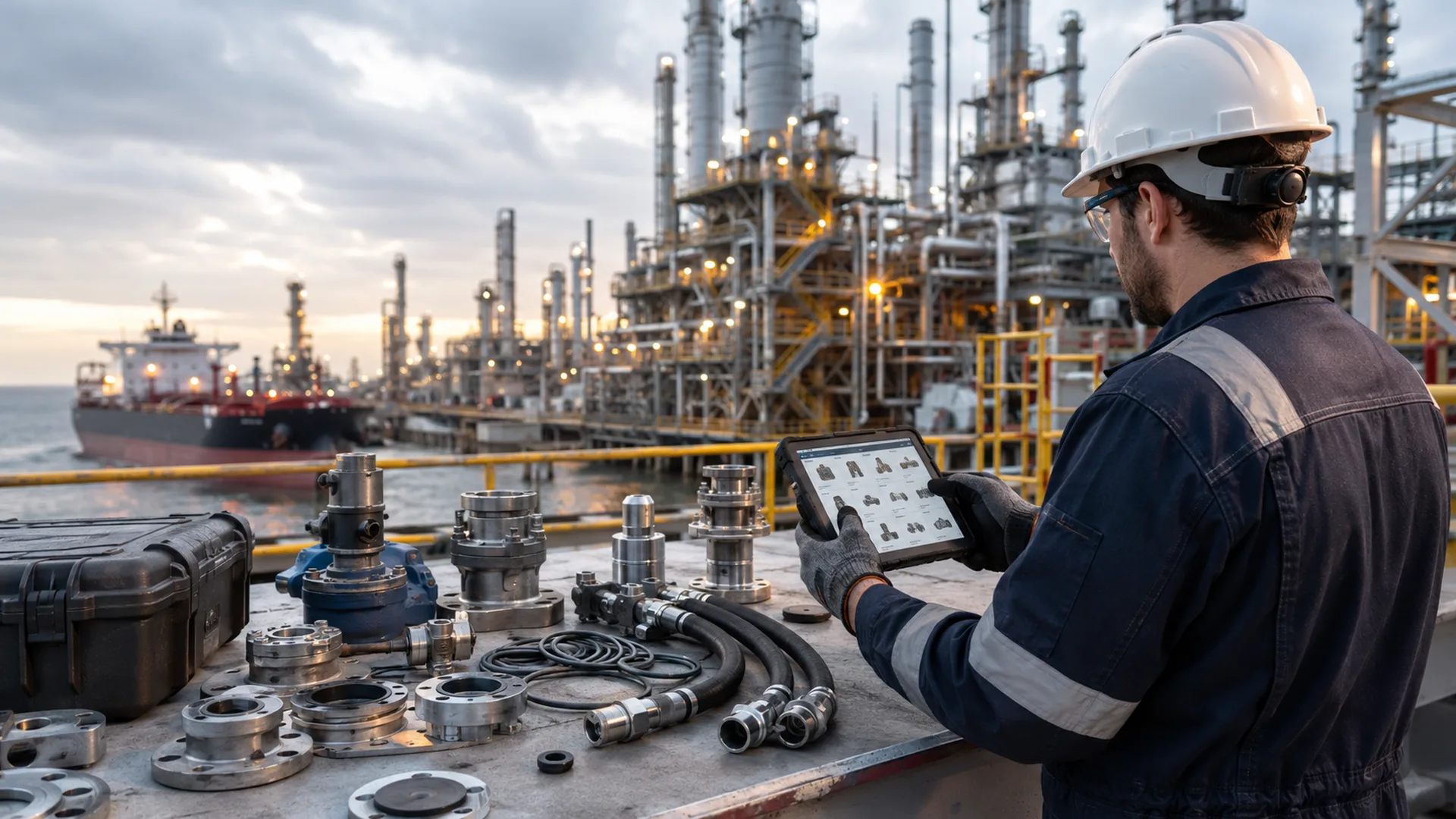
For companies operating in environments where component availability is critical, such as marine terminals, offshore facilities, and fluid transfer systems, digital procurement platforms offer real-time access to product information, inventory availability, technical specifications, certifications, and specialized supplier networks. Instead of relying on numerous emails, phone calls, and manual searches, procurement teams can identify and acquire critical components through centralized online catalogs and interconnected purchasing environments.
This evolution is closely tied to broader industry trends such as digital supply chains, purchasing automation, and data-driven purchasing. Using digital tools, organizations can improve material traceability, streamline approval processes, reduce administrative burden, and achieve greater transparency throughout the procurement cycle.
For industries where equipment reliability is critical, faster access to specialized suppliers and essential spare parts can significantly improve operational readiness. Most importantly, digitalization does not replace technical expertise or engineering judgment. Instead, it provides maintenance, operations, and procurement teams with better information to make faster decisions and gain more efficient access to the components needed to keep plants running safely and reliably.
TABLE 1. Traditional Procurement vs. Digital procurement
| Aspect | Traditional Procurement | Digital Procurement |
| Product Search | Multiple emails and calls | Centralized online access |
| Inventory Visibility | Limited or delayed | Real-time availability |
| Supplier Access | Fragmented network | Connected supplier ecosystem |
| Documentation | Manual management | Digital traceability |
| Approval Process | Multiple administrative steps | Streamlined workflows |
| Response Time | Days or weeks | Hours or minutes |
| Operational Impact | Higher risk of delays | Faster decision-making |
| Asset Availability | Reactive approach | Proactive support |
Supporting Operational Continuity Through Faster Access
Operational continuity depends on more than the reliability of equipment in service. It also depends on how quickly critical components can be sourced when maintenance, repairs, or unexpected failures occur. In today’s industrial environment, asset availability, reliability, and operational resilience are increasingly linked to the efficiency of procurement processes and supply chain responsiveness.
The ability to rapidly locate and obtain hoses, fittings, valves, couplings, and marine transfer components can significantly reduce operational risks and help prevent extended downtime. This is particularly important in offshore installations, marine terminals, and energy infrastructure where even minor delays in obtaining replacement parts can affect operational schedules and maintenance programs.
Recognizing these challenges, IOCS has expanded its traditional role as a specialized provider of fluid transfer solutions and terminal operations support by incorporating digital tools designed to facilitate faster access to critical components. Through decades of experience in marine terminals, offshore facilities, and hydrocarbon transfer systems, the company has observed how the timely availability of hoses, couplings, valves, camlock coupling, fittings, and other essential components can directly influence the operational continuity of its customers.
TABLE 2. Operational Impact of Critical Component Availability
| Component | Typical Application | Potential Impact if Unavailable |
| Marine Hoses | Ship-to-terminal transfer operations | Interruption of loading and unloading activities |
| Camlock Couplings | Fluid transfer systems | Operational delays and increased safety risks |
| Valves | Flow control systems | Operational restrictions and deferred maintenance |
| Fittings and Connectors | Process and transfer systems | Extended repair and maintenance times |
| Gaskets and Studbolts c/w Nuts | Fluid transfer systems | Extended repair and maintenance times |
| Loading Components | Marine terminal operations | Disruption of operational schedules |
| Transfer Equipment | Offshore facilities and terminals | Increased downtime and reduced operational efficiency |
From Operational Experience to Digital Procurementl
The evolution of digital procurement is not driven solely by a technological trend. It stems from real operational needs identified through years of experience in marine terminals, offshore facilities, and fluid transfer systems. With this vision in mind, IOCS has developed IOCS-e, a digital platform designed to simplify access to specialized industrial components, improve product visibility, and streamline purchasing processes for operators and maintenance teams.
By combining technical expertise with digital tools, IOCS-e aims to reduce the time associated with sourcing, selecting, and acquiring critical components, helping organizations respond more quickly and effectively to their operational requirements.
A More Connected Future for Industrial Supply Chains
The future of industrial procurement is being shaped by connectivity, data visibility, and faster access to information. As digital procurement platforms continue to evolve, organizations are gaining greater control over inventory management, supplier networks, purchasing decisions, and material traceability. These capabilities are helping build more resilient supply chains capable of responding more effectively to operational demands and market disruptions.
Looking ahead, the integration of procurement systems, inventory data, and supplier information will play an increasingly important role in supporting asset reliability and operational performance. In an industry where every hour of downtime carries significant financial and operational consequences, the ability to quickly access the right components is no longer simply a competitive advantage; it is becoming an operational necessity.
In this context, IOCS-e represents the natural evolution of the experience accumulated by IOCS in marine terminals, offshore facilities, and fluid transfer systems. Beyond offering products, the platform aims to provide faster, more transparent, and more efficient access to specialized components that play a fundamental role in maintaining the operational continuity of critical infrastructure across the entire energy value chain.
This article was developed by specialists from IOCS Srl and published as part of the eighth edition of the Inspenet Brief magazine July 2026, dedicated to technical content of the energy and industrial sector.