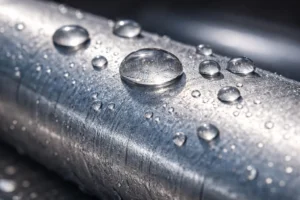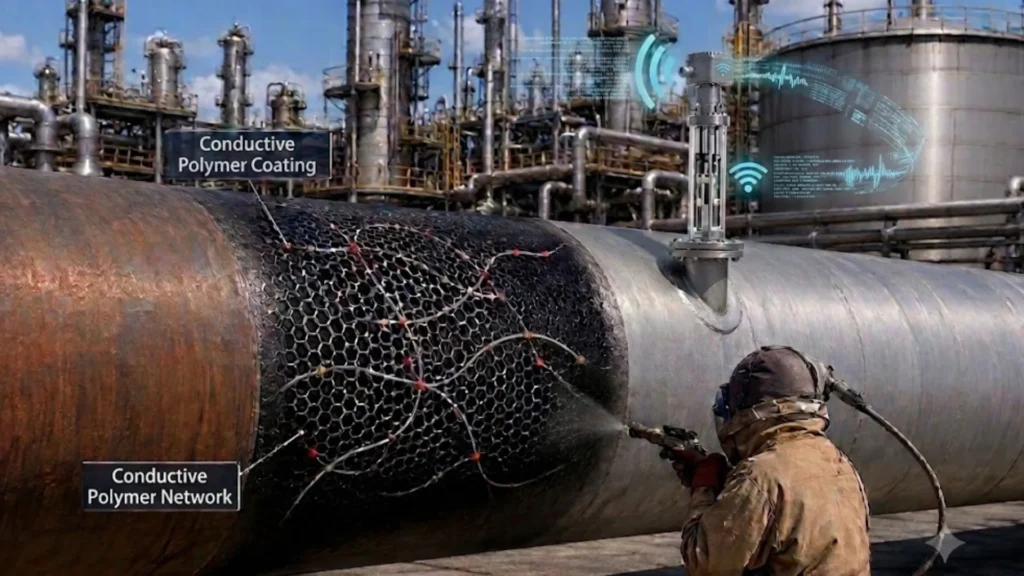
Corrosion continues to be one of the leading causes of degradation in fixed equipment within the energy industry. New developments in conductive polymers and smart coatings are strengthening corrosion protection by reducing degradation rates and extending the service life of assets1. When integrated with sensor-based monitoring systems, they can improve early failure detection and operational reliability.
Fixed equipment used in refineries, petrochemical plants, storage terminals, and power generation systems operates under severe conditions of pressure, temperature, humidity, and chemical exposure. In these environments, corrosion represents a direct threat to mechanical integrity, operational continuity, and industrial safety.
Although conventional coatings have been widely used for decades, increasing operational complexity and sustainability objectives have driven the development of more advanced solutions. Today, research in conductive polymers and smart coatings is enabling the creation of surfaces capable of actively responding to corrosive environments, detecting early-stage degradation, and even activating self-healing mechanisms. This technological evolution marks a transition from passive protection systems toward intelligent corrosion mitigation models.
The Impact of Corrosion on Fixed Equipment
Corrosion critically affects pressure vessels, storage tanks, process piping, heat exchangers, and metallic structures exposed to aggressive industrial environments. Its consequences include wall thickness loss, cracking, perforations, leaks, and structural failures capable of causing unplanned shutdowns and significant environmental risks.
In the energy industry, corrosion-related costs amount to billions of dollars annually due to asset repairs, production losses, and safety incidents. According to estimates by NACE International, the global cost of corrosion exceeds 3% of the world’s industrial GDP.
Beyond its economic impact, corrosion compromises operational reliability and limits the predictive capability of mechanical integrity programs. This has driven the need to develop technological solutions not only to protect metallic surfaces but also to monitor degradation conditions and respond dynamically to incipient damage.
New Corrosion Prevention Technologies
Scientific Advances: Conductive and Smart
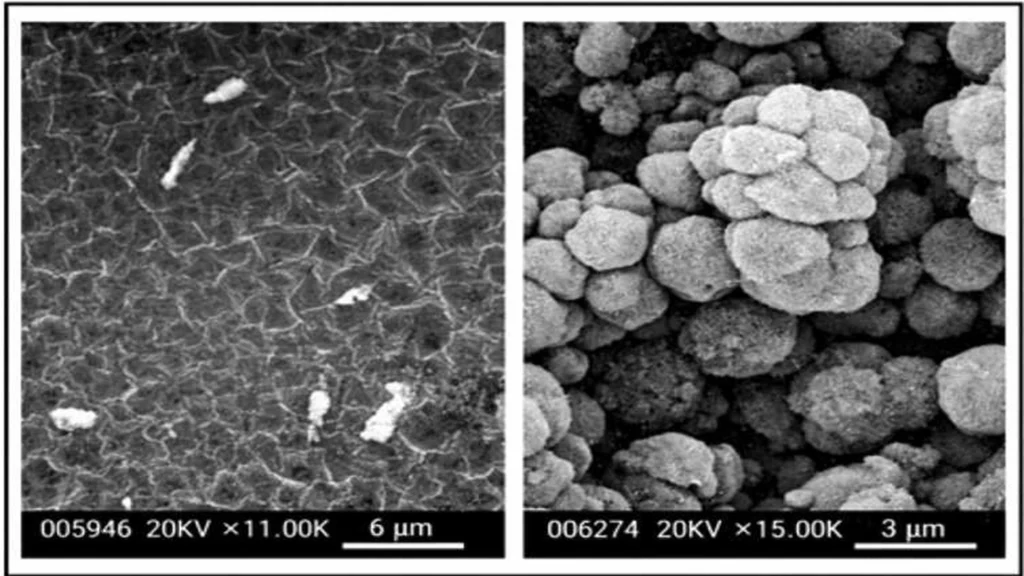
Polymeric Coatings The new generation of smart coatings is incorporating conductive polymers such as polyindole2, polypyrrole, polyaniline, and polythiophene, materials capable of modifying their electrochemical properties in response to external stimuli associated with corrosive processes. Unlike traditional coatings, these systems act as active barriers capable of inhibiting corrosion reactions and maintaining electrochemical stability on metal surfaces. In the following image, an electron micrograph of polindole on a stainless steel surface is shown, displaying a cauliflower-shaped microstructure, characteristic of these types of polymers.
Recent research highlights the development of self-healing coatings based on cross-linked polypyrrole hydrogel networks, capable of partially restoring protective properties after experiencing mechanical damage. This smart approach allows extending the coating service life and reducing localized corrosion propagation.
Another important advance corresponds to smart coatings with SnO2 nanocapsules. These systems combine nanotechnology, active encapsulation, and controlled release of protective agents to improve resistance to aggressive corrosive environments.
Technical advances: Monitoring sensors
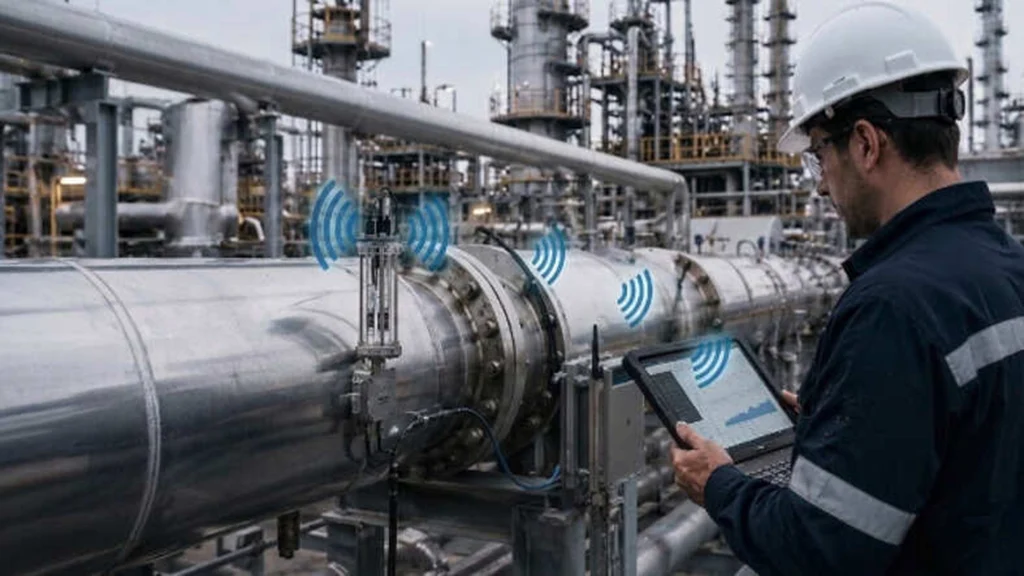
In parallel, the integration of corrosion sensors connected through industrial IoT is enabling real-time monitoring, integrity traceability, and predictive maintenance based on operational data. Predictive monitoring is consolidated through electrical resistance (ER), electrochemical noise (EN), and fiber optic sensors3. These devices measure in real time the thickness loss, moisture ingress, and galvanic corrosion rate without interrupting operation. When integrated with wireless systems, they transform periodic inspection into a continuous data-driven strategy, allowing instantaneous correlation of deviations in critical process variables with the actual degradation rate of the industrial asset. The following image shows a representative illustration of these real-time monitoring advances.
Case Studies in Anticorrosion Solutions
- Polyaniline (PANI) films at 90%: Studies developed in China, jointly led by researchers in China (CAS/Key Laboratory) to mitigate marine corrosion.
- Polyaniline coatings: Evaluated on carbon steel in saline environments and acid gases, demonstrating significant improvements compared to conventional systems, positioning conductive polymers as a viable alternative to chromate- based coatings: validated by NASA (Kennedy Space Center) and Los Alamos (USA).
- Polypyrrole (PPy) films: optimized for refineries and hydrocarbons by IIT institutes in India and Iran. • Pilot projects with SnO2 nanocapsules and digital twins: deployed on offshore platforms in the North Sea (UK/Norway).
- Equinor (North Sea): wireless ultrasonic sensors (Permasense) that reduced manual inspections by 70%
- Trans-Alaska Pipeline System (Alyeska): electrical resistance (ER) sensors to control microbiological corrosion in critical zones
- Chevron refineries (USA): electrochemical noise (EN) sensors to automate inhibitor dosing against naphthenic acids.
Long-term benefits of corrosion mitigation
The implementation of smart coatings and advanced monitoring technologies offers sustainable long-term operational and economic benefits. These solutions make it possible to extend the service life of critical equipment, reduce the frequency of corrective maintenance, and minimize unplanned shutdowns.
The ability to detect incipient damage and activate early protection mechanisms significantly improves operational reliability and reduces risks of loss of containment. Additionally, the digitalization of monitoring of corrosion strengthens data traceability and optimizes risk-based inspection (RBI) strategies.
From an environmental standpoint, the reduction of leaks and structural failures also contributes to ESG objectives and industrial sustainability goals. In this context, smart coatings based on conductive polymers emerge as one of the most promising technologies for the next generation of mechanical integrity programs.
Conclusion
The evolution of conductive polymers and smart coatings is transforming corrosion control in critical fixed equipment. These technologies combine active protection, self-healing, and intelligent monitoring to strengthen mechanical integrity and improve operational reliability. As the energy industry moves toward more digitalized and sustainable models, the adoption of smart anticorrosion solutions represents a key strategy to reduce risks, optimize maintenance, and extend the service life of industrial assets.
References
- Rout, T. K., Jha, G., Singh, A. K., Bandyopadhyay, N., & Mohanty, O. N. (2003). “Development of conducting polyaniline coating: https://doi.org/10.1016/S0257-8972(02)00867-7
- Reyes R., Yolanda. Studies of Organic (Indole) Coatings on Platinum, Glassy Carbon, and Steel Electrodes. Contact: yolandar90@gmail.com.
- Petiti, C. (2005). Pre-corroded ER sensors as realistic mock- ups for evaluating conservation strategies. Corrosion and Materials Degradation, 6(4), 66. https://doi.org/10.3390/cmd6040066
This article was written by Yolanda Reyes of Inspenet and published as part of the eighth issue of Inspenet Brief magazine (July 2026), dedicated to technical content in the energy and industrial sectors.