Emission control in tanks with new solutions in NISTM 2026
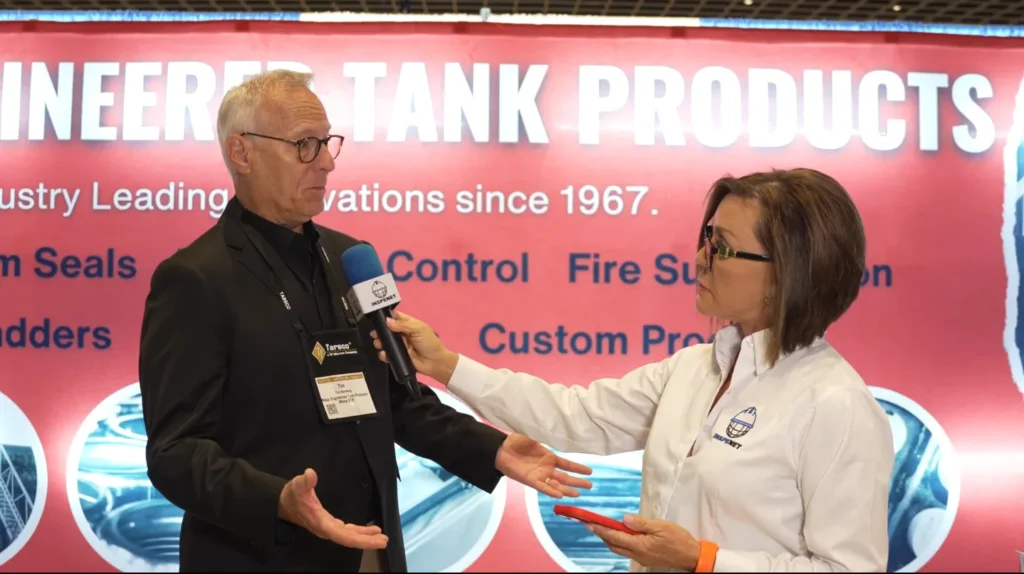
At NISTM 2026, one of the most relevant events for the tank storage industry, the conversation revolves around a persistent challenge: how to improve the emission control without compromising operations. In this context, Tim Nymberg, CEO of Mesa Engineering, provides a clear vision based on technical expertise and development of industry-specific solutions.
In addition, his speech reflects a trend that is gaining weight in the industry: betting on tangible improvements in efficiency, with technologies that are integrated into existing infrastructures and respond to the real needs of the operator.
A sector conditioned by durability and slow change
Currently, the aboveground storage tank sector faces a particular scenario. On the one hand, assets have long life cycles that can extend between 15 and 20 years. On the other hand, there is a certain resistance to adopting new technologies, which slows down the implementation of improvements.
This context also has a direct effect on the market: fewer maintenance interventions and less frequent component replacement. As a result, companies must offer solutions that stand out for their reliability and clear improvements in performance.
Engineering applied to real needs
Against this backdrop, Mesa ETP has consolidated a proposal based on two pillars: customer proximity and applied innovation. The company, part of Mesa Industries, has decades of experience in the design and manufacture of products for industrial tanks, with a global presence and a focus on customized solutions.
Instead of developing generic technologies, the company works on specific designs that respond to specific customer problems. This approach makes it possible to optimize system performance and adapt them to different operating conditions.
FlexCore: a tangible improvement in emission control
At the core of its proposal is FlexCore, a liquid mounted seal system designed to reduce emissions in storage tanks. As Nymberg explains, this technology offers a 30% to 40% improvement over traditional solutions.
In addition, FlexCore's design prioritizes simplicity and durability, two important factors in industrial environments where reliability is critical. The emissions reduction does not depend on complex configurations, but on optimized engineering that improves system performance from the ground up.
This solution also responds to a growing demand in the industry: to implement measurable improvements without the need to completely redesign the existing infrastructure.
Advanced materials for increased performance
Another of the differential elements in the development of Mesa ETP is the use of advanced materials. In particular, the so-called "armor fabric", a fabric designed to offer greater resistance and stability in demanding conditions, stands out.
This type of material extends component life and maintains consistent performance over time. As a result, maintenance requirements are reduced and the tank's operating efficiency is improved.
In addition, the incorporation of these materials reinforces the company's ability to offer solutions that combine robustness and technical precision.
Artificial intelligence enters progressively
In terms of the adoption of new digital technologies, artificial intelligence, the artificial intelligence is beginning to have a presence in the company's internal processes. Although its implementation is still initial, it is already being used to improve operational efficiency and optimize certain tasks.
Likewise, this trend reflects a broader shift in the industry, where digital tools are beginning to complement traditional engineering. However, the pace of adoption remains gradual, in line with the conservative nature of the industry.
Structural challenges that condition the evolution
Despite technological advances, the sector continues to face significant challenges. One of the main ones is the resistance to change on the part of operators, who tend to prioritize known solutions over new alternatives.
In addition, long asset life cycles limit the frequency with which improvements are introduced. This reduces the size of the market in terms of interventions and forces companies to differentiate themselves through real innovation and measurable results.
In this sense, the ability to demonstrate concrete improvements in emissions control becomes a crucial factor in driving the adoption of new technologies.
An evolution marked by efficiency
Looking to the future, the tank storage industry is moving towards a model where operational efficiency and emissions reduction will be key factors. In this scenario, companies such as Mesa ETP seek to position themselves through technical solutions that add value from the outset.
Thus, the combination of applied engineering, advanced materials and measurable performance improvements defines a line of work aligned with the current needs of the industry. Tim Nymberg's vision reinforces this direction, where every advance responds to a clear objective: to optimize system performance without adding unnecessary complexity.
For more content about NISTM 2026, visit our LinkedIn profile.
Source: Inspenet.