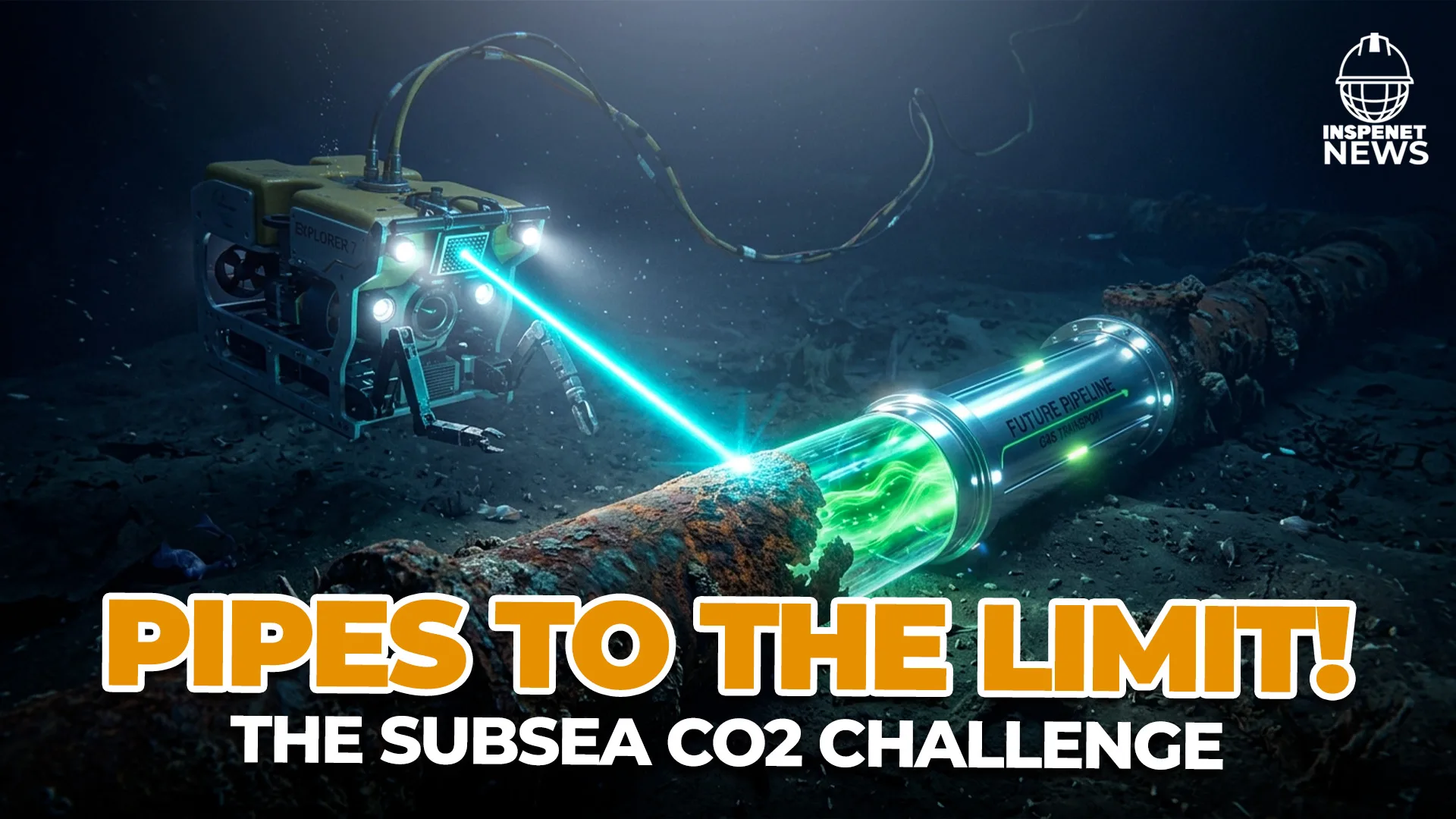
NSTA strengthens carbon storage with studies on CO2 pipelines
UK carbon storage industry has new studies to address one of its main challenges: moving large volumes of carbon dioxide to the places where it will be stored.
On July 30, the North Sea Transition Authority (NSTA) published two studies commissioned from Penspen and DNV. The studies examine both the construction of new offshore CO2 pipelines and the potential reuse of existing gas and oil pipelines.
Furthermore, the results show that much of the experience accumulated over decades by the British oil and gas industry can serve as a basis for developing networks intended for the transport of CO2 .
Two studies address CO2 transport in the open ocean
On one hand, Penspen analyzed the capabilities needed to install new offshore pipeline systems intended for carbon dioxide.
The study reviewed aspects such as contaminant control, fracture propagation, long-distance underwater connections, measurement, and models used to study flow.
According to their findings, there are no major technical obstacles related to the equipment needed to develop these systems. The challenge arises when considering the available experience at full scale.
Currently, there are few large-scale marine CO2 pipeline systems in operation worldwide. This limits the amount of practical experience that can be used as a reference for future projects.
For this reason, new developments rely heavily on knowledge gained from hydrocarbon pipelines. This experience must be complemented with tests, models, and specific requirements for the behavior of carbon dioxide.
Penspen sets higher demands for new systems
Given this situation, the development of carbon storage infrastructure requires a more precise definition of how the new networks should be designed and operated.
Among the aspects that need to be addressed are the integration of the systems, their validation, and the coordination between the different participants in the project.
It will also be necessary to align technical requirements with commercial and regulatory conditions. These areas can affect everything from the initial design to the future operation of a CO2 transport network .
Nigel Curson, Penspen's executive vice president of Technical Excellence, highlighted the role that the UK's accumulated experience in oil and gas engineering can play in the development of infrastructure aimed at carbon capture .
From Penspen's perspective, the analysis identifies the actions needed to support the safe and efficient installation of new large-scale transportation networks.
DNV analyzes the reuse of hydrocarbon pipelines
The second report, meanwhile, examines a different option: reusing offshore infrastructure that was originally designed to transport oil or gas.
DNV studied the factors that must be considered before adapting these assets for CO2 transport . The work includes an evaluation methodology and two case studies designed to show how it can be applied.
The results indicate that reusing marine pipelines can be technically feasible. It can also offer economic advantages over building entirely new infrastructure.
However, each pipeline must be studied individually before being incorporated into a carbon storage network .
The condition of the asset, its technical characteristics, and the conditions planned for the new service will determine whether it can continue to be used.
Fractures limit the reuse of CO2 pipelines
Among the factors studied by DNV is ductile fracture propagation. This phenomenon becomes especially important when carbon dioxide circulates in a dense phase.
Therefore, checking how a pipe responds to these conditions is part of the necessary evaluation before reusing it.
The report indicates that many pipelines could be adapted. Some could operate with dense-phase CO2, while others would be better suited for transporting it in gaseous phase.
When none of those alternatives prove viable, it will be necessary to install a new pipe.
This process opens up the possibility of leveraging some of the existing infrastructure in British maritime areas. In turn, it can prevent all projects from having to develop entirely new networks from scratch.
Reusing infrastructure can reduce costs and timelines
From an economic point of view, the reuse of existing assets can have a significant effect on future carbon capture and storage projects.
Hari Vamadevan, senior vice president and regional director for the UK and Ireland of DNV's Energy Systems division, noted that this option can allow for better use of available assets.
Furthermore, DNV believes that reusing gas and oil pipelines can reduce capital expenditures and shorten the time required to develop new carbon capture, utilization, and storage chains.
This possibility is especially relevant for projects that need to connect industrial facilities with offshore sites where CO2 can be stored.
In this scenario, CO2 pipelines become an essential part of the chain. Capture can take place in industrial facilities, but the carbon dioxide must then be transported to its final destination.
NSTA accelerates the development of carbon storage
NSTA also views these studies as tools to support license holders, potential operators, and supply chain companies.
Ernie Lamza, the authority's technology manager, explained that the reports will allow current and future developers to study both the reuse of existing pipelines and the installation of new infrastructure.
The work is part of a series of documents developed by the NSTA to accompany the growth of carbon storage in the UK.
On July 16, 2026, the authority also published guidelines related to the safe, efficient, and transparent implementation of storage projects. These complemented the management expectations presented in September 2025.
The UK is moving forward with new storage licenses
Meanwhile, technical development coincides with the expansion of the British licensing system.
carbon storage licenses began in December 2025. Proposals received in March 2026 are currently under evaluation.
This development increases attention on the infrastructure needed to connect emission sources with future storage sites.
Therefore, the studies by Penspen and DNV provide references for deciding what infrastructure can be used and where it will be necessary to build new systems.
The sector's growth will now depend on combining expertise from hydrocarbon networks with specific CO2 requirements. Technical validation, system integration, and regulatory coordination will determine which projects can move toward large-scale operations.
For the UK, the possibility of reusing some of its offshore infrastructure offers a way to reduce investment and accelerate projects. At the same time, the development of new CO2 pipelines will still be necessary where existing assets do not meet the required conditions for CO2 transport.
News of additional interest
Gulf oil holds firm despite attacks
oil and condensate exports remained stable in July despite the ongoing conflict in the region. Saudi Arabia, the United Arab Emirates, Iraq, Kuwait, and Iran collectively shipped approximately 10.7 million barrels per day. This represents a 2% monthly increase, although it remains nearly 40% below pre-war levels. Iraq stood out by doubling its exports compared to June, while Saudi Arabia and the UAE reduced their shipments.
Maritime activity remains under severe pressure. Tanker traffic through the Straits of Hormuz and Bab el-Mandeb remains well below pre-conflict levels, and at least 14 vessels reported attacks in July, compared to eight in June. Furthermore, Saudi shipments from Yanbu have fallen to 3 million barrels per day since July 20. Saudi Aramco estimates that the market has lost more than 2.6 billion barrels since the start of the war.
Monument accelerates its path to producing oil in 2026
Beacon Offshore Energy is moving forward with the development of Monument, a deepwater oil field in the U.S. Gulf of Mexico. The company is preparing to drill its second development well after the first reached a measured depth of 32,250 feet and encountered approximately 250 feet of net hydrocarbon thickness. Upon completion of both wells, the project aims to begin production by the end of 2026.
Monument will be connected via subsea infrastructure to the Shenandoah facility, allowing it to utilize an existing platform to bring its crude oil to market. Beacon operates the field with a 41.7% stake, while Talos Energy owns 29.7% and Navitas Petroleum the remaining 28.6%. In parallel, Talos is conducting exploration with the Daenerys well in the Gulf and expanding its international presence with agreements to control up to 80% of an area of more than 4 million acres off the coast of Honduras.
Beacon adds oil and accelerates projects in the Gulf
Beacon Offshore Energy is moving forward with two projects aimed at increasing its production in the deep waters of the U.S. Gulf of Mexico. At Monument, the company drilled its first development well to a measured depth of 32,250 feet and encountered 245 feet of net vertical thickness of oil. The results matched expectations regarding the quality of the Lower Wilcox crude oil reservoirs. Drilling of a second well will follow, and both will then be completed, with initial production expected before the end of 2026.
The company also brought the Zephyrus #2 well online in late April 2026, after completing work during the first quarter. This well joins Zephyrus #1, which has been active since late 2025, and Beacon expects the field to exceed 20,000 barrels of oil equivalent per day at its peak. Monument will be connected via 17 miles of subsea infrastructure to the Shenandoah floating system, while Zephyrus utilizes subsea infrastructure operated by Shell and processes its production on the Olympus platform.
Coastal Bend LNG enters the permitting process in Texas
Coastal Bend LNG has initiated the preliminary permitting process with the U.S. Federal Energy Regulatory Commission (FERC) for its future LNG export terminal on the Texas Gulf Coast. The complex will consist of four liquefaction trains, each with a capacity of 4.8 million tons per year, for a total capacity of 19.2 million tons per year. The formal application under the Natural Gas Act is expected in early 2027.
The project will utilize ConocoPhillips technology to process the gas and will be designed with integrated carbon capture facilities. Its location will facilitate access to Texas natural gas supplies and areas suitable for underground CO₂ storage. Coastal Bend LNG has already selected KBR and Técnicas Reunidas for engineering and construction work, while it continues with commercial and regulatory preparations.