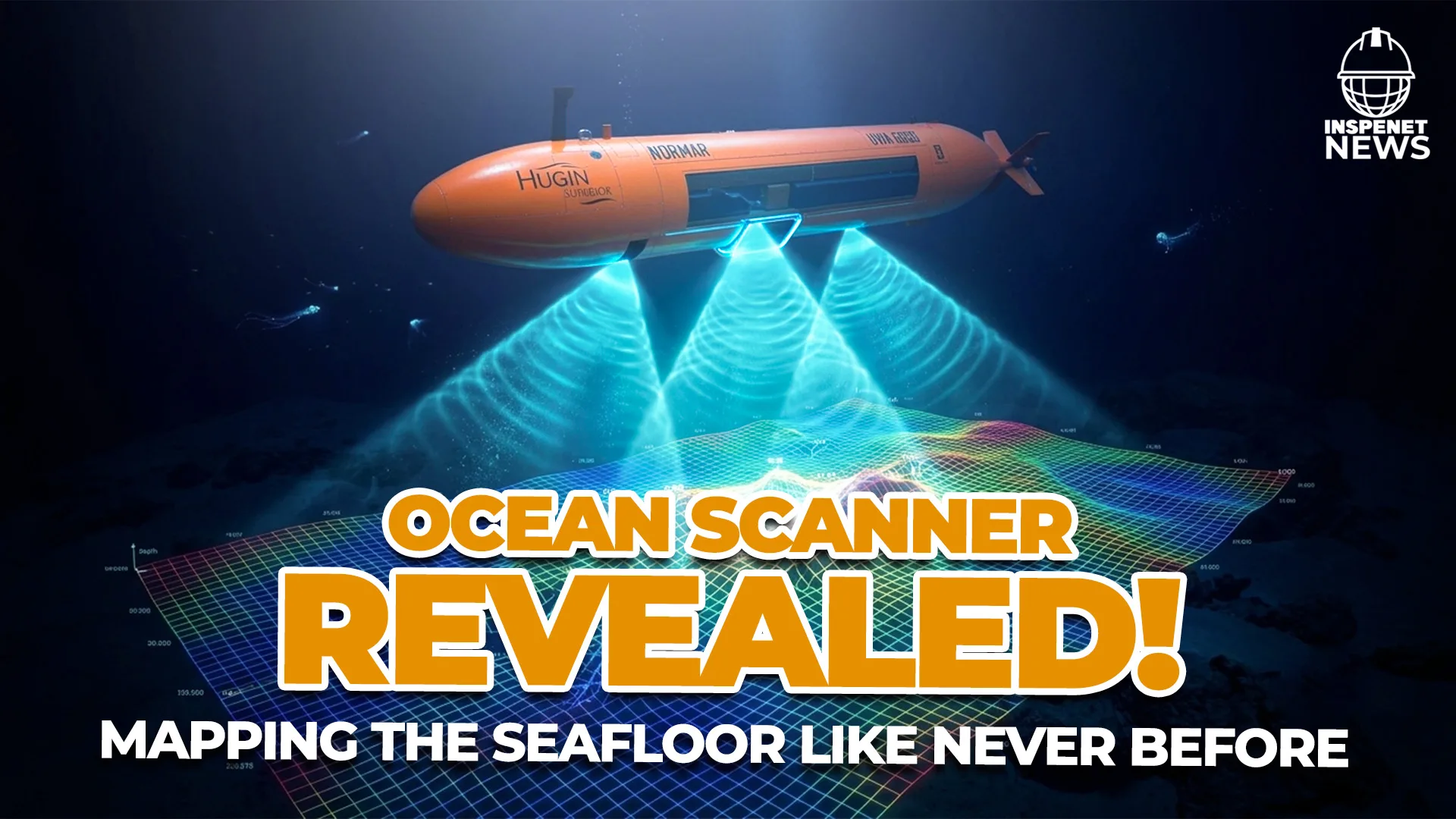
Norway deploys autonomous underwater vehicle for deep waters
The first mission of an autonomous underwater vehicle in the Norwegian Sea marks a new era in ocean floor data collection . Thanks to this technology, Norway aims to expand its knowledge of its deep waters and strengthen the management of these environments through information obtained directly by public agencies.
The first deployment of an AUV marks a new advance
Recently, the Norwegian Directorate of Maritime Operations completed the first expedition of its new autonomous underwater vehicle, a platform designed to conduct detailed studies of the seabed in extreme conditions.
The mission took place in the northern Norwegian Sea and represents a significant step for the country's authorities. Until now, much of the advanced mapping work was carried out by external companies. With the implementation of this system, Norway will be able to generate a significant portion of its strategic information using its own resources.
Authorities also hope that the data obtained will contribute to expanding the available scientific base on deep-water areas and allow for a better understanding of the characteristics of these ecosystems.
From manual measurements to advanced underwater mapping
The exploration of the seabed has undergone a remarkable transformation since the 19th century. At that time, depth measurements were taken using weights and ropes, which offered a limited view of the conditions below the surface.
Subsequently, the development of multibeam echosounders allowed for more precise imaging of the underwater topography. These tools remain essential for deep-sea mapping conducted from specialized vessels.
However, technological advances have driven the use of autonomous platforms capable of approaching the seabed and capturing information with a much higher level of detail than is available through traditional methods.
A vehicle prepared to operate at 6,000 meters
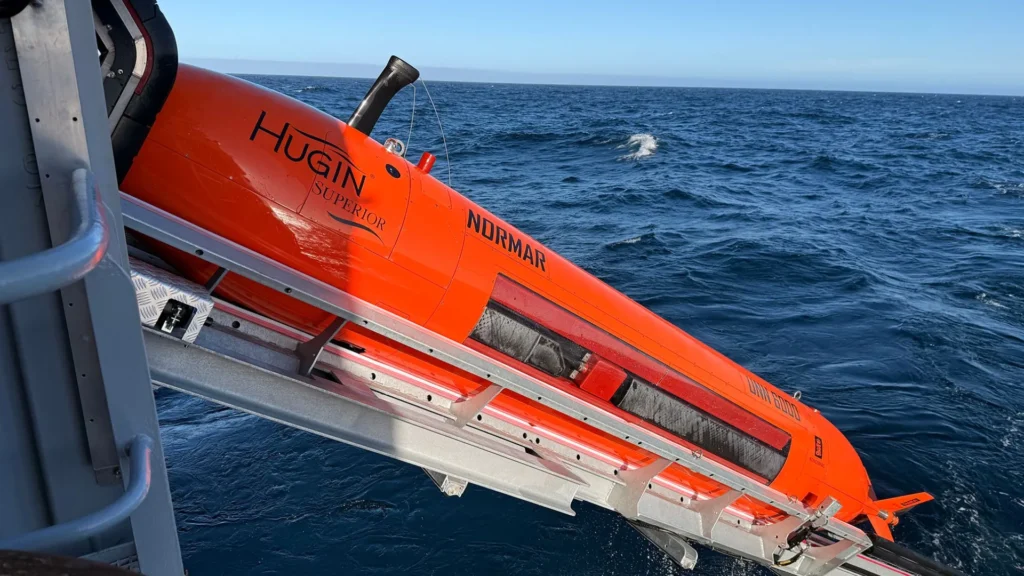
The system incorporated by Norway corresponds to the HUGIN Superior model, an AUV designed to work in some of the deepest areas of the ocean.
Thanks to its operational capabilities, the vehicle can descend to depths of up to 6,000 meters and collect high-resolution data on the underwater geography . It does this using sonar-based technology, which allows it to detect structures and objects by emitting and receiving acoustic waves.
Similar to the orientation mechanisms used by certain animal species, the team interprets the echoes generated by these signals to build detailed representations of the surrounding environment.
Furthermore, this capability facilitates the identification of geological formations, terrain features, and other elements relevant to marine research.
A strategic commitment to ocean exploration
The acquisition of the vehicle was financed by the Norwegian Ministry of Energy and managed through the Norwegian Directorate of Offshore Platforms.
Furthermore, the technical operation will be managed by the Norwegian Centre for Marine Data (NORMAR), an organization affiliated with the University of Bergen. This collaboration brings together scientific, technological, and governmental capabilities to strengthen the study of deep-sea areas.
Having our own autonomous underwater vehicle will also allow for greater continuity in research campaigns and more flexible planning of future expeditions.
The data will bolster deep-sea exploration
As the collected data increases, authorities hope to build a more comprehensive picture of Norway's deep waters. The new records can be used for scientific studies, environmental analyses, and assessments related to the sustainable management of marine resources.
Meanwhile, the start of AUV operations demonstrates how technology is transforming ocean exploration . What began over a century ago with simple depth measurements has now become an activity capable of generating detailed maps and highly accurate data from some of the most remote points on the seabed.
News of additional interest
INEOS will close its polystyrene plant in Illinois
INEOS Styrolution announced the permanent closure of its polystyrene production plant in Channahon, Illinois, a facility with the capacity to produce approximately 400,000 metric tons per year and employing about 100 workers. The company expects to complete the closure and decommissioning process during the fourth quarter of 2026.
The company explained that the decision is a response to pressure on profit margins caused by oversupply in the North American market. As part of a reorganization of its operations, INEOS will concentrate polystyrene production at its plants in Decatur, Alabama, and Altamira, Mexico. Despite the closure, the company assured that it will continue to supply its customers and will maintain its regional development and innovation center in Channahon.
Venture Global expands LNG supply to Germany
Venture Global and German energy company EnBW have signed new binding agreements for the supply of approximately 0.82 million tons of liquefied natural gas annually for about five years starting in 2026. The fuel will come from Venture Global's project pipeline and will complement the long-term contracts that both companies already have for 2 million tons annually for 20 years.
The companies emphasized that this new agreement strengthens an already established business relationship and responds to the evolving needs of the energy market. Venture Global, one of the largest LNG exporters in the United States, seeks to leverage its production and marketing capabilities to offer contracts with varying supply horizons, from short to long term.
New plant will transform CO₂ emissions into useful products
Australia will launch a new pilot carbon capture and utilization plant in Newcastle with the aim of transforming industrial emissions into raw materials for various production sectors. The project, developed by MCi Carbon at Orica's facilities on Kooragang Island, will capture carbon dioxide generated during ammonia production and convert it into compounds used in the manufacture of concrete, plasterboard, glass, and paper.
The facility will have the capacity to capture up to 1,000 tons of CO₂ per year and produce around 10,000 tons of materials such as magnesium carbonate, calcium carbonate, and amorphous silica. The initiative received $14.5 million in funding from the Australian Government through its carbon capture technologies program and will serve to test this technology under real-world industrial conditions.
50Hertz bets on German technology to connect offshore wind farms
German electricity operator 50Hertz has awarded a contract to a consortium formed by Siemens Energy and Neptun Smulders Offshore Renewables (NSORe) to supply a marine converter system to connect North Sea wind farms to the German electricity grid. The project includes an offshore converter platform and an onshore converter station, while discussions continue regarding the addition of a second system.
The initiative is notable for being the first to utilize marine converter platforms of the new two-gigawatt standard, manufactured primarily in Germany. Some of the key components will be produced in Rostock-Warnemünde, strengthening the local industry's involvement in the development of strategic energy infrastructure. If the planned expansion materializes, NSORe's revenue could reach approximately €2.5 billion.