During the PANNDT Conference in Niagara Falls, Neal Couture, CEO of ASNT (American Society for Nondestructive Testing), shared with the Inspenet team how the organization is rapidly evolving to respond to current challenges in the NDT sector. His account revealed an approach that combines political action, technological innovation and a clear vision to address the technical talent crisis.
Neal Couture did not follow a traditional path to leadership at NDT, as a former military officer, he went through the aerospace industryprofessional associations, professional associations, and university teaching before joining ASNT in 2019. This outside perspective allowed him to identify opportunities that the NDT sector had traditionally overlooked.
I have not been involved in nondestructive testing. In fact, I started in the military. I'm a former military officer and went through the aerospace and defense industry. Then I went from industry to association management.
Neal Couture.
His arrival at the association coincided with the pandemic and with only a few months in office, he had to lead a forced transition to digital. This accelerated adaptation laid the foundations for a more agile and modern technical association.
One of the most significant moves in Couture's tenure was the opening of the Washington, D.C. office. In its first fly-in day, ASNT brought together 45 members to hold more than 150 meetings with members of Congress and their staffs, with the aim of raising awareness of the value of nondestructive testing in safety, health and infrastructure. Couture also stressed that the next step is to influence agencies such as the NRC (Nuclear Regulatory Commission), where the association is already beginning to have an impact.
One of the things we have learned is that no one in Washington, D.C. knows what NDT is. [...] But one of our missions is to inform and educate.
Neal Couture.
Artificial intelligence is transforming the NDT sector, and ASNT has decided to anticipate it with concrete actions. Recently, the organization published a draft standard to regulate the use of AI in nondestructive testing, where guidelines are established to validate algorithms, avoid automated decisions without human supervision and maintain process traceability.
This new standard is part of a broader strategy known as NDE 4.0, which defines the evolution of NDT towards digital and interconnected environments. Its pillars include:
On the other hand, Neal Couture argues that the NDT sector is experiencing a talent crisis that can no longer be attributed simply to a lack of promotion or attractiveness to young people. The problem lies in the fact that there are fewer people available to fill technical positions in general, not just for non-destructive testing, but also in welding, metallurgy, electrical or industrial maintenance.
According to ASNT's internal estimates, there are currently more than 100,000 unfilled vacancies in the NDT industry in the United States alone, but this is not limited to the U.S. context alone; countries in Europe, Asia and Latin America are also facing similar difficulties. This is a demographic issue, as the technical workforce is aging rapidly and there are fewer young people interested or available to replace retiring generations.
In the face of this crisis, Couture points out that, although the association cannot solve the problem on its own, it is in a position to play an articulating role. Its strategic actions include:
We have been talking about workforce for 20 years. There are not enough people for any field because of demographics. [...] So when we ask: how do we get young people into this field? The real answer is: how do we get everyone into this field? Because there simply aren't enough young people to meet the demand for all the fields, whether it's welding, NDT, or any other field.
Neal Couture.
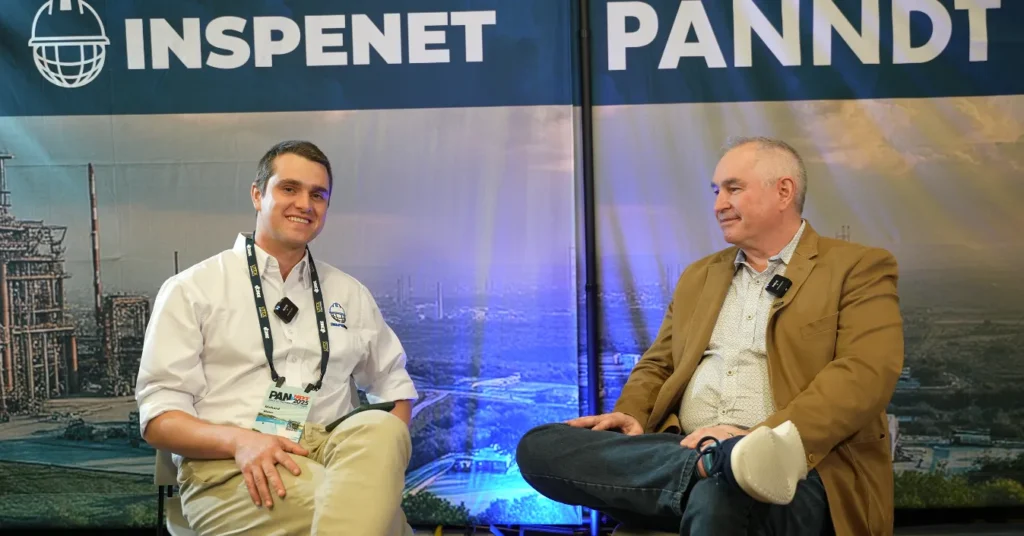
Looking ahead, Couture highlighted the importance of ASNT's next major event, the October conference in Orlando, Florida, where one of the focuses will be the revision of the SNT-TC-1A document, essential for employer-based certification systems. The integration of emerging technologies into daily practice will also be discussed in depth.
Since its foundation in 1941, ASNT has been a major player in the development of nondestructive testing, with contributions such as the publication of SNT-TC-1A in 1966 and the creation of Level 3 certification a decade later. Today, under the leadership of Neal Couture, the organization is writing a new chapter.
The NDT sector faces urgent challenges such as adapting to digitalization and closing talent gaps, which is why the association is responding with strategic vision, direct action and global collaboration.
For more content on PANNDT 2025, visit our LinkedIn profile.
Source: Inspenet.