
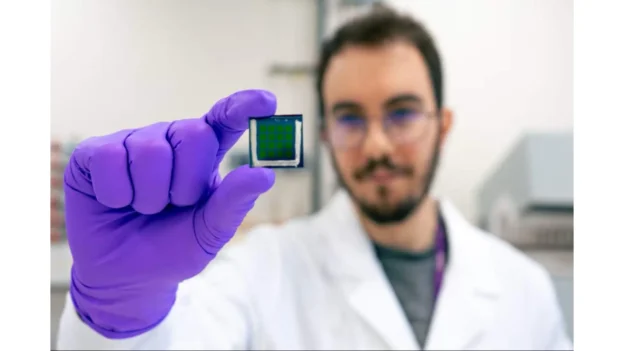
Researchers at the International Institute of Nanotechnology (INL), in collaboration with Uppsala University, succeeded in designing a nanometer mirror that improves the performance of ultrathin solar cells, a promising technology for flexible or portable applications.
How does the nanometer mirror work?
Ultra-thin solar cells are solar panels much thinner and easier to manufacture than conventional ones, however, because they are so thin, they capture less sunlight and lose some of the energy from the back side, which drastically reduces their performance.
To solve this problem, the INL researchers created a nanostructured back contact, that is, a base or mirror on the back of the solar cell, but with a microscopic design. The contact is made of an ultrathin gold layer patterned with a special technique and then encapsulated with aluminum oxide.
This works so that light that was not absorbed on its first pass through the cell hits this gold mirror and is returned to the absorber layer, giving it a second chance to be captured and converted into electricity. The aluminum oxide acts as a shield that reduces the energy losses that occur at the contact surface between materials, making the cell more efficient.
Results: efficiency improved by 1.5 %.
By applying this architecture to ACIGS-type solar cells (an advanced material), the light-to-electricity conversion efficiency increased by an absolute 1.5%, a very significant breakthrough in this field.
The system also demonstrated high compatibility with low-temperature processes (450 °C), which is crucial for maintaining integrity on flexible substrates and avoiding material diffusion that often occurs in metallic layers such as gold.
Research supported by European funds
The study was conducted under the R2U Technologies project, funded by the Portuguese Recovery and Resilience Plan through the NextGenerationEU fund, together with four individual grants from the Fundação para a Ciência e a Tecnologia (FCT).
Thanks to this development, the photovoltaic photovoltaic industry could have more efficient, thinner, lighter solar cells that are compatible with curved or flexible surfaces. This would open up new opportunities for applications in portable technology, transportation, architecture and other areas where weight, thickness and adaptability are key.