
Subsurface characterization defines corridor viability
The development of Fugro’s Delta-Rhine Corridor West (DRC West) in the Netherlands marks a strategic advance in integrated energy infrastructure, with a technical focus on subsurface characterization. This project will not only transport hydrogen but also captured CO₂, consolidating a dual model of industrial decarbonization.
In the context of the energy transition, advanced geotechnical studies along 70 kilometers are crucial, where precision in understanding the terrain will be decisive in ensuring the structural integrity of the pipelines. This phase defines critical parameters such as bearing capacity, differential settlements, and hydrogeological behavior.
From a technical perspective, this approach reduces uncertainty in detailed design stages, especially for multi-product infrastructures. The interaction between hydrogen transport, with embrittlement risks, and CO₂, with variable pressure conditions, demands highly controlled geomechanical conditions.
In-situ tests optimize design and reduce risks
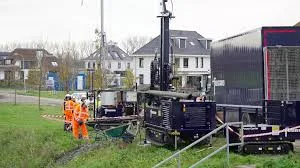
The work led by Fugro includes cone penetration tests (CPT), mechanical drilling, and groundwater level monitoring, generating a detailed model of subsurface behavior under real conditions.
These tests allow for the identification of stratigraphic variations, low-strength zones, and potential groundwater flow paths. This information is key to defining construction techniques such as horizontal directional drilling (HDD), especially in complex crossings.
The differential technical value lies in integrating geotechnical and geophysical data into predictive models, which allows for optimizing routes and minimizing risks during construction and operation, reducing costs associated with failures or redesigns.
Hollands Diep crossing demands advanced geophysical analysis
One of the critical points of the project is the crossing of the Hollands Diep, a highly trafficked waterway that introduces additional challenges in terms of bed stability and sedimentary dynamics.
To address this challenge, Fugro is conducting high-resolution geophysical surveys to map the subsurface beneath the riverbed. This includes seismic reflectivity analysis and characterization of sedimentary layers.
This data is fundamental to prevent phenomena such as scour, loss of support, or structural failures in the pipeline, especially in scenarios of dynamic loads induced by maritime traffic.
Multi-fluid infrastructure drives decarbonization
The corridor, developed by Gasunie with the support of Sweco, will connect relevant industrial hubs between Rotterdam, Moerdijk, and Boxtel, facilitating both hydrogen transport and carbon capture and storage (CCS).
This model represents a shift in energy infrastructure by integrating energy vectors and emission mitigation systems within the same physical corridor. From an engineering perspective, it involves designing systems capable of operating under different thermodynamic and chemical conditions.
In technical terms, the consolidation of geotechnical, environmental, and archaeological studies enables comprehensive project planning, ensuring not only structural viability but also regulatory compliance and long-term sustainability.
Source and Photo: https://www.fugro.com/news/