
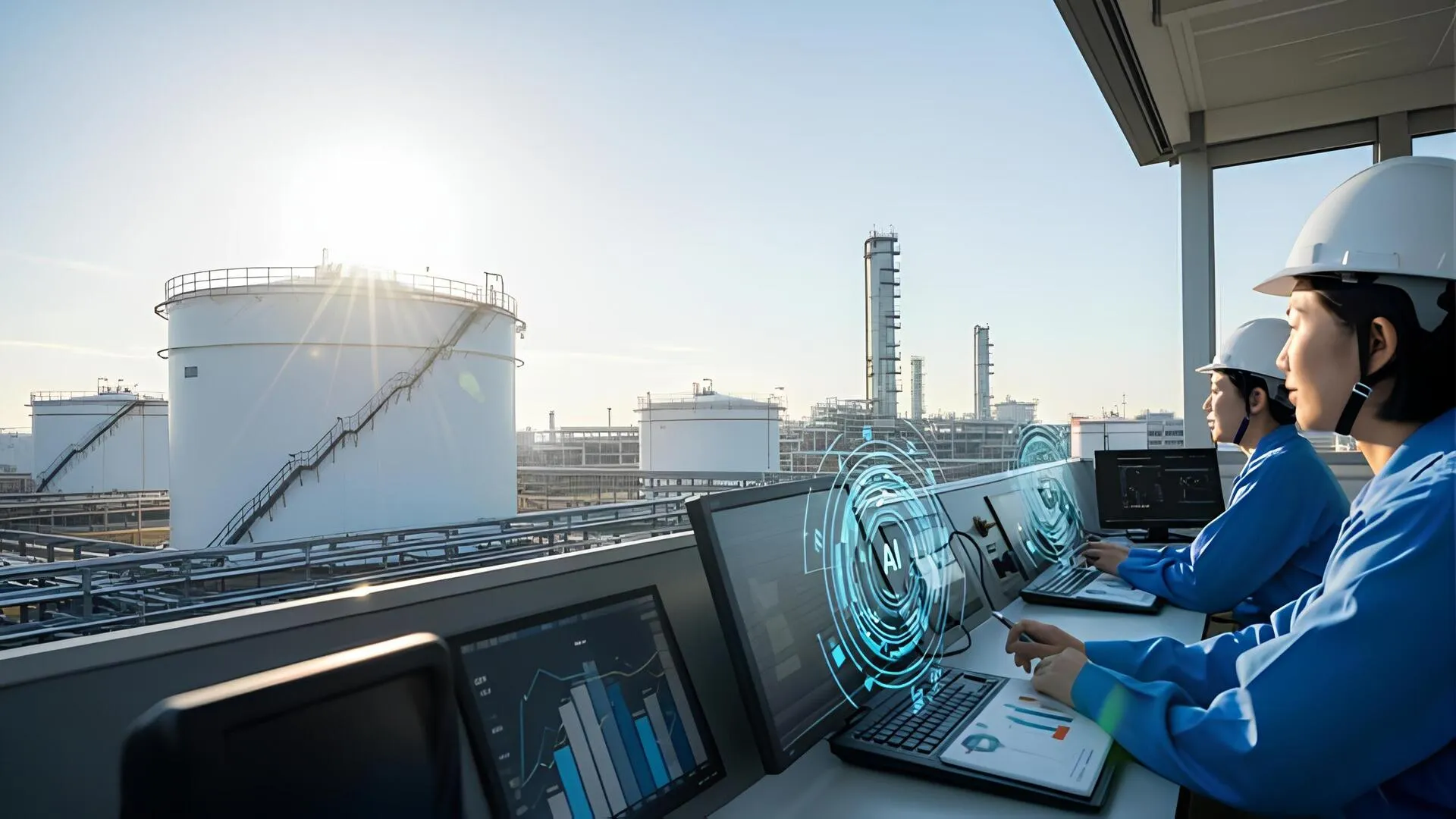
Storage tank inspection is essential for industrial continuity and safety. Tank integrity is imperative, yet traditional non-destructive testing (NDT) methods, based on costly fixed intervals, provide only a temporary snapshot. This limitation drives Digital Transformation.
The industry is shifting from reactive maintenance to continuous predictive maintenance. This progress is powered by the synergy between Digital Twins and Industrial AI-technologies that analyze degradation and model the asset’s future to anticipate failures. Let’s explore how this alliance redefines integrity management, optimizing both safety and efficiency.
From periodic NDT to continuous monitoring
The historically accepted inspection model is based on elapsed time, following industry codes such as API 653. While manual NDT methods (e.g., hammer testing, ultrasonic, or magnetic particle inspection on floors) are fundamental, their periodic nature poses a significant integrity risk. Between inspections, corrosion or pitting can progress silently to a critical point, compromising tank integrity.
Asset management and cost optimization processes worsen this challenge: taking a tank out of service is a complex logistical and financial exercise. The solution is not to inspect more frequently, but rather to inspect more intelligently and continuously.
This is where digitalization begins. The integration of IoT sensors, laser scanners, and drones with automated NDT transforms a static asset into a dynamic data source. This continuous data flow – the digitalization of every weld, every thickness change – is the foundation for shifting from rigid time-based inspection to automated predictive maintenance, allowing integrity to be actively managed rather than merely measured.
Digital twins and AI: The pillars of prediction
The true disruption in storage tank inspection lies in the implementation of two technological pillars: Digital Twins and Industrial Artificial Intelligence (AI). Together, they move tank integrity management from the physical to the virtual realm, enabling a holistic and predictive view of the industrial asset.
- Digital twins: The dynamic model
A Digital Twin is far more than a 3D model; it is a dynamic and living virtual replica of the tank, continuously fed with real-time data. This replica merges the original engineering design with operational data (temperature, level, vibration) and, crucially, both historical and current NDT results. For example, corrosion scan data from the tank floor is uploaded to the Twin to model the degradation rate.
The key benefit lies in its “what-if” analysis capability: engineers can simulate the impact of service changes or defect progression, enabling continuous and precise Remaining Useful Life (RUL) calculations.
- Industrial AI: From data to actionable decisions
Industrial AI is the analytical engine that powers the Digital Twin. Machine Learning algorithms are designed to process the vast amount of data generated by sensors and automated NDT systems. This AI can detect subtle degradation patterns or anomalies that escape human detection or predefined alarm thresholds.
The most powerful application is the shift from fault detection to fault prediction. AI correlates complex variables (e.g., temperature fluctuations with accelerated corrosion rates) and automatically generates risk alerts. This not only improves tank integrity but also enables predictive maintenance, optimizing every operational and inspection decision.
Predictive maintenance and integrity optimization
The culmination of the Digital Transformation in tank inspection is the adoption of predictive maintenance. By integrating Digital Twins with Industrial AI, the industry can finally move beyond the costly paradigm of time- based inspection.
Instead of inspecting a tank every X years, a dynamic Risk-Based Inspection (RBI) model is continuously recalculated. Industrial AI analyzes corrosion rates modeled by the Digital Twin, along with real-time data and automated NDT results, to accurately predict the optimal and safest time for the next intervention. This minimizes the risk of catastrophic failures and maximizes tank integrity.
The operational advantage is twofold: unplanned downtime is drastically reduced, and when a shutdown is scheduled, it is surgical and efficient, focusing directly on high-risk areas identified by the system. This creates a closed-loop integrity cycle: inspection data confirms the prediction, feeds the Digital Twin, and refines the AI algorithm, ensuring continuous improvement in tank integrity management.
Conclusion: The operational standard of the future
Digital Transformation has transcended the stage of mere promise to become the new operational standard for storage tank inspection. The fusion of Digital Twins and Industrial AI has built an infrastructure where tank integrity is managed proactively, not reactively.
We no longer rely solely on periodic NDT to detect damage; we use predictive intelligence to anticipate it.
The shift from time-based maintenance to predictive maintenance is not merely cost optimization, it represents an evolution in safety and reliability.
Companies that adopt these technologies will not only improve uptime but also establish a new level of environmental and operational responsibility.
The future of asset management is intelligent, continuous, and data-driven.
INSPENET is committed to leading this change!
This article was developed by specialist Mario Toyo and published as part of the seventh edition of Inspenet Brief February 2026, dedicated to technical content in the energy and industrial sector.