

Table of Contents
- When corrosion breaks the core assumption of the inspection program
- Critical assets where unplanned corrosion manifests first
- Other high-risk equipment where early degradation tends to appear
- From periodic inspections to continuous asset knowledge
- Real cases: when early detection changes the outcome
- Strategic implications for integrity, reliability, and operations
- Final reflection: corrosion does not warn, but it can be detected
- References
- Frequently Asked Questions (FAQs)
- Can unplanned corrosion occur even in recently inspected assets?
- How is unplanned corrosion different from normal process variability?
- Why do deadlegs remain a critical point even when they are identified in the inspection program?
- Does early detection replace traditional inspections?
- What is the main mistake when managing unplanned corrosion?
In most industrial facilities, asset integrity is managed through a formal inspection and maintenance program. This program, based on methodologies such as RBI, API standards, or internal integrity plans, defines which equipment is inspected, how often, and under what damage assumptions, based on the premise that degradation mechanisms are known and corrosion rates will remain within predictable ranges.
In the context of asset integrity management, the term unplanned corrosion does not imply a lack of control or failures in maintenance planning. Conceptually, it refers to an unforeseen degradation process that was not considered within the assumptions of the RBI analysis and that develops outside the intervals, rates, or damage mechanisms anticipated by the inspection program.
In practice, this means that corrosion may manifest between inspection campaigns, accelerate in an unanticipated manner, or be triggered under operating conditions different from those considered when the integrity strategy was defined. This type of degradation breaks the premise of predictable behavior and reduces safety margins before formal inspection systems can detect it.
Changes in operation, process chemistry, thermal patterns, or flow regimes can significantly alter the corrosive behavior of a system. When this occurs, corrosion does not wait for the next inspection campaign, turnaround (shutdowns), or scheduled review. It progresses silently, reducing safety margins in critical assets such as deadlegs, heat exchangers, columns, reactors, and auxiliary systems, where thermal and chemical transients can induce localized accelerations of unplanned corrosion.
This article examines why unplanned corrosion represents one of the most underestimated risks in industrial asset integrity, where it tends to appear first, and what real-world lessons have been learned by detecting these processes early, before they evolve into events, failures, or operational losses.
When corrosion breaks the core assumption of the inspection program
Every inspection program is built upon a set of technical assumptions that allow risk to be managed in a structured way. It is assumed that damage mechanisms have been identified, that corrosion rates are relatively stable, and that the defined inspection intervals will be sufficient to detect degradation before asset integrity is compromised. Under this approach, periodic inspection serves as a verification tool within a predictable operating scenario.
The problem arises when these assumptions are no longer valid. Changes in operation, variations in process chemistry, new thermal regimes, or modifications to flow patterns can radically alter corrosion behavior, generating acceleration that the program was not designed to capture. In such cases, corrosion does not evolve linearly or within the historical margins used to calculate remaining life.
The risk gap originates precisely in this mismatch between what the program expects and what the asset experiences in operation. While the plan remains valid on paper, degradation progresses between inspections, outside the defined intervals and without obvious signals to the operator. This is not a failure of the program itself, but rather an inherent limitation of any model based on static assumptions applied to dynamic and variable processes.
In these scenarios, RBI-based models can underestimate operational risk when corrosion accelerates in response to dynamic process changes. Even in well-designed programs, periodic inspection faces the challenge of capturing degradation that evolves between intervals, particularly when operating conditions cease to behave stably and predictably. In this context, operational approaches such as on-stream inspection programs emerged to reduce this uncertainty and enable inspection activities without shutting down the asset.
Critical assets where unplanned corrosion manifests first
Unplanned corrosion does not distribute uniformly across a facility. It tends to concentrate in critical industrial equipment where operational complexity, local variability, and inspection limitations converge. Industrial experience shows that certain assets act as true initiation points for accelerated damage.
The assets where unplanned corrosion most commonly manifests first are analyzed below. This is not an exhaustive list, but rather those pieces of equipment that, due to their configuration, operating conditions, and inspection limitations, tend to concentrate the earliest signs of accelerated degradation. In these systems, small changes in the process can generate disproportionate impacts if they are not detected early.
Deadlegs
Deadlegs are sections of piping or process branches where flow is nonexistent or very limited during normal operation. These areas can remain filled with stagnant fluid for long periods, creating favorable conditions for contaminant accumulation, chemical stratification, and the development of localized corrosion. For this reason, they represent one of the clearest examples of unplanned corrosion.
Over extended periods, deadlegs may appear to remain under control, with low corrosion rates and no visible signs of degradation. This initial stability often reinforces the perception of low risk, relegating them to a secondary priority within the inspection plan.
However, small operational changes can completely alter this balance. A variation in fluid composition, a new stagnation condition, a temperature change, or even minor operational adjustments can create a highly aggressive environment. In the absence of effective flow, phenomena such as stratification, contaminant buildup, or localized chemical differentiation are promoted, abruptly accelerating corrosion.
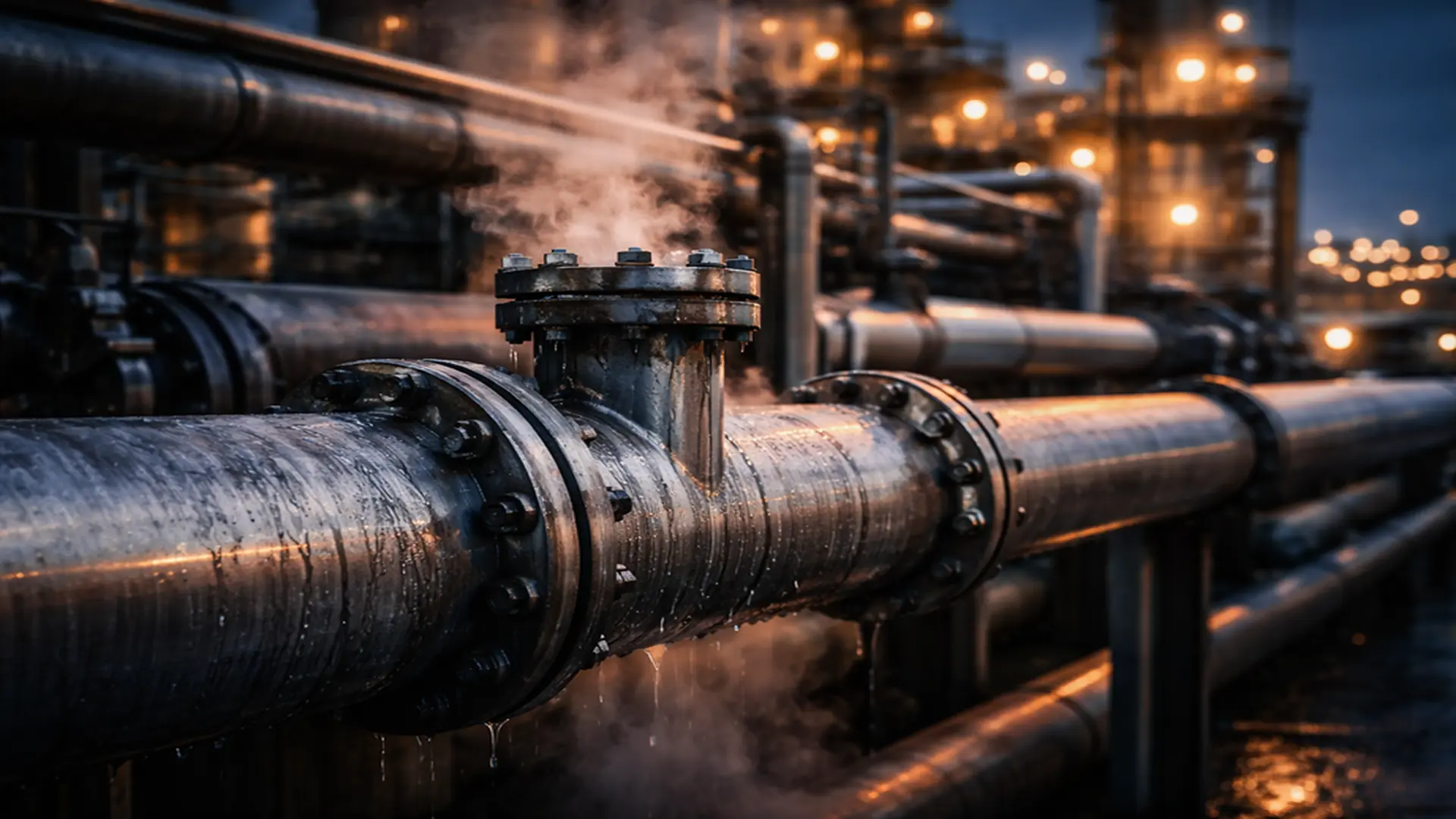
The result is degradation that progresses between inspections, with no correlation to the historical rates used for planning. Documented industrial cases show how deadlegs in pumping stations and process systems began to exhibit significant damage well before the next scheduled interval, allowing early detection only when continuous visibility into the asset’s actual behavior was available.
Heat exchangers
In heat exchangers, unplanned corrosion is often associated with highly dynamic local conditions. Internal micro-leaks, transient thermal changes, or unexpected condensation phenomena can create localized environments that are significantly more corrosive than the average conditions of the equipment. Degradation may progress silently across tubes, tube sheets, or shells, without becoming evident until damage has exceeded critical thresholds. In such scenarios, advanced heat exchanger inspection techniques make it possible to characterize the damage and anticipate failures.
Unlike other assets, these mechanisms can be intermittent and difficult to capture through conventional inspections, especially when the equipment operates continuously and shutdowns are infrequent. Degradation can advance silently in tubes, plates, or shells, without becoming evident until the damage has already exceeded critical thresholds.
Real cases in refineries and chemical plants have shown that early detection of these anomalies made it possible to identify the onset of accelerated corrosion before major leaks, safety events, or loss of containment occurred. In these scenarios, the damage did not follow the mechanical inspection schedule but instead responded directly to operational changes that altered the thermal and chemical balance of the system.
Columns and reactors
Columns and reactors are particularly sensitive to unplanned corrosion due to their direct dependence on the process regime. Changes in feedstock, adjustments to operating conditions, or an increase in the frequency of startups and shutdowns can significantly modify the active damage mechanisms.
Areas such as bottoms, nozzles, condensation zones, or regions with pronounced thermal gradients are usually the first to show accelerated degradation. In numerous instances, corrosion is not uniformly distributed, but instead concentrates at specific points that are not always accessible through external inspections.
Documented industrial experience shows unexpected increases in corrosion rates within reactors and columns, detected before the next turnaround through the early identification of anomalous trends. These cases demonstrate that when the process changes, corrosion responds immediately, without waiting for traditional inspection cycles or previously established maintenance plans.
Other high-risk equipment where early degradation tends to appear
In addition to the assets traditionally considered critical, there are other systems where early degradation tends to develop silently, outside the main focus of inspection programs. Their risk does not lie in the immediate severity of the damage, but in the difficulty of detecting incipient changes before they accumulate.
Cooling systems are a recurring example. They operate under conditions of high thermal variability, the presence of moisture, and, in numerous instances, fluids with high corrosive potential. Small deviations in temperature, flow rate, or water quality can generate localized corrosion, deposits, or under-deposit corrosion phenomena that evolve rapidly between inspections.
In degassing and venting systems, exposure to variable mixtures of gases, condensables, and contaminants creates highly unstable environments. These systems often experience intermittent cycles, changes in composition, and uncontrolled condensation, ideal conditions for accelerated corrosion mechanisms that are not always reflected in inspection histories.
Finally, low-throughput or intermittently operated lines represent an underestimated risk. Reduced flow velocity promotes stagnation, stratification, and the accumulation of corrosive phases. In these cases, degradation progresses outside design assumptions and without evident signals until the damage is already advanced.
From periodic inspections to continuous asset knowledge
The classical integrity model based on periodic inspections has, for decades, been a fundamental tool for managing corrosion. However, its main limitation lies in the fact that it provides discrete snapshots of the asset’s condition, separated by intervals that may be too long in the face of dynamic degradation processes.
Continuous monitoring techniques and automated NDT inspections add a different dimension: they capture how the asset evolves between intervals, enabling the early detection of deviations that would have gone unnoticed until the next inspection campaign. Far from replacing periodic inspection, this approach complements it and reduces uncertainty between cycles, where unplanned corrosion tends to consolidate.
When corrosion exhibits a non-linear behavior or responds rapidly to operational changes, the information obtained during the last inspection can lose validity in a short period. In these scenarios, the risk is not the lack of data, but making current decisions based on past information, assuming that conditions remain stable.
Early detection makes it possible to close this gap. By identifying trends, deviations, or incipient accelerations, time is gained to evaluate causes, adjust operations, and prioritize interventions before safety margins are compromised. Continuous corrosion monitoring provides the missing visibility between inspection intervals. It is not about replacing inspection, but about complementing it with continuous visibility of the asset’s actual behavior.
The key difference lies in moving from historical data, useful for retrospective analysis, to actionable data capable of influencing operational decisions in near real time. This shift transforms integrity management, enabling anticipation of damage rather than reacting once it has already become evident.

In industrial practice, this transition requires closing the gap between what is inspected in the field and what is actually managed within integrity systems. Digital inspection capture, traceability of findings, and operational close-out solutions, such as those demonstrated in AsInt’s ‘Mobile Inspection Management’ use case, illustrate how inspection data can be integrated into the decision-making flow without extending inspection cycles or compromising operational continuity.
The following video explains how the combination of periodic inspection, continuous monitoring, and automated NDT helps in the immediate detection of subtle deviations.
Real cases: when early detection changes the outcome
Industrial experience shows that the highest value of early detection lies not only in identifying corrosion, but in changing the outcome of asset management. In multiple facilities, the timely identification of incipient degradation made it possible to avoid premature replacements that would have been justified solely by uncertainty rather than by confirmed actual damage.
In several documented cases, anomalous increases in corrosion rates were detected shortly after operational or process changes. Industrial case studies in refinery process units have demonstrated similar patterns, where sulfidation and other high-temperature corrosion mechanisms accelerated unexpectedly following operational changes. In these scenarios, damage evolved between scheduled inspection intervals and became visible only when continuous monitoring or targeted inspection was performed.
Reference video: “Understanding Sulfidation Corrosion Case Studies,” by Mech Technical

Understanding sulfidation corrosion.
Without this early visibility, the usual response would have been to accelerate invasive inspections, advance shutdowns, or even plan the replacement of the affected equipment. Instead, the information obtained made it possible to correlate the damage with specific conditions, adjust operation, and stabilize corrosive behavior without compromising integrity.
Early detection has also proven to be key in event prevention. In assets such as deadlegs, heat exchangers, or process systems, identifying trends before critical thickness was reached prevented leaks, loss of containment, and unnecessary exposure to safety and environmental risks.
The real technical learnings extracted from these cases are consistent: unplanned corrosion rarely appears without prior signals. The challenge is not its existence, but the ability to recognize those signals in time and translate them into informed operational decisions. Experiences documented by organizations such as mPACT2WO show that when damage is detected early, the available options expand and the total cost of risk is significantly reduced.
Strategic implications for integrity, reliability, and operations
Early detection of unplanned corrosion has implications that go beyond the technical domain. It directly changes decision-making by shifting the focus from reacting to late findings toward anticipation based on the asset’s actual behavior. This makes it possible to decide with greater certainty when to intervene, when to monitor, and when to adjust operation.
This approach also promotes better alignment between areas. Integrity, reliability, operations, and maintenance share a common view supported by objective data, reducing isolated interpretations and decisions based on partial assumptions. The asset ceases to be the responsibility of a single discipline and becomes managed in an integrated manner.
From a modern risk management perspective, the most relevant benefit is the reduction of uncertainty. By having early and contextual information, risk ceases to be treated as an abstract probability and is managed as an observable and dynamic condition, reducing uncertainty in operational risk. This shift strengthens operational resilience and improves the ability to anticipate scenarios that would otherwise only become evident when the margin for action is already limited.
Final reflection: corrosion does not warn, but it can be detected
Unplanned corrosion is not an isolated anomaly nor the result of a specific poor practice. It is the natural consequence of operating industrial assets in dynamic environments, where processes change faster than any inspection program can anticipate. Deadlegs, heat exchangers, columns, reactors, and auxiliary systems demonstrate that degradation does not always follow linear paths nor respect the intervals defined on paper.
Throughout this analysis, it is clear that the risk does not lie in the existence of an inspection program, but in assuming that such a program is sufficient on its own in the face of inevitable operational, chemical, and thermal variations. When assumptions no longer hold, corrosion advances between inspections, reducing safety margins without generating evident alerts until the damage is already significant.
The real cases reviewed confirm that early detection changes the outcome. It not only allows failures, leaks, or environmental events to be avoided, but also enables more rational decision-making, deferral of unnecessary replacements, and more precise risk management, enabling risk reduction through informed operational decisions. The fundamental difference lies in moving from reactive management, based on historical data, to a continuous understanding of the asset’s actual behavior.
In an increasingly demanding industrial environment, the ability to recognize and act on unplanned corrosion ceases to be a technical advantage and becomes a key element of operational resilience and long-term sustainability.
References
- American Petroleum Institute. (2022). API Recommended Practice 580: Risk-Based Inspection (4th ed.). API Publishing.
- American Petroleum Institute. (2020). API Recommended Practice 571: Damage Mechanisms Affecting Fixed Equipment in the Refining Industry (3rd ed.). API Publishing.
- American Petroleum Institute. (2021). API Standard 570: Piping Inspection Code—In-service Inspection, Rating, Repair and Alteration of Piping Systems (4th ed.). API Publishing.
- American Petroleum Institute. (2020). API Recommended Practice 581: Risk-Based Inspection Methodology (3rd ed.). API Publishing.
- Fontana, M. G. (1987). Corrosion Engineering (3rd ed.). McGraw-Hill.
- Kovarik, T. (2018). Deadlegs: Understanding and Managing Corrosion Risk. Inspectioneering Journal, 24(3), 1–7.
- Jones, D. A. (1996). Principles and Prevention of Corrosion (2nd ed.). Prentice Hall.
Frequently Asked Questions (FAQs)
Can unplanned corrosion occur even in recently inspected assets?
Yes. A recent inspection only reflects the condition of the asset at a specific time. If operational, chemical, or thermal conditions change after the inspection, corrosion can develop between intervals, outside the assumptions used to define inspection frequency.
How is unplanned corrosion different from normal process variability?
The difference lies in the trend. Normal variability remains within known ranges, whereas unplanned corrosion shows sustained accelerations or patterns that do not match historical rates or the mechanisms anticipated in the integrity program.
Why do deadlegs remain a critical point even when they are identified in the inspection program?
Because their behavior can change abruptly. A deadleg may remain stable for years and, following even a minimal operational change, enter an accelerated corrosion regime that progresses between inspections without early visible signals.
Does early detection replace traditional inspections?
No. Early detection does not replace inspections; it complements them. Its value lies in providing continuous visibility between inspection campaigns, enabling the identification of incipient deviations and the focusing of resources where risk is truly evolving.
What is the main mistake when managing unplanned corrosion?
Assuming it will not occur because the inspection program is well designed. The error is not technical, but conceptual: relying on static assumptions in the face of dynamic processes. Experience shows that corrosion is better managed when its early signals are recognized and acted upon in time.