
Table of Contents
- What is a non-magnetic crawler and how does it work
- Industrial applications of non magnetic
- NDT techniques integrated into non magnetic crawlers
- Technical advantages over conventional manual
- Real-world limitations and operational challenges
- Technical selection criteria for non-magnetic crawlers
- Role of non-magnetic crawlers in asset integrity and RBI programs
- Regulatory acceptance and procedural validation of robotic NDT
- Technological trends in non-magnetic crawlers for NDT
- Conclusions
- Frequently Asked Questions (FAQs)
- In which cases is a non-magnetic crawler better than a magnetic one?
- How reliable are the data compared to manual inspection?
- Can they operate in humid environments or on coated surfaces?
- What training is required for personnel to operate these systems?
- How are crawler data integrated into integrity and RBI programs?
- References
Non-destructive testing (NDT) inspection in industrial environments is undergoing a structural transition: from manual, time-intensive methods with high personnel exposure, toward robotic solutions that enable greater coverage, repeatability, and risk control in field NDT inspection programs. Crawler robots have gained prominence in tank, structure, pipeline, and large-surface inspections by facilitating systematic data acquisition in hard-to-access areas.
However, traditional magnetic crawlers present a critical limitation: their dependence on clean ferromagnetic surfaces. In real assets, it is common to find coatings, paints, liners, surface corrosion, or non-ferromagnetic materials that reduce or nullify magnetic adhesion. This has driven the development of non-magnetic crawlers capable of operating on aluminum, stainless steel, advanced composite materials, and coated surfaces, significantly expanding the range of field applications.
Unlike traditional magnetic crawlers, these systems employ adhesion technologies based on suction (vacuum), high-friction traction, and hybrid solutions, allowing them to operate on aluminum, stainless steel, composite materials, and painted or coated surfaces, thereby significantly extending the operational scope of robotics applied to field NDT inspection.
From an asset integrity and mechanical integrity perspective, these robotic platforms help improve operational safety by reducing work at height and in confined spaces, increase productivity through repeatable inspection paths, and strengthen inspection data traceability in critical assets.
What is a non-magnetic crawler and how does it work
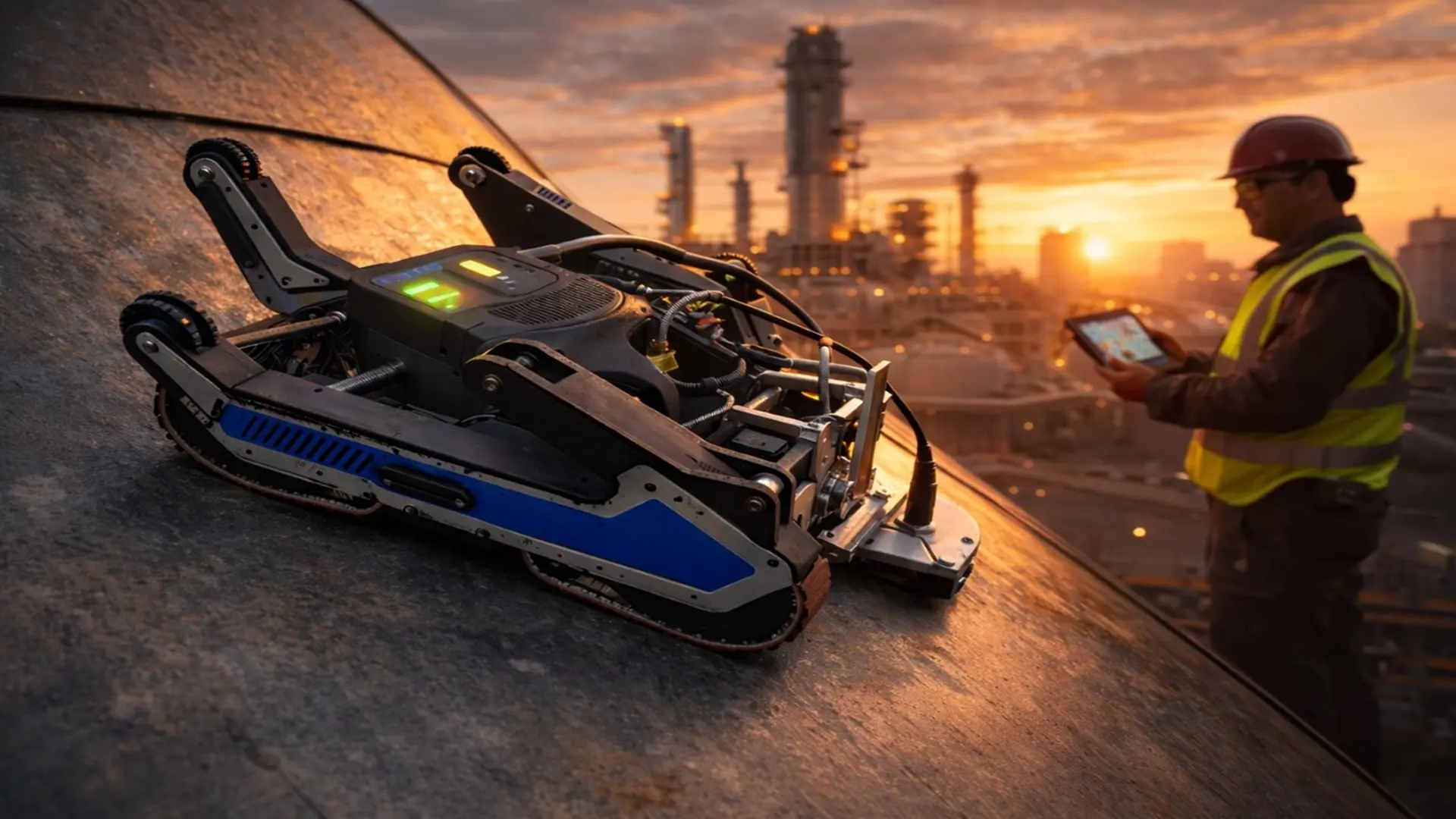
A non-magnetic crawler is a mobile robotic platform designed to move in a controlled manner over surfaces where magnetic adhesion is not viable or is ineffective. Unlike traditional crawlers, its operating principle does not rely on the magnetism of the substrate, which enables its use on assets made of aluminum, stainless steel, composite materials, or surfaces coated with paint, liners, or anticorrosion systems. These systems are intended to carry NDT sensors and execute repeatable scanning paths for systematic data acquisition, with a high level of geometric control and traceability.
Principle of mobility and adhesion
Mobility and adhesion mechanisms include vacuum suction systems, high-friction wheels, polymer track systems, and hybrid configurations that combine mechanical traction with assisted vacuum. Compared to magnetic crawlers, these systems offer greater surface versatility, although they require finer stability control, especially on vertical surfaces or pronounced curvatures. In terms of payload capacity, non-magnetic models typically optimize the weight of the NDT module to maintain adhesion without compromising maneuverability.
Typical system architecture
A non-magnetic crawler system integrates a robust mobile platform, an NDT inspection module (UT, PAUT, ECA, VT, among others), a remote control unit—either tethered or wireless—and positioning and navigation systems that enable data georeferencing, trajectory programming, and inspection repeatability.
Industrial applications of non magnetic
Non-magnetic crawlers have significantly expanded the scope of robotic inspection in NDT by enabling interventions on assets where magnetic adhesion systems are not viable. Their primary value lies in their ability to perform repeatable, safe inspections with high traceability on coated surfaces, non-ferromagnetic materials, and complex geometries, thereby reducing personnel exposure and enhancing the quality of technical data for mechanical integrity management.
Inspection of coated tanks and vessels
On tank bottoms with liners, coatings, and anticorrosion protection systems, non-magnetic crawlers enable inspections to be performed without removing coatings, thereby preserving the integrity of protective barriers. This is particularly relevant in predictive maintenance programs, where inspection under paint or coatings reduces shutdown times, coating reapplication costs, and risks associated with confined space work. The capability for systematic mapping supports early detection of generalized corrosion and wall thickness loss.
Non-ferromagnetic structures
In aluminum (aerospace and marine), stainless steel (chemical plants, LNG facilities), and composite materials used in energy and transportation assets, these robots enable inspections that previously required scaffolding, rope access, or partial disassembly. Controlled mobility over these surfaces expands inspection coverage and improves repeatability, providing more consistent data for condition assessment and fitness-for-service evaluations within asset integrity programs and long-term degradation monitoring strategies.
Complex surfaces and irregular geometries
Curved walls, geometric transitions, and vertical surfaces pose operational challenges for manual inspection. Non-magnetic crawlers facilitate access at height and in confined spaces, enabling the execution of programmed trajectories with geometric control. This enhances safety, standardizes data capture, and enables temporal comparisons within RBI scheme.
As a visual reference for these types of applications in complex geometries and restricted-access environments, there are demonstrations of crawler-type robotic platforms operating in industrial field conditions, illustrating controlled mobility and remote operation under real inspection scenarios. It is important to note that the platform shown below corresponds to a modular industrial inspection crawler; the adhesion technology may vary depending on the specific system configuration and the type of surface being inspected.

VersaTrax™: Multi-Mission Modular Inspection Crawlers
NDT techniques integrated into non magnetic crawlers
The integration of NDT techniques into non-magnetic crawlers transforms field inspection by combining robotic mobility with the repeatable and traceable acquisition of volumetric, surface, and visual data. In conventional ultrasonic testing (UT) and phased array ultrasonic testing (PAUT), these systems enable wall thickness measurements, detection of generalized corrosion, and mapping of material loss along controlled trajectories. Robotization reduces variability in transducer coupling and positioning, improving data consistency and facilitating temporal comparisons within mechanical integrity programs.
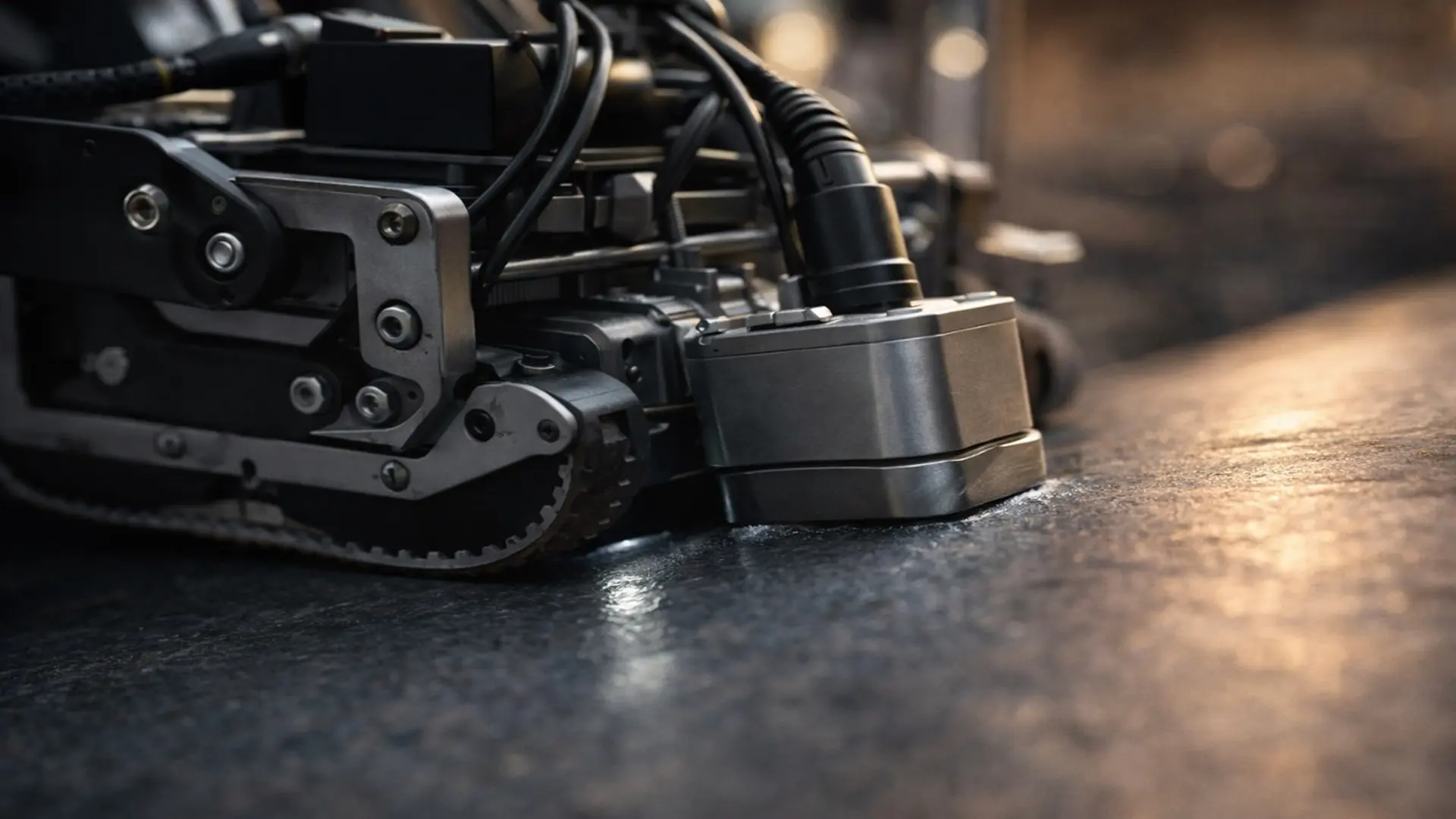
With eddy current array (ECA) techniques, non-magnetic crawlers enable the detection of corrosion under coatings and surface-breaking cracks in conductive materials, maintaining uniform scanning speed and contact pressure. This improves signal repeatability and reduces operator dependence, particularly on large or hard-to-access surfaces.
Remote visual inspection through digital VT, using HD cameras and integrated lighting systems, provides geometric context and visual inspection evidence to correlate indications detected by UT/PAUT or eddy current techniques The multimodal combination of techniques on a single platform increases inspection coverage and reduces uncertainty in damage assessment.
From an RBI and fitness-for-service perspective, robotics adds spatial traceability (positioning), route repeatability, and standardized acquisition parameters. This enables the creation of digital baselines, monitoring degradation over time, and more robust maintenance decisions, with reduced personnel exposure and higher field productivity.
Technical advantages over conventional manual
The adoption of non-magnetic crawlers in NDT inspection offers clear technical advantages over traditional manual methods, particularly in complex industrial environments. First, it significantly reduces personnel exposure to risks associated with working at heights, confined spaces, hazardous atmospheres, or hot surfaces, improving safety performance and HSE compliance. By transferring physical presence to the robotic platform, the need for scaffolding, rope access, or special access systems is minimized.
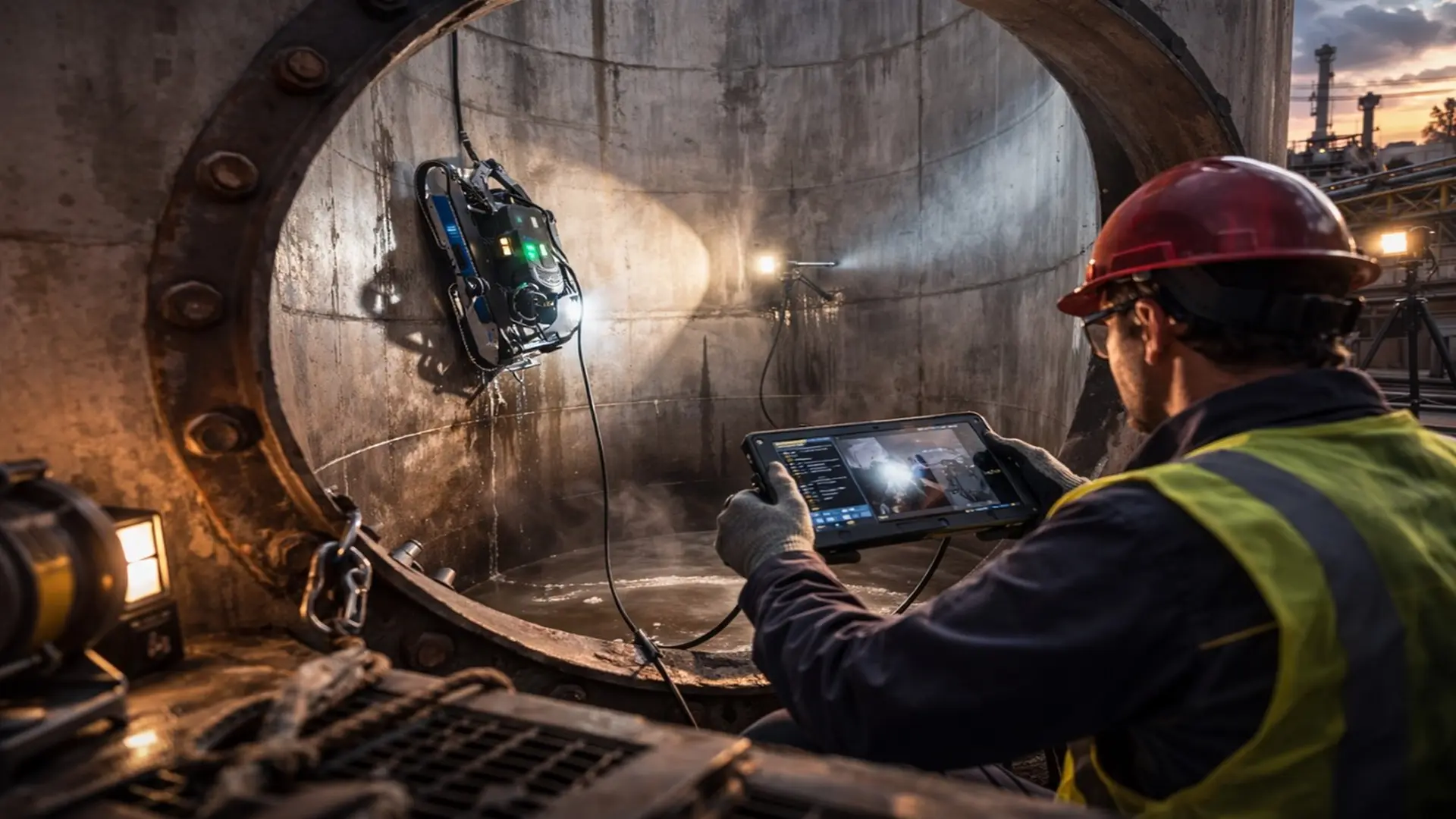
In terms of data quality, the controlled mobility of the crawler enables broader surface coverage with repeatable scanning paths and standardized acquisition parameters, resulting in more consistent and time-comparable data. This is a key factor for mechanical integrity programs and corrosion monitoring strategies.
Another major benefit is access to areas that are difficult or impractical for inspectors to reach, enabling remote inspection of large vertical surfaces, coated tank bottoms, or non-ferromagnetic structures in operation under live plant conditions. Additionally, native integration with digital inspection workflows enables traceability, structured storage of results, and analysis within asset management platforms. Ultimately, higher productivity and remote planning lead to reduced downtime on critical assets, thereby positively impacting operational availability.
Real-world limitations and operational challenges
Despite their advantages, non-magnetic crawlers present technical limitations that must be managed to ensure reliable field results. Their performance is highly dependent on surface conditions: high roughness, moisture, the presence of oils, dust, or deposits can affect traction, vacuum adhesion, and system stability, potentially compromising the quality of the acquired data. On vertical surfaces or pronounced curvatures, dynamic stability becomes critical and requires proper selection of the adhesion system, as well as appropriate speed and payload parameters to prevent slippage.
Energy autonomy and system weight condition the duration of inspection campaigns and crawler maneuverability, especially during extensive surveys or in remote locations. Tether management introduces range limitations and entanglement risks, while wireless operation depends on the robustness of communications and battery capacity. Finally, the learning curve of technical personnel is a non-negligible factor: effective operation requires specific training in robotics, integration of NDT sensors, and data management to avoid operational errors that could reduce the value of the technology.
Technical selection criteria for non-magnetic crawlers
When selecting a non-magnetic crawler for field NDT inspection, several technical criteria must be evaluated to ensure reliable performance and data quality. Surface condition is a primary factor: roughness, coating type, contamination (oil, dust, corrosion products), and moisture directly affect traction and suction efficiency. The geometry of the asset—curvature, inclination, and the presence of weld reinforcements, nozzles, or obstacles—defines mobility constraints and dictates the required adhesion margin and maneuverability.
Payload capacity and system weight must be balanced against adhesion performance, particularly when integrating UT, PAUT, or ECA modules that impose contact force requirements. Environmental conditions such as temperature, humidity, offshore exposure, and potential ATEX classifications also influence crawler design and material selection.
Finally, inspection resolution requirements and data traceability objectives should guide the choice of positioning systems, navigation accuracy, and integration with digital integrity management platforms. Selecting the appropriate crawler platform is therefore an engineering decision that must align asset characteristics, inspection objectives, and operational constraints.
Role of non-magnetic crawlers in asset integrity and RBI programs
Non-magnetic crawlers deliver value when they are coherently integrated into asset integrity programs and risk-based inspection (RBI) frameworks used for inspection planning and asset prioritization. Their ability to perform repetitive inspections with controlled trajectories makes it possible to establish digital condition baselines, facilitating the monitoring of corrosion and degradation over time. This repeatability improves the reliability of trend analysis and strengthens condition assessments that feed Risk-Based Inspection (RBI) models and risk management decision-making.
In practice, these systems do not fully replace traditional inspection techniques but rather complement them. The combination of robotics with selective manual inspection, conventional UT, direct VT, or other methodologies helps build a more comprehensive view of asset condition. In addition, integrating crawler-generated data into integrity management platforms enables more objective analysis to prioritize interventions, optimize maintenance windows, and move toward evidence-based predictive maintenance approaches, with a direct impact on safety, reliability, and operating costs.
For internal inspection of pipelines made of non-ferromagnetic materials or with coatings, mechanically expandable crawlers offer clear advantages over magnetic solutions. One example of this type of architecture is the VersaTrax™ Y-Series by Eddyfi Technologies, used as a platform to integrate UT, PAUT, or ECA within asset integrity and RBI programs.
Regulatory acceptance and procedural validation of robotic NDT
The effective use of non-magnetic crawlers in regulated industrial environments requires alignment with applicable inspection standards, client acceptance criteria, and internal quality management systems. While robotic platforms enhance data acquisition consistency, inspection procedures must be formally validated to demonstrate equivalence or superiority compared to conventional manual methods. This includes qualifications of scanning procedures, verification of positioning accuracy, calibration of NDT sensors, and documentation of data traceability.
In contexts governed by standards such as API, ASME, ISO, or client-specific integrity frameworks, robotic inspection workflows should be integrated into approved inspection procedures and risk-based inspection plans. Acceptance of crawler-acquired data for fitness-for-service evaluations, regulatory reporting, or life-extension decisions depends on demonstrating repeatability, uncertainty control, and compliance with inspection codes. As robotic NDT adoption increases, the integration of these technologies into formal inspection governance frameworks becomes a critical success factor for their widespread industrial deployment.
Technological trends in non-magnetic crawlers for NDT
Automation and semi-autonomy
Recent developments point toward higher levels of automation in both mobility and inspection execution. Assisted navigation using inertial sensors, computer vision, and digital mapping enables the definition of programmable routes, the maintenance of repeatable trajectories, and reduced dependence on continuous manual control. This improves data consistency and decreases operational variability between inspection campaigns.
Integration with digital analytics
The progressive incorporation of AI algorithms for defect recognition and corrosion pattern assessment is transforming data post-processing. These systems enable the pre-classification of indications, prioritization of critical areas, and faster technical validation by certified personnel. At the same time, data management within asset integrity platforms enhances traceability, historical analysis, and integration with RBI and asset management programs.
Design oriented toward harsh environments
Manufacturers are increasingly focusing on greater mechanical robustness and environmental resistance. Sealed enclosures, tolerance to humidity, dust, and corrosive atmospheres, as well as stable operation in offshore environments and operating plants, expand the range of real field applications without compromising system reliability.
Typical use cases across industrial sectors
In Oil & Gas, non-magnetic crawlers are used for the inspection of tank bottoms with coatings, storage spheres, and protected pipelines, where magnetic systems are not viable. In the energy sector, their application extends to thermal power plants, renewable energy facilities, and hydroelectric plant components, enabling inspections on painted or non-ferromagnetic surfaces. In maritime and offshore environments, these robots support the assessment of hulls, decks, and non-magnetic structures under complex access conditions. In aerospace and heavy industry, they are used to inspect aluminum, stainless steel, and composite structures, providing digital traceability and reducing personnel exposure in high-risk environments.
Conclusions
Non-magnetic crawlers have moved beyond being an experimental solution to become a strategic technical tool within modern industrial inspection programs. Their value does not lie solely in the automation of movement, but in the engineering of their adhesion and traction systems—based on suction, controlled friction, or hybrid architectures—which enable operation on non-ferromagnetic, coated, or geometrically complex surfaces where magnetic robotics is not viable.
Their adoption makes the most sense in scenarios with access restrictions, high safety requirements, the need for data repeatability, and digital traceability demands within mechanical integrity and RBI programs. They do not fully replace manual techniques or other robotic approaches, but they concretely expand the operational reach of field NDT. The key is selecting the appropriate technology according to the asset, the operating environment, and the inspection objective.
Frequently Asked Questions (FAQs)
In which cases is a non-magnetic crawler better than a magnetic one?
A non-magnetic crawler is superior when the surface to be inspected is non-ferromagnetic (aluminum, stainless steel, composite materials) or when coatings, paints, liners, or anticorrosion protections prevent effective magnetic adhesion. It is also more suitable for assets where surface cleaning is limited or where removing coatings is not feasible for operational, integrity, or cost reasons.
How reliable are the data compared to manual inspection?
Reliability is high when the system is properly calibrated and operated under validated procedures. Non-magnetic crawlers offer advantages in repeatability, systematic coverage, and reduction of the human factor, improving data consistency compared to spot manual inspections. In addition, the integration of UT, PAUT, or ECA enables the generation of condition maps that are more representative of the asset’s actual state.
Can they operate in humid environments or on coated surfaces?
Yes, with technical considerations. Suction-based and friction-traction systems are designed to tolerate moderate humidity and operate on industrial coatings, provided manufacturer design limits are respected. In environments with condensation, very rough surfaces, or heavy contamination, crawler stability should be assessed in advance through field trials.
What training is required for personnel to operate these systems?
Personnel must hold NDT certification in the applied technique (UT, PAUT, ECA, VT) and receive specific training in robotic operation, system configuration, adhesion control, and digital data management. It is not simply about “moving a robot,” but about understanding how mobility parameters, suction pressure, or traction affect the quality of the data obtained.
How are crawler data integrated into integrity and RBI programs?
Data generated by non-magnetic crawlers are integrated into integrity management platforms through digital storage, traceability, and historical comparison systems. This enables the creation of baselines, monitoring corrosion progression or thickness loss over time, and feeding RBI analyses with more representative information, strengthening predictive maintenance decision-making.
References
- Eddyfi Technologies. (s. f.). Robotic inspection systems for NDT. Eddyfi Technologies. https://www.eddyfi.com/en/solutions/robotic-inspection
- American Society for Nondestructive Testing (ASNT). (s. f.). NDT handbook: Volume 7 – Ultrasonic testing. ASNT. https://www.asnt.org/Publications/Handbooks
- American Petroleum Institute (API). (2016). API recommended practice 580: Risk-based inspection (3rd ed.). American Petroleum Institute. https://www.api.org/products-and-services/standards/important-standards/rp-580
- American Petroleum Institute (API). (2016). API recommended practice 581: Risk-based inspection technology (3rd ed.). American Petroleum Institute. https://www.api.org/products-and-services/standards/important-standards/rp-581
- DNV. (s. f.). Robotics and digital inspection in asset integrity. DNV. https://www.dnv.com/oilgas/insights/robotics-drones-inspection.html
- Electric Power Research Institute (EPRI). (s. f.). Robotics for power plant inspection. EPRI. https://www.epri.com/research/products/000000003002020168