
Table of Contents
- Functions of monobuoys in modern maritime infrastructure
- Alternative fuels and their impact on offshore transfer
- Technical challenges in adapting monobuoys to alternative fuels
- Regulatory frameworks, standards, and the evolution toward new fuels
- Engineering solutions applicable to future adaptation
- Role of EPC engineering in the offshore energy transition
- What will monobuoys moorings look like in the next decade?
- Conclusions
- References
- Frequently asked questions (FAQs)
- What are the challenges of adapting monobuoys tanks to hydrogen and ammonia?
- What role do international organizations play in their standardization?
- Can current monobuoys operate with alternative fuels?
- Which clean fuels are viable for offshore transfer?
- What will be the first solutions for single-buoy moorings for new fuels?
The global energy transition, driven by maritime and land decarbonization goals, requires the development of the necessary infrastructure to handle low-carbon energy carriers. The transport and transfer of hydrogen, ammonia, methanol, and LNG require a combination of operational safety, volumetric efficiency, and long-term structural integrity, especially under cryogenic and chemical conditions that are more demanding than those of conventional hydrocarbons.
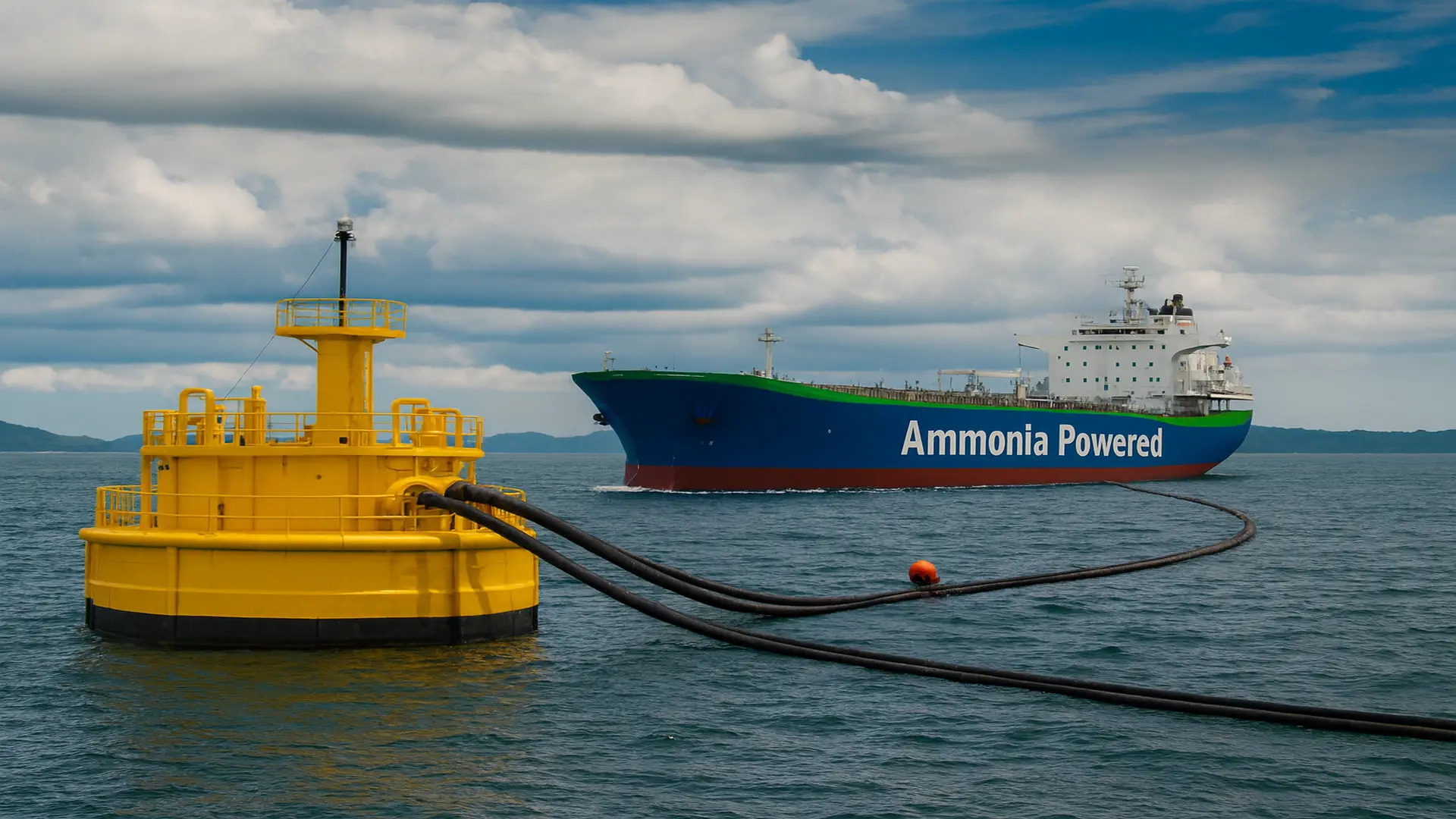
Calm-type monobuoys, the most widely used mooring technology for fluid transfer, are no longer an asset exclusive to hydrocarbon logistics, but have become a strategic element in the future offshore transfer of alternative fuels.
Technical management is based on adapting proven engineering to the cryogenic, toxicological, and corrosion requirements of these fluids. The next generation of single-buoy moorings will require technical changes to components such as hoses, swivels, transfer lines, and safety systems to ensure safe and reliable maritime transfer for sustainable fuels.
Functions of monobuoys in modern maritime infrastructure
Calm-type monobuoys, remain one of the most efficient and safest solutions for the offshore transfer of crude oil, derivatives, and LNG in areas where building a conventional dock is not feasible. This design allows for operation in dynamic conditions, absorbs mooring forces, and ensures stable transfer even in high-energy environments.
In the energy logistics chain, these structures significantly reduce loading and unloading times, allow deep-draft vessels to operate far from the coast, and increase operational availability compared to fixed terminals exposed to draft restrictions or port congestion. At the same time, their deployment minimizes the environmental footprint associated with extensive coastal works, as they concentrate the infrastructure at a floating point connected by underwater pipes.
If the energy transition requires new energy vectors, floating structural designs must be adapted to remain strategic nodes in maritime infrastructure and meet the safety and performance requirements of new fuels.
Alternative fuels and their impact on offshore transfer
The expansion of low-carbon fuels is creating new global logistics needs. These include:
- Liquefied Natural Gas (LNG): Widely transferred at coastal terminals and, to a lesser extent, offshore.
- Liquid hydrogen (LH₂) or compressed hydrogen: Temperatures close to –253 °C and severe risks of material embrittlement.
- Anhydrous ammonia (NH₃): A promising, toxic, and corrosive energy carrier, considered for mass hydrogen transport.
- Methanol and e-fuels: Easier to handle than pure hydrogen, but equally demanding in terms of chemical compatibility.
- Biofuels and advanced blends: Require materials resistant to aging and oxidation.
Currently, no large-scale commercial SPM system operates with pure hydrogen, but there are advanced concepts and designs for ammonia monobuoys and jetty-less solutions that use calm technologies as a basis. Experience with LNG and cryogenic terminals shows that adaptation is technically feasible.
LNG as a precursor to safe offshore transfer
LNG has served as a stepping stone for the transfer of cryogenic fluids at sea. Its handling requires hoses, swivels, and internal lines designed to withstand temperatures of –162 °C, high pressures, and strict evaporation controls. The engineering developed for LNG includes multi-layer thermal insulation, cryogenic materials, and specific operating protocols, which form the basis for the future transfer of ammonia and other clean fuels from monobuoys.
Technical challenges in adapting monobuoys to alternative fuels
Material compatibility and mechanical behavior
The use of alternative fuels generates risks that are different from those associated with traditional hydrocarbons. Hydrogen can induce embrittlement by diffusion, reducing the toughness of steels and welds; ammonia requires alloys that are resistant to stress corrosion; and the low temperatures of LNG and LH₂ require the incorporation of cryogenic materials such as nickel steels, austenitic stainless steels, or advanced composites.
Consequently, any future adaptation of these structures will have to consider the redesign of critical components such as swivels and turntables, internal lines and cryogenic hoses, as well as dynamic sealing systems, gaskets, elastomers, and bearings. It is not just a matter of “changing the fluid,” but also of resizing the system for new mechanical, thermal, and chemical load regimes.
Control of leaks and accidental emissions
Existing monobuoys have been designed and optimized for the transfer of hydrocarbons, where the dominant risk is associated with spills of flammable products. With alternative fuels, the risk profile changes: hydrogen has an extremely small molecule, with high permeability and a wide flammability range; ammonia combines acute toxicity with corrosion risk; and methanol or certain biofuels increase interaction with elastomers and coatings.
Future engineering will need to integrate double containment solutions in internal lines, passive barriers against leaks, and early detection systems based on specific sensors for each fluid, connected to OT/IT networks that trigger automatic responses. Natural and directed ventilation protocols, together with safe dispersion strategies, will be necessary to limit exposure of people and equipment.
Thermodynamics and operational stability
Cryogenic handling generates significant thermal contractions, thermal shocks during start-up, and ice or frost formation on exposed surfaces. These phenomena would affect the effective geometry of the single buoy, the behavior of bearings and swivels, and the dynamic alignment between the buoy and the vessel.
Future solutions point to multi-layer cryogenic insulation, low thermal conductivity coatings, and joints with adaptive tolerances that absorb differential displacements. Similarly, numerical models will need to capture the interaction between thermal load, hydrodynamic forces, and stresses on mooring elements.
Regulatory frameworks, standards, and the evolution toward new fuels
Although there is currently no specific standard for “monobuoys for hydrogen or ammonia,” there are regulatory frameworks that will serve as the basis for future regulation:
- The IMO’s IGC Code defines design and safety criteria for the maritime transport of liquefied gases.
- The OCIMF guidelines for SPM systems establish references for the design, operation, and maintenance of conventional monobuoys.
- Standards such as ISO 16904 and EN 1474 regulate aspects of cryogenic transfer (especially LNG).
- Existing standards for the storage and handling of refrigerated ammonia are used as a starting point for new offshore applications.
On this basis, classification societies have begun issuing Approvals in Principle (AiP) for CALM terminal concepts and jetty-less solutions specifically geared toward ammonia and other new fuels.
Engineering solutions applicable to future adaptation
The adaptation of CALM-type single buoys for alternative fuels requires redesigning not only hoses and swivels, but also the SPM system as a whole. This includes the PLEM, subsea pipelines, floating and subsea lines, cryogenic valves, and the Centerwell, all of which are subject to new thermal, chemical, and mechanical demands.
Hoses and transfer lines
The development of cryogenic hoses for LNG has demonstrated the feasibility of operating at extreme temperatures. Their evolution will need to incorporate chemical compatibility with ammonia and methanol, as well as embedded sensors that monitor pressure, temperature, and micro-leaks in real time.
Swivels and turntables
The swivel, the hydraulic core of the single buoy, will require alloys resistant to hydrogen embrittlement, multi-layer hybrid seals, and bearings designed for combined loads in cryogenic conditions. Redundant containment barriers will be essential to limit potential leak scenarios.
SPM system engineering
The PLEM and associated piping must use materials capable of withstanding stress corrosion, thermal contraction, and high pressure gradients. The integration of fail-safe shutdown systems (ERS/ESD) will allow the flow to be quickly isolated in the event of any operational anomaly.
Advanced monitoring
Distributed smart sensors, numerical models, and digital twins will enable real-time assessment of stresses, thermodynamics, and structural behavior, enabling predictive maintenance strategies and data-driven decisions.
Structural integrity
Operating with hydrogen, ammonia, or methanol requires evaluating embrittlement, thermal fatigue, and sorption effects on elastomers. This demands specific inspection criteria and RBI programs tailored to the failure modes specific to these fuels.
Role of EPC engineering in the offshore energy transition
The energy transition requires new EPC engineering solutions capable of designing, manufacturing, and implementing offshore infrastructure subject to increasingly rigorous safety, reliability, and performance requirements. Experience in SPM/CALM systems, floating terminals, and dockless technologies will be decisive in enabling the transfer of alternative fuels.
Specialized engineering in mooring, structural analysis, mechanical and process systems, as well as piping, valves, and critical equipment, becomes strategic to ensure that each terminal operates with integrity from design to operation. EPC companies focused on marine and offshore solutions, such as Seawing Company, which integrates design, equipment provision, installation, commissioning, and maintenance of CALM systems, provide the technical support necessary to modernize and prepare maritime infrastructure for new fuels.
This combination of capabilities in offshore engineering, field services, and lifecycle management will enable the transformation of conventional monobuoys into configurations ready to operate with transition fuels and clean energy vectors, reducing operational risks and enabling safe adoption on an industrial scale.
What will monobuoys moorings look like in the next decade?
The evolution of monobuoys mooring design is driven by commitments to energy transition and the sustainable energy market. In the next decade, offshore transfer terminals for sustainable fuels will be characterized by their autonomy, material resilience, and advanced digital integration. In the future, these structures will feature:
- Reinforced integrity: double- or triple-walled offshore transfer lines and swivels made of advanced metal alloys resistant to hydrogen embrittlement and ammonia corrosion.
- Modularized cryogenic systems: design of cryogenic components (for LNG or LH₂) in replaceable, vacuum-insulated modules.
- Operational digitization: use of digital twins for real-time simulation of loads, fatigue, and thermodynamics, enabling predictive maintenance and fine-tuning of offshore transfer protocols.
- Autonomous safety: integrated wireless and smart sensors for early leak detection and ESD/ERS systems activated by risk algorithms.
- Targeted ventilation: structures designed with natural and forced ventilation for the safe management of ammonia or hydrogen vapors.
Conclusions
The energy transition requires maritime infrastructure to evolve in order to safely handle new sustainable energy vectors. Calm-type monobuoys are an irreplaceable logistical asset, but adapting them to fuels such as ammonia and hydrogen poses complex technical challenges, particularly in cryogenics, material compatibility, and containment.
The path to safe offshore transfer is defined by innovation in swivels with redundant sealing, the development of cryogenic hoses, and the implementation of real-time monitoring systems aimed at early detection of leaks and abnormal conditions. Early validation through Approval in Principle (AiP) is important to mitigate risks and drive investment.
References
- https://www.offshore-energy.biz/dnv-greenlights-sbm-offshores-ammonia-terminal/
- https://www.offshore-energy.biz/dnv-approves-h2carriers-green-ammonia-floating-production-unit-design/
Frequently asked questions (FAQs)
What are the challenges of adapting monobuoys tanks to hydrogen and ammonia?
They focus on material compatibility, hydrogen embrittlement, cryogenics, NH₃ toxicity, seal permeability, and the need for double containment systems and early leak detection.
What role do international organizations play in their standardization?
They will define safety standards, containment requirements, operating distances, emergency systems, certification criteria, and training guidelines, structuring the framework that will allow these solutions to be deployed at scale.
Can current monobuoys operate with alternative fuels?
Not in their current configuration. Monobuoys designed for hydrocarbons do not have seals, materials, or containment systems suitable for hydrogen or ammonia.
Which clean fuels are viable for offshore transfer?
LNG and methanol are the closest candidates, as they rely on already known cryogenic and chemical handling technologies.
What will be the first solutions for single-buoy moorings for new fuels?
Probably improved cryogenic hoses, swivels with advanced alloys, smart monitoring systems, and double containment configurations initially applied to LNG, ammonia, and transition fuels, before reaching massive hydrogen applications.