
Table of Contents
- What is in-service underwater inspection?
- Technologies used in underwater inspection
- Underwater non-destructive testing (NDT)
- Structural monitoring sensors
- Critical zones for monitoring in marine installations
- In-service inspection strategies
- Collaboration in subsea projects and maintenance
- Importance of in-service underwater inspection
- Benefits of integrating advanced technology
- Challenges of underwater inspection
- Innovation and trends
- Conclusion
- References
Subsea structures are exposed to extreme conditions that affect their performance and longevity. Underwater inspection enables accurate assessment of the condition of platforms, pipelines, and submerged foundations without interrupting operation. By combining underwater inspection with ROVs, subsea robotics, and structural monitoring systems, it is possible to identify early signs of subsea corrosion, material fatigue, or deformation. This practice, together with underwater non-destructive testing (NDT) and underwater visual inspection (VT), provides critical data to plan maintenance, optimize resources, and ensure operational continuity while complying with standards such as API RP 2SIM.
What is in-service underwater inspection?
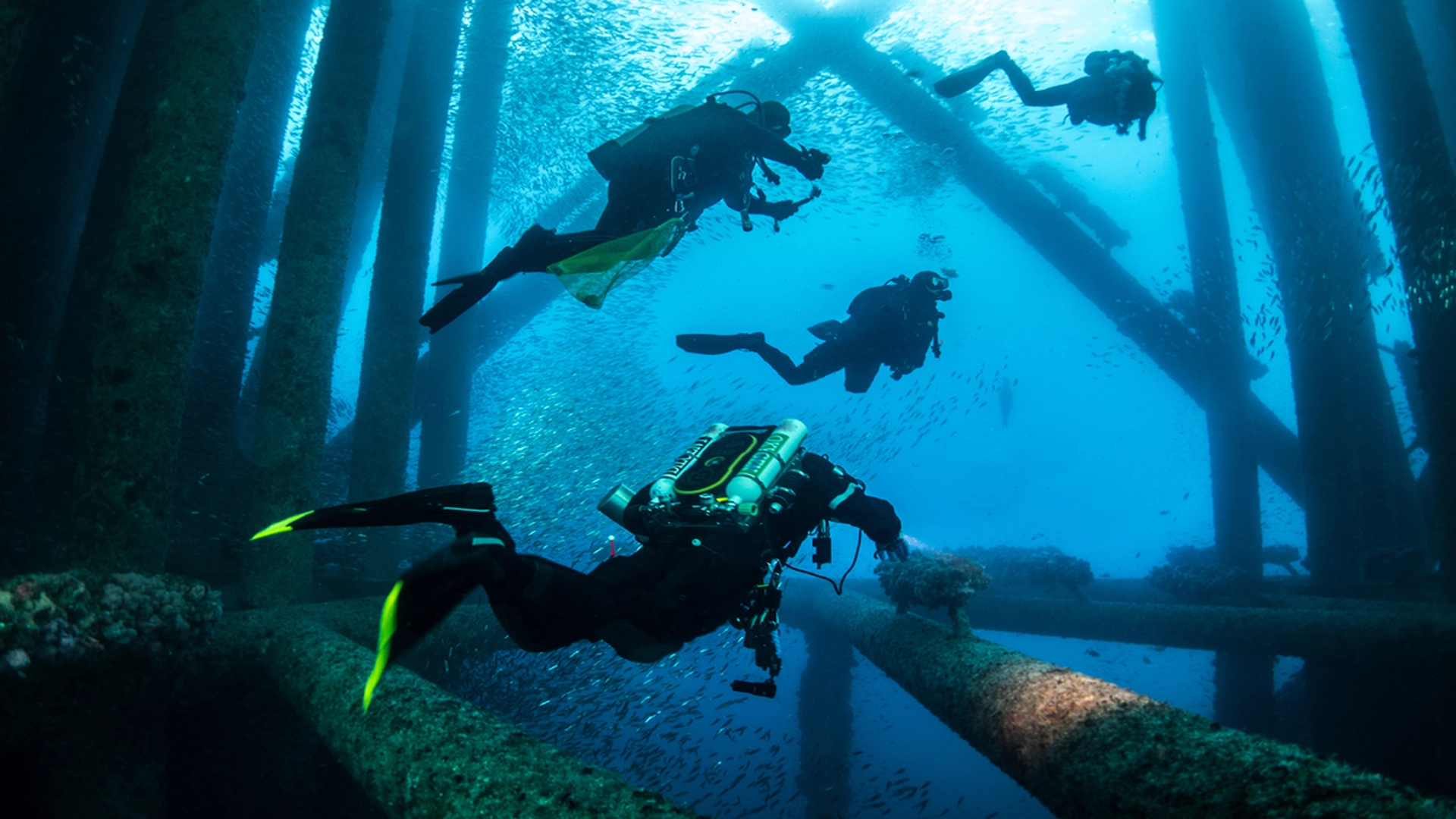
In-service underwater inspection consists of assessing the condition of submerged structures while they remain operational, avoiding the need to shut down critical processes. This approach is used across a wide range of installations, including:
- Offshore oil and gas platforms: submerged topsides, piles, and flowlines.
- Subsea pipelines and oil pipelines: welds, bends, and critical connections.
- Bridges and piers: piles and foundation decks.
- Marine energy installations: wind turbine foundations, anchoring systems, and submerged cables.
- Floating tanks and subsea storage systems: FPSOs, storage buoys, and submerged floats.
- Subsea flow stations (manifolds / FPS): which centralize hydrocarbons from multiple wells.
- Subsea production wells (Christmas trees, wellheads, and flowlines): critical points for hydrocarbon extraction and transport.
The primary objective is to ensure structural integrity against factors such as pressure, currents, sedimentation, biofouling, and subsea corrosion, enabling failures to be anticipated before they evolve into critical incidents. API RP 2SIM establishes inspection procedures and frequencies to maintain safety and reliability standards.
Technologies used in underwater inspection
Underwater inspection has evolved through the integration of advanced technologies that enable more accurate and safer assessments:
Underwater inspection with ROVs
ROVs (Remotely Operated Vehicles) are unmanned vehicles controlled from the surface. Equipped with high-definition cameras, ultrasonic sensors, thickness gauges, and intervention tools, they enable:
- Visual documentation of the condition of piles, welds, and subsea pipelines.
- Measurement of wall thickness and detection of internal cracks.
- Execution of minor repairs without the need for divers.
These capabilities make ROVs ideal for inspections of offshore platforms, subsea pipelines, flow stations, and subsea production wells.
Subsea robotics
Subsea robotics includes autonomous drones, manipulators, and hybrid vehicles that enable:
- Mapping of large subsea infrastructure areas.
- Execution of preventive maintenance tasks and deformation monitoring.
- Integration of structural monitoring sensors to detect subsea corrosion, fatigue, and mechanical failures.
Examples of applications include inspection of pier piles, wind turbine foundations, flowlines, and subsea wellheads.
Underwater non-destructive testing (NDT)
Underwater non-destructive testing (NDT) allows materials and structures to be evaluated without compromising their operation and is essential for maintaining structural integrity. Common techniques include:
- Underwater visual inspection (VT): a fast and cost-effective method that detects cracks, deformations, and corrosion using specialized divers or ROVs, complementing other NDT techniques.
- Ultrasonic testing (UT): measures thickness of pipelines, piles, and wellheads, detecting internal cracks and subsea corrosion.
- Underwater radiography: enables visualization of internal discontinuities, particularly in welds.
- Eddy current testing: identifies surface and near-surface defects in submerged metals.
These techniques are combined to generate a comprehensive structural diagnosis, guiding preventive interventions and optimizing in-service monitoring.
Structural monitoring sensors
Sensors enable continuous monitoring of deformations, vibrations, and subsea corrosion. This includes:
- Accelerometers to measure vibrations in piles and foundation decks.
- Corrosion sensors for pipelines, flow stations, and subsea production lines.
- Deformation sensors and strain gauges to assess fatigue in piles, foundations, and subsea Christmas trees.
Combining sensor data with visual inspection using ROVs or subsea robotics enables predictive maintenance strategies and optimization of asset service life.
Critical zones for monitoring in marine installations
The most vulnerable areas requiring priority attention include:
- Submerged piles and foundations: exposure to currents, biofouling, and structural fatigue.
- Welds and critical connections: stress concentration points and corrosion-prone areas.
- Foundations and anchoring systems: essential for the stability of platforms and turbines.
- Flowlines and subsea pipelines: risk of erosion, abrasion, and leaks.
- Impact or contact zones: collisions with vessels or equipment.
- Surfaces with biofouling: accelerate corrosion and obstruct flow.
- Submerged mechanical connections and valves: high stresses and contact with process fluids.
- Subsea flow stations (manifolds / FPS): risk of internal erosion and external corrosion.
- Subsea production wells (Christmas trees, wellheads, and flowlines): critical points for hydrocarbon extraction and transport.
In-service inspection strategies
To maximize the value of underwater inspection, the following are recommended:
- Detailed planning: define critical zones, objectives, and inspection frequency based on regulations and operational experience.
- Use of ROVs and subsea robotics: select platforms according to depth, structure type, and complexity.
- Integration of underwater NDT: combine ultrasonic testing, eddy current testing, and magnetic particle testing as required.
- Continuous monitoring: install deformation, corrosion, and vibration sensors for real-time tracking.
- Advanced data analysis: process information using specialized software to maintain structural integrity and plan predictive maintenance.
These strategies ensure that in-service inspection delivers tangible value and enhances the reliability of subsea installations.
Collaboration in subsea projects and maintenance
Maintenance and construction of subsea installations require collaboration among companies with expertise in engineering, construction, and operation of marine structures.
A notable example is Buzca S.A., with more than 50 years of experience in the Colombian Caribbean, specializing in marine and fluvial engineering, construction of piers, port terminals, and subsea pipelines, as well as industrial diving and underwater emergency response. Its participation in complex projects, such as structural reinforcements, EPC of subsea lines, and maritime terminals, complements the work of specialists in structural monitoring, underwater non-destructive testing (NDT), and subsea corrosion detection, contributing to the preservation of structural integrity.
Importance of in-service underwater inspection
Continuous monitoring of structural integrity provides strategic benefits:
- Early detection of subsea corrosion: prevents severe deterioration of piles, pipelines, welds, and wellheads.
- Operational safety: reduces exposure of divers and technicians to hazardous environments.
- Maintenance optimization: enables planning of interventions based on accurate data and avoidance of unexpected failures.
- Regulatory compliance: ensures conformity with international standards such as API RP 2SIM.
In critical installations such as offshore platforms, flow stations, and subsea production wells, in-service inspection allows operations to continue without interruption, reducing risks and costs.
Benefits of integrating advanced technology
- Safety: minimizes personnel exposure to hostile environments.
- Operational and economic efficiency: avoids prolonged and costly shutdowns.
- Documentation and traceability: facilitates audits and regulatory compliance.
- Predictive maintenance: enables anticipation of failures and prioritization of interventions based on risk.
Integrating data from sensors, ROVs, and underwater non-destructive testing (NDT) provides a comprehensive view of structural condition and strengthens evidence-based decision-making.
Challenges of underwater inspection
- Extreme environmental conditions: turbidity, strong currents, and low temperatures limit visibility and maneuverability.
- Depth and pressure: require specialized equipment resistant to high pressure.
- Structural complexity: complex geometries hinder full inspection coverage.
- Data management: large volumes of information require specialized software for analysis and storage.
These challenges drive the adoption of subsea robotics and the integration of underwater NDT, ensuring more reliable and safer inspections.
Innovation and trends
Current trends focus on automation and digitalization of underwater inspection:
- Autonomous underwater drones: cover large areas with minimal human intervention.
- Subsea IoT sensors: transmit real-time data on corrosion and deformation.
- Artificial intelligence: analyzes degradation patterns and predicts future failures.
- Digital simulation: enables anticipation of damage and optimization of maintenance programs.
The following video shows innovations that strengthen data-driven decision-making and improve operational efficiency in complex marine environments.
Conclusion
Continuous monitoring of structural integrity through underwater inspection transforms the management of platforms, pipelines, flow stations, and subsea production wells. Technologies such as ROVs, subsea robotics, underwater visual inspection (VT), and underwater non-destructive testing (NDT) enable detection of subsea corrosion and deformation before operations are compromised. Integrating structural monitoring and in-service maintenance strategies optimizes resources, ensures operational continuity, and guarantees compliance with standards such as API RP 2SIM.
References
- API. (2014). API Recommended Practice 2SIM: Structural Integrity Management of Fixed Offshore Structures. American Petroleum Institute.
- ISO. (2019). ISO 19901-9: Petroleum and natural gas industries – Specific requirements for offshore structures – Structural integrity management. International Organization for Standardization.
- Zhang, W., Zhu, K., Yang, Z., Ye, Y., Ding, J., & Gan, J. (2024). Development of an underwater detection robot for structures with pile foundations. Journal of Marine Science and Engineering, 12(7), 1051. https://doi.org/10.3390/jmse12071051