
Table of Contents
- What is a borescope and why is it essential in NDT?
- Types of borescopes used in industry
- How does a borescope work? Key technical principles
- Advantages of the modern borescope
- Critical applications of the borescope in NDT
- Borescopy in asset management and reliability
- Borescopy and its contribution to mechanical integrity
- Common errors in borescope inspections
- Success Case: USA Borescopes
- Technical comparison: borescope, videoscope, fiber optics
- Criteria for selecting industrial borescopes
- Technological trends in industrial borescopy
- Conclusions
- References
- Frequently Asked Questions (FAQs)
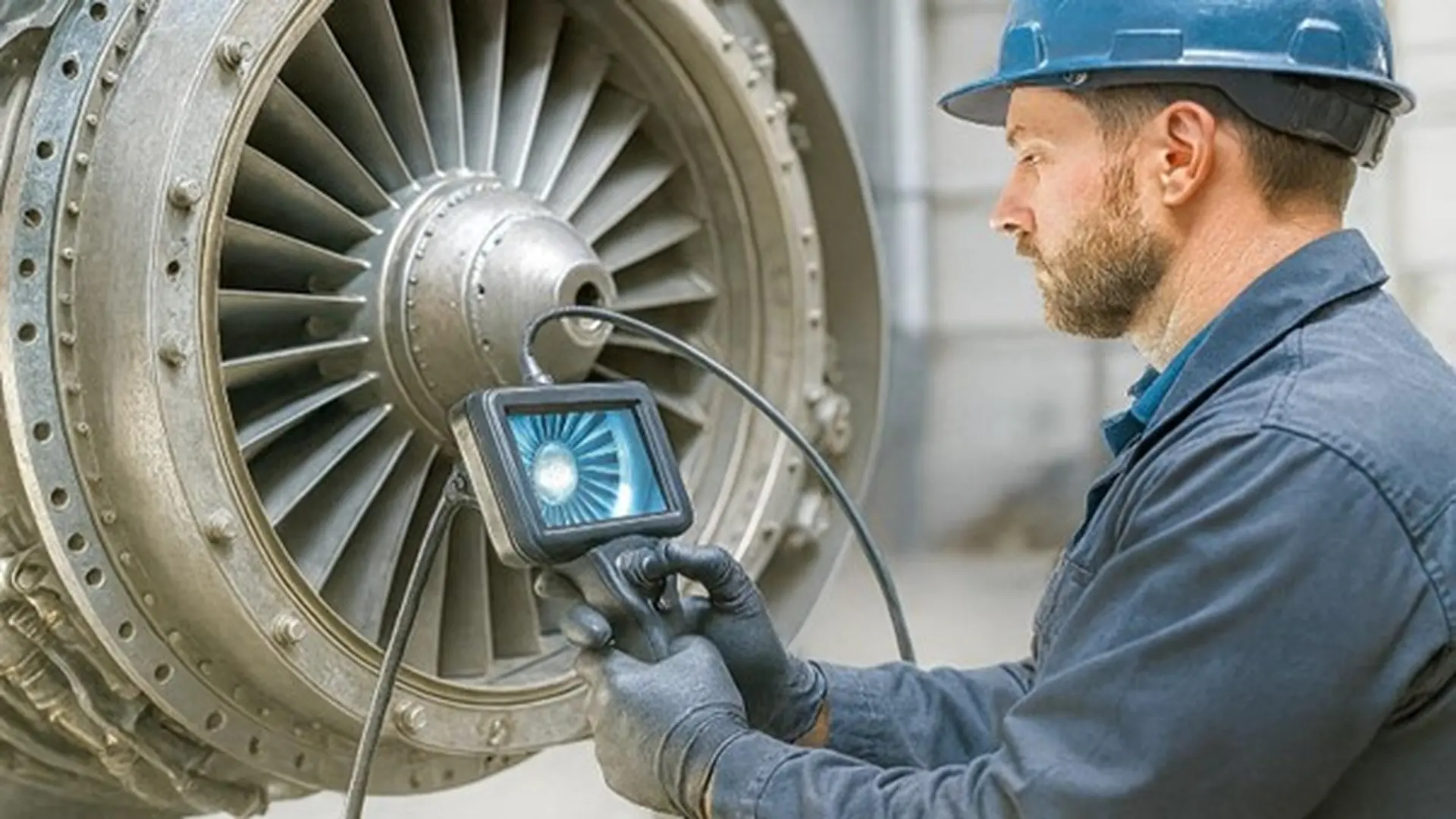
Borescopy is an NDT technique used to perform remote visual inspections when the human eye is insufficient to verify an inaccessible area. Faced with the challenge of maintaining operational availability, Non-Destructive Testing (NDT) required a method that could provide internal visual inspection without incurring the costly and risky dismantling of critical equipment.
Borescopy meets this need by allowing engineers to carry out precise diagnostics of the internal condition of turbines, piping, and heat exchangers. Its adoption consolidates Remote Visual Inspection (RVI) as a reliable standard, providing quantifiable data for decision-making.
What is a borescope and why is it essential in NDT?
A borescope is an optical or digital device designed to perform remote visual inspection (RVI) inside confined or inaccessible spaces. Unlike direct visual testing (VT), it allows internal components to be observed without dismantling, cutting, or interrupting operations.
Key differences
- Borescope: a rigid or flexible optical device for internal inspections.
- Videoscope: an advanced version with a digital camera, LED illumination, and video/photo recording.
- Remote visual inspection: a discipline within NDT that employs borescopes, cameras, drones, and robots.
The strategic role of the borescope in NDT lies in its ability to detect early degradation, reinforce reliability, and reduce operational uncertainty.
This technology is a pillar of Non-Destructive Testing (NDT) because it enables early detection and precise localization of various structural and surface defects, such as:
- Corrosion and Erosion: material loss in piping or turbine components.
- Cracks and Fractures: indicators of fatigue or mechanical stress.
- Pitting: common in bearings and gears, a symptom of imminent failure.
- Blockages or Impact Damage: presence of foreign object debris (FOD) or blade damage.
The role of the videoscope in non-destructive testing is not only qualitative (seeing the defect) but also locational, allowing the technician to accurately map where the damage is located for eventual repair or monitoring, ensuring that the asset does not lose its integrity.
Types of borescopes used in industry
- Rigid borescope: ideal for inspections where access is direct and the cavity is straight (e.g., combustion engine cylinders or valve cavities). They offer superior optical quality and better illumination compared to fiber optics, but their lack of flexibility is a limitation in complex systems.
- Flexible borescope: uses fiber optic technology and is crucial for systems with bends and curves (e.g., HVAC systems, certain heat exchangers, or piping with multiple angles). Its main advantage is navigability.
- Industrial videoscopes: represent the gold standard. Thanks to the digital camera at the tip, they allow ultra-high-precision borescope inspection (HD/4K), millimetric articulation capability (joystick), and, critically, complete documentation of the test through video recording and photographic capture.
- Fiberscopes and microborescopes: microborescopes are probes with diameters smaller than 3 mm. They are indispensable in the aerospace industry (inspection of small blades) and for detecting microcracks or internal corrosion in extremely narrow conduits.
How does a borescope work? Key technical principles
The operation of the modern borescope (videoscope) is based on optoelectronic engineering technology:
- Illumination: the light source (generally a powerful LED or halogen lamp) is located in the control unit, and light is guided to the probe tip through optical fibers. In more advanced videoscopes, LEDs are located directly at the tip for superior illumination and better contrast.
- Articulation: the probe tip uses a cable system (controlled by a joystick or levers) that allows up to four-way movement (up, down, left, right) at angles of up to 210°. This is vital for examining critical areas such as the back face of a blade.
- Optics and Camera: the core is the digital microsensor (CCD or CMOS) at the tip. The primary lens determines the Depth of Field (DOF) and the Field of View (FOV). Modern remote visual inspection requires interchangeable lenses to adapt to different focal distances.
- Technology and Digitalization: current systems incorporate processors for image correction, noise reduction, and, in the most advanced trends, 4K technology that enables the application of Artificial Intelligence (AI) algorithms for automatic defect detection.
Advantages of the modern borescope
The adoption of borescope inspection is justified by its superiority in efficiency, safety, and diagnostic reach:
| Inspection Method | Cost Impact | Reliability Impact | Downtime |
|---|---|---|---|
| Visual Inspection (VT) | Low | Depends on access | High (partial disassembly) |
| Manual Disassembly | Very High | Low (reassembly risk) | Very High |
| Radiography | Medium–High | High | Requires exposure time and safety measures |
| Ultrasonic Testing | Medium | High (thickness only) | Medium (surface preparation) |
| Borescope / Videoscope | Low | High (Internal Diagnosis) | Minimal (access port only) |
The advantage of remote visual inspection is evident: uncertainty is reduced, disassembly costs are avoided, and downtime is minimized, directly contributing to higher reliability.
Critical applications of the borescope in NDT
- Internal inspection of piping and confined spaces: the borescope is used to identify visible cracks, corrosion under internal deposits (fouling), undercutting, and obstructions that affect flow and wall integrity. It is crucial in the chemical and Oil & Gas industries.
- Turbines, compressors, and pumps: allows routine checks of combustion chambers, compressor and turbine blades, and foreign object damage (FOD) inspections. This inspection is mandatory for condition-based maintenance of these critical assets.
- Heat exchangers: used to verify tube integrity, identifying blockages, leaks, and internal corrosion without dismantling the tube bundle.
- Engines, valves, and pressure vessels: the videoscope accesses spark plug or injector ports to assess piston and valve wear, ensuring inspection without disassembly during preventive maintenance.
- Weld inspection (remote VT): the borescope allows remote visual inspection of the weld root or the inside of piping, verifying compliance with codes such as API 1104, ASME, and AWS, especially in complex geometries.
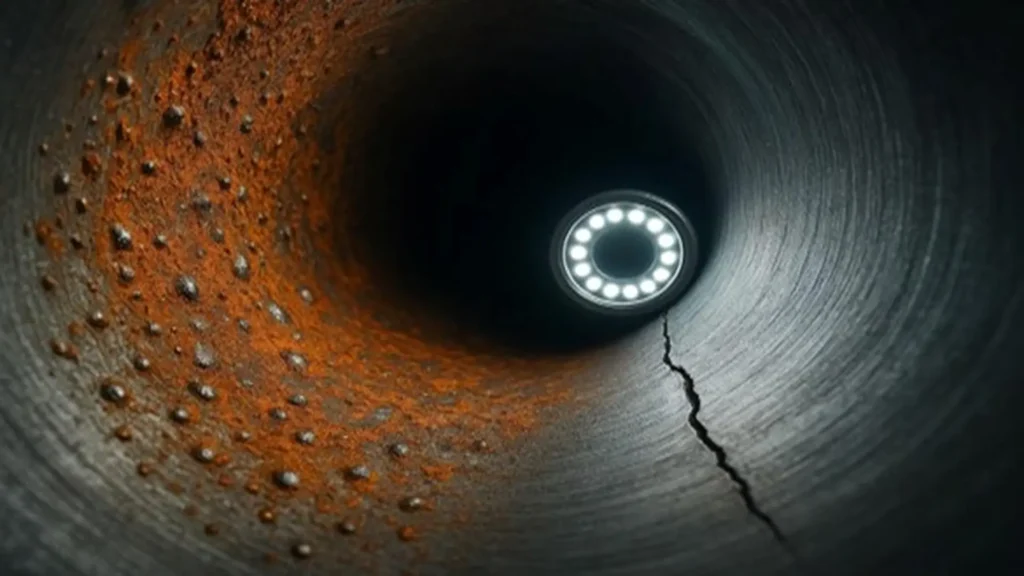
The following image shows a pipe inspection using borescopy.

Borescopy in asset management and reliability
Visual data from borescope inspection is the link between NDT and modern Asset Management.
- Predictive Maintenance: videoscope findings are integrated into CMMS or Digital Twin platforms to feed Predictive Maintenance models.
- RBI (API 580/581) and FFS (API 579): 3D measurement data obtained through remote visual inspection are critical. They allow estimation of remaining corrosion rates (RBI) or determination of fitness for service (FFS), justifying asset life extension.
- Reduction of Uncertainty: visual evidence reduces the uncertainty inherent in other methods, improving the quality of maintenance investment decisions.
Borescopy and its contribution to mechanical integrity
Borescopy is fundamental to maintaining the mechanical integrity of a system. Its greatest contribution is the early identification of damage mechanisms before they are detectable by vibration monitoring or thermography. By recording and measuring internal damage, remote visual inspection allows modeling of failure progression. This makes it possible to reduce uncertainty and, therefore, achieve the main savings: avoiding unnecessary and costly disassembly when the issue is not critical.
Common errors in borescope inspections
For inspection with the equipment to be effective, the operator must avoid common technical errors:
- Incorrect Illumination: improper brightness adjustment can hide microcracks or falsely enhance corrosion relief.
- Optical Distortion: occurs when the probe tip is too close to or too far from the object. The lack of dimensional reference prevents proper 3D measurement.
- Lack of Dimensional Reference: failing to record working distance or use stereo measurement makes the visual inspection non-quantifiable and reduces its predictive value.
- Rushed Diagnosis: failure to properly clean the cavity or inspect the entire available surface may lead to missing a critical defect.
Success Case: USA Borescopes
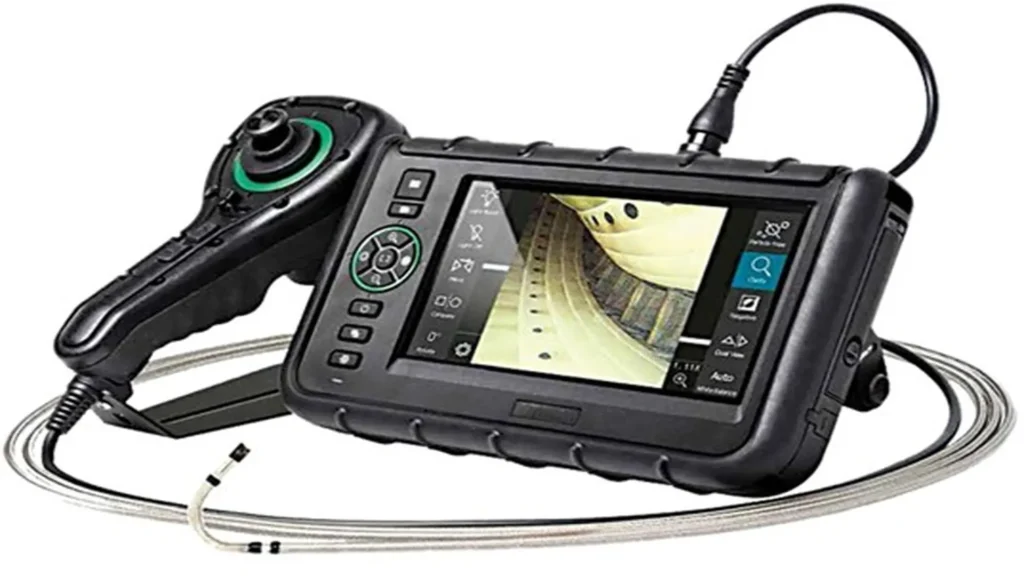
USA Borescopes’ proposal focuses on transforming inspection without disassembly into a high-precision practice. The interview conducted by Inspenet TV at ASNT 2025 highlights this mission:
- “Remote Visual Inspection is no longer just about seeing, but about measuring. Our articulated videoscopes eliminate the excuse of the ‘inaccessible asset,’ providing precise evidence at the right moment.”
- Common Industrial Problem: the high operational and logistical cost of dismantling gas turbines or compressors for routine checks.
- Solution: supply of high-durability articulated videoscopes with 3D measurement capability.
- Benefit: inspection is performed through existing access ports, reducing downtime from weeks to hours. This ensures that accurate visual evidence reaches the reliability engineer without delay.
- I invite you to watch the interview video at the following link:

Technical comparison: borescope, videoscope, fiber optics
| Equipment | Precision | Flexibility | Cost (Relative) | Recommended Use |
|---|---|---|---|---|
| Borescope (Rigid) | High Optics | Low | Medium | Straight, fixed cavities |
| Fiberscope | Medium (fiber limit) | High | Medium | Navigation of curved piping |
| Industrial Videoscope | Very High (Digital HD/4K) | High (Articulation) | High | Quantitative NDT, Critical Asset Management |
Criteria for selecting industrial borescopes
Selecting a borescope should be an engineering exercise:
- Diameter and Length: determined by the asset’s access ports. The probe must be sufficiently thin and long.
- Resolution and Articulation: necessary for clear and complete visual inspection.
- ATEX Compatibility: critical for remote visual inspection in hazardous environments (Oil & Gas, mining), where explosion-proof certification is required.
- Recording and Software: the ability to record and export measurement data to Asset Management platforms is indispensable.
Technological trends in industrial borescopy
The future of borescope inspection is moving toward intelligent automation:
- AI for Automatic Detection: software that learns to automatically identify corrosion or microcracks in the video feed, reducing human error.
- Augmented Reality (AR): the operator will see measurement data or diagrams overlaid on the real image of the asset interior.
- 4K and 8K Borescopes: superior image quality for forensic visual testing (VT).
- Wireless Remote Inspection: equipment with enhanced connectivity for real-time data analysis.
- Integration with Digital Platforms: direct connection with CMMS and Digital Twins for fully integrated Asset Management.
Conclusions
Industrial borescopy has evolved from a simple observation tool into a quantitative diagnostic system, fundamental to industrial reliability. Remote visual inspection is now a competitive advantage: it enables early failure detection, reduces costs, and maximizes operating time.
Inspenet connects the industry with advanced technologies such as those offered by USA Borescopes, driving more precise, safer, and more efficient inspections. Investing in borescopy is investing in the service life and safety of your assets.
This article is part of Inspenet’s editorial line, official media partner of global events such as: API, AMPP, SLOM, GASTECH, CINDE, NISTM, INCORRS, LATINCORR, ILTA, AEND, PAN NDT 2025.
References
- ASME Boiler and Pressure Vessel Code, Section V: Nondestructive Examination (Latest edition).
- API 579-1 / ASME FFS-1: Fitness-For-Service (Latest edition).
- API Recommended Practice 580: Risk-Based Inspection (Latest edition).
- API 510: Pressure Vessel Inspection Code: In-Service Inspection, Rating, Repair, and Alteration (Latest edition).
- API Standard 1104: Welding of Pipelines and Related Facilities (Latest edition).
Frequently Asked Questions (FAQs)
What is a borescope?
It is a remote visual inspection instrument used in Non-Destructive Testing (NDT) to examine the interior of critical machinery.
What is it used for in NDT?
It is used to identify, locate, and measure defects (cracks, corrosion, erosion) without dismantling the asset.
Which industries use it?
Primarily energy, aviation, Oil & Gas, manufacturing, and petrochemical.
What is the difference with a videoscope?
The videoscope uses a digital microcamera at the tip to provide high resolution and 3D measurement, surpassing traditional fiber borescopes.