
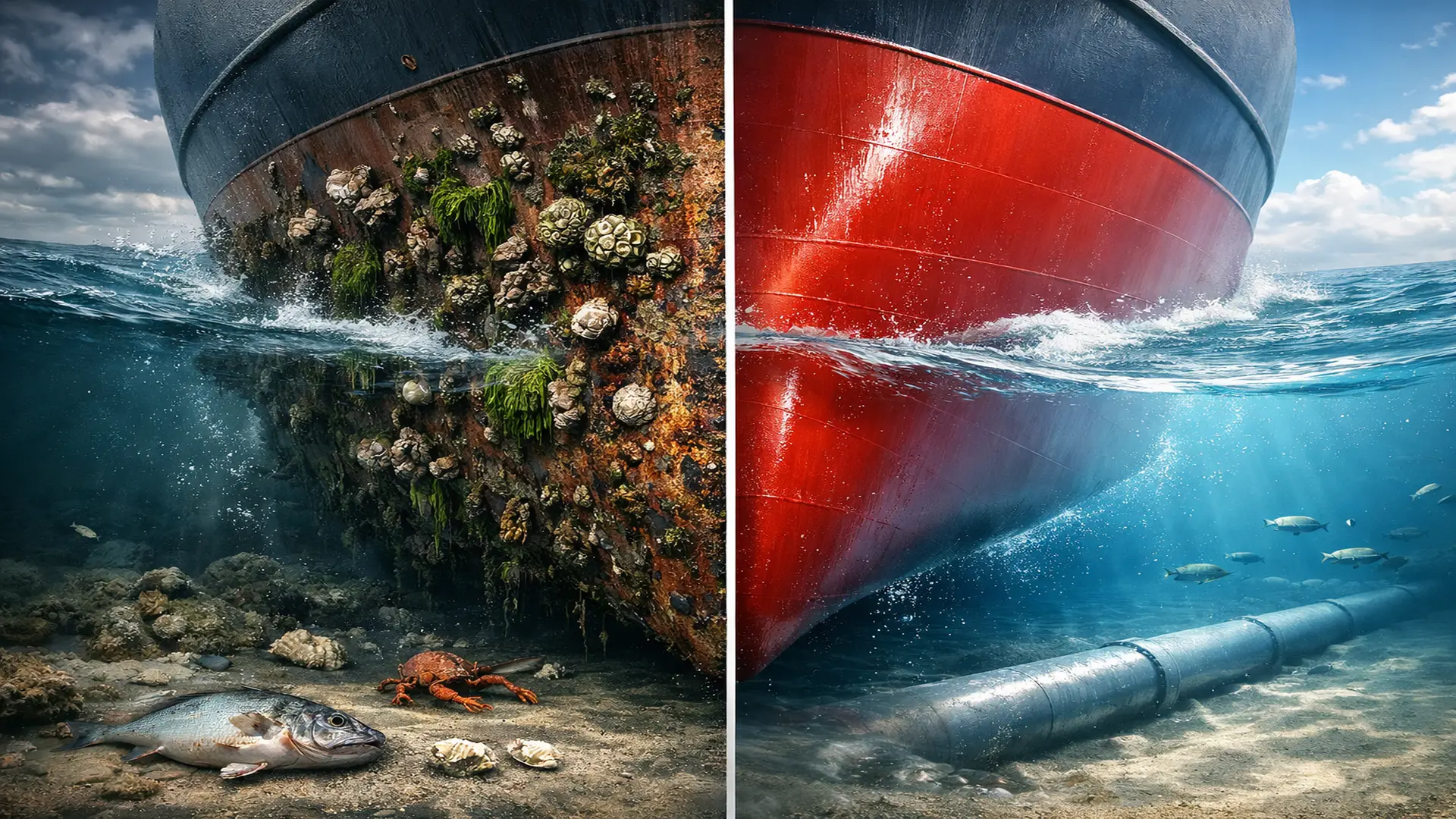
Biofouling represents one of the main operational challenges for the maritime and offshore sectors. The adhesion of marine organisms such as algae, barnacles, mollusks, and bacteria on ship hulls, platforms, pipelines, and other submerged structures increases surface roughness, promotes corrosion processes, and significantly raises the energy consumption of vessels.
In this context, biofouling control technology in marine environments has evolved toward sophisticated solutions that integrate surface protection and hydrodynamic efficiency. These technologies include advanced coatings, controlled biocide release systems, and low-adhesion surfaces designed to prevent the attachment of organisms.
Why is it necessary to biofouling control in marine environments?
The accumulation of marine organisms such as algae, barnacles, and mollusks increases the roughness of ship hulls and resistance to movement. Traditionally, highly toxic biocides such as TBT were used; although they prevented biofouling, they contaminated seawater and affected biodiversity. In addition, biofouling intensifies corrosion in metallic structures, reducing their service life.
Furthermore, the presence of biological colonies favors processes of microbiologically influenced corrosion (MIC), accelerating the deterioration of metals and alloys exposed to seawater. In infrastructures such as offshore platforms, dock piles, and subsea pipelines, this combination of biofouling and corrosion can reduce the service life of materials and increase maintenance costs.
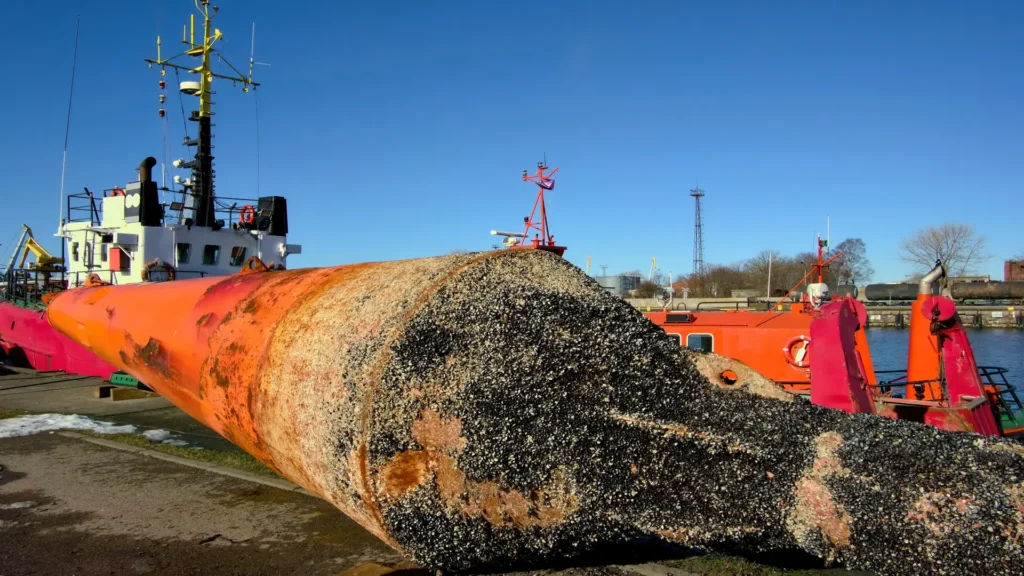
Historically, to protect ship hulls and submerged structures, antifouling coatings with broad-spectrum biocides were used, including compounds such as tributyltin (TBT). Although they are effective against the adhesion of marine organisms, their toxicity generates serious environmental problems: constant release of chemical compounds into the water, bioaccumulation in organisms, reproductive alterations in mollusks, and contamination of marine ecosystems.
The use of these coatings is also directly related to protection against corrosion, since steel hulls and metallic alloys exposed to seawater are susceptible to electrochemical processes accelerated by biofouling. Without an adequate antifouling system, the combination of adhered organisms and saline water can increase localized and general corrosion, affecting structural integrity and reducing the service life of the hull.
For these reasons, the development of biofouling control technologies has become a key element within strategies for structural integrity, energy efficiency, and environmental sustainability in maritime transport and the offshore industry.
Environmental impact of traditional antifouling systems
Traditional antifouling coatings effectively protected hulls; however, their impact on marine ecosystems was significant. For decades, biofouling control relied on coatings that released highly toxic biocides into seawater. Among the most widely used compounds was tributyltin (TBT), recognized for its high effectiveness in preventing the adhesion of organisms.
However, subsequent research demonstrated that these compounds generated serious environmental effects, including:
- Seawater contamination: Continuous release of toxic substances into the marine environment.
- Bioaccumulation and toxicity: Affecting fish, mollusks, and crustaceans.
- Ecosystem alteration: Impact on biodiversity and native species.
- Indirect corrosion: Some biocides alter ionic balance, promoting corrosion in nearby metals.
Due to these impacts, the International Convention on the Control of Harmful Anti-fouling Systems of the International Maritime Organization (IMO) prohibited the use of TBT on ships worldwide, driving the development of safer and more sustainable antifouling technologies.
Evolution of technologies for biofouling control
Technological development in marine coatings has made it possible to create more efficient systems with lower environmental impact. Currently, biofouling control is based on several complementary technologies. The technological transition has led to controlled-release and self-polishing coatings (SPC). These systems gradually release active agents, protect the surface from biofouling, and reduce environmental impact.
For centuries, shipowners have struggled against biofouling. Early solutions were rudimentary, highly toxic, and ineffective. With the ban on TBT in the early 2000s and the increase in environmental regulations, the industry had to reinvent itself.
The evolution of biofouling technology to protect the marine environment has led to advanced controlled-release systems, where self-polishing copolymers (SPC) represent the dominant innovation. These coatings allow a gradual release of active agents while the surface is constantly renewed, achieving three key objectives:
- Controlled release of biocide to protect the surface over time.
- Maintaining a smooth hull that optimizes hydrodynamic efficiency and reduces friction.
- Extending coating service life and reducing environmental impacts.
Commercial examples include the JD744 chlorinated rubber antifouling paint, which continuously releases antifouling agents to prevent marine growth, and the JD753 tin-free self-polishing coating, which maintains a clean hull even in warm and subtropical waters, preventing organism adhesion without using highly harmful compounds.
Current research is advancing toward biocide-free technologies, including silicone elastomer coatings, fluoropolymer surfaces, and biomimetic solutions inspired by shark skin, combining operational efficiency, corrosion protection, and minimal environmental contamination.
New technologies for biofouling control
Self-polishing coatings (SPC)
Self-Polishing Copolymers (SPC) represent one of the most widely used solutions in the naval industry. These coatings operate through a controlled erosion mechanism that gradually renews the coating surface, releasing controlled amounts of active agents.
This process helps maintain a smooth hull and minimize the adhesion of marine organisms, while also improving the vessel’s hydrodynamic efficiency.
Controlled-release coatings
Another technological strategy consists of coatings that release biocides in a controlled manner, which reduces the total amount of substances released into the environment and prolongs the service life of the protection system.
These systems allow a balance between antifouling effectiveness and compliance with increasingly strict environmental regulations.
Silicone foul-release coatings
More recent technologies include silicone-based elastomer coatings designed to create extremely smooth surfaces with low surface energy. Instead of eliminating organisms through biocides, these systems make adhesion more difficult.
When the vessel is moving, water flow facilitates the detachment of organisms, keeping the surface relatively clean without releasing toxic compounds.
Biomimetic technologies
Research is also exploring solutions inspired by nature, known as biomimetic technologies. Some experimental surfaces mimic the microstructure of shark skin, which reduces microorganism adhesion and limits biological colonization.
These technologies seek to provide long-lasting protection against biofouling with minimal environmental impact. In the following video, “DefenseInnovationPartnersh” presents new technological developments in active coatings to prevent the growth of unwanted organisms on marine surfaces.
New solutions for controlling the growth of marine organisms.
Comparison of technologies for biofouling control in marine environments
| Technology | Operating principle | Advantages | Limitations | Common applications |
|---|---|---|---|---|
| Traditional biocide coatings | Continuous release of toxic compounds that inhibit marine organism growth | High initial effectiveness | High environmental impact, regulatory restrictions | Older vessels and limited applications |
| Self-polishing copolymers (SPC) | Controlled erosion of the coating that renews the surface and gradually releases active agents | High hydrodynamic efficiency, long service life, reduced biocide release | Dependence on vessel movement | Commercial ships, tankers, container vessels |
| Controlled-release coatings | Gradual diffusion of biocides from the coating matrix | Greater control of chemical release and lower environmental impact | Limited service life due to depletion of biocides | Ship hulls and marine structures |
| Silicone foul-release coatings | Low surface energy surfaces that hinder organism adhesion | Biocide-free, lower environmental impact | Require vessel speed for self-cleaning | High-speed ships and modern vessels |
| Biomimetic technologies | Surfaces inspired by natural structures that reduce biological colonization | Ecological solutions with long-term potential | Still under development or limited application | Advanced research and specialized applications |
Conclusions
Technology for the biofouling control in marine environments has evolved significantly, moving from highly toxic coatings to advanced systems based on controlled release, low-adhesion surfaces, and biomimetic solutions.
The adoption of these technologies improves vessel energy efficiency, reduces corrosion in metallic structures, and minimizes environmental impact on marine ecosystems.
References
- Champ, M. A. (2000). A review of organotin regulatory strategies, pending actions, related costs and benefits. Science of the Total Environment, 258(1–2), 21–71.
- International Maritime Organization. (2001). International Convention on the Control of Harmful Anti-fouling Systems on Ships (AFS Convention). London: IMO.
- Yebra, D. M., Kiil, S., & Dam-Johansen, K. (2004). Antifouling technology—Past, present and future steps towards efficient and environmentally friendly antifouling coatings. Progress in Organic Coatings, 50(2), 75–104.