
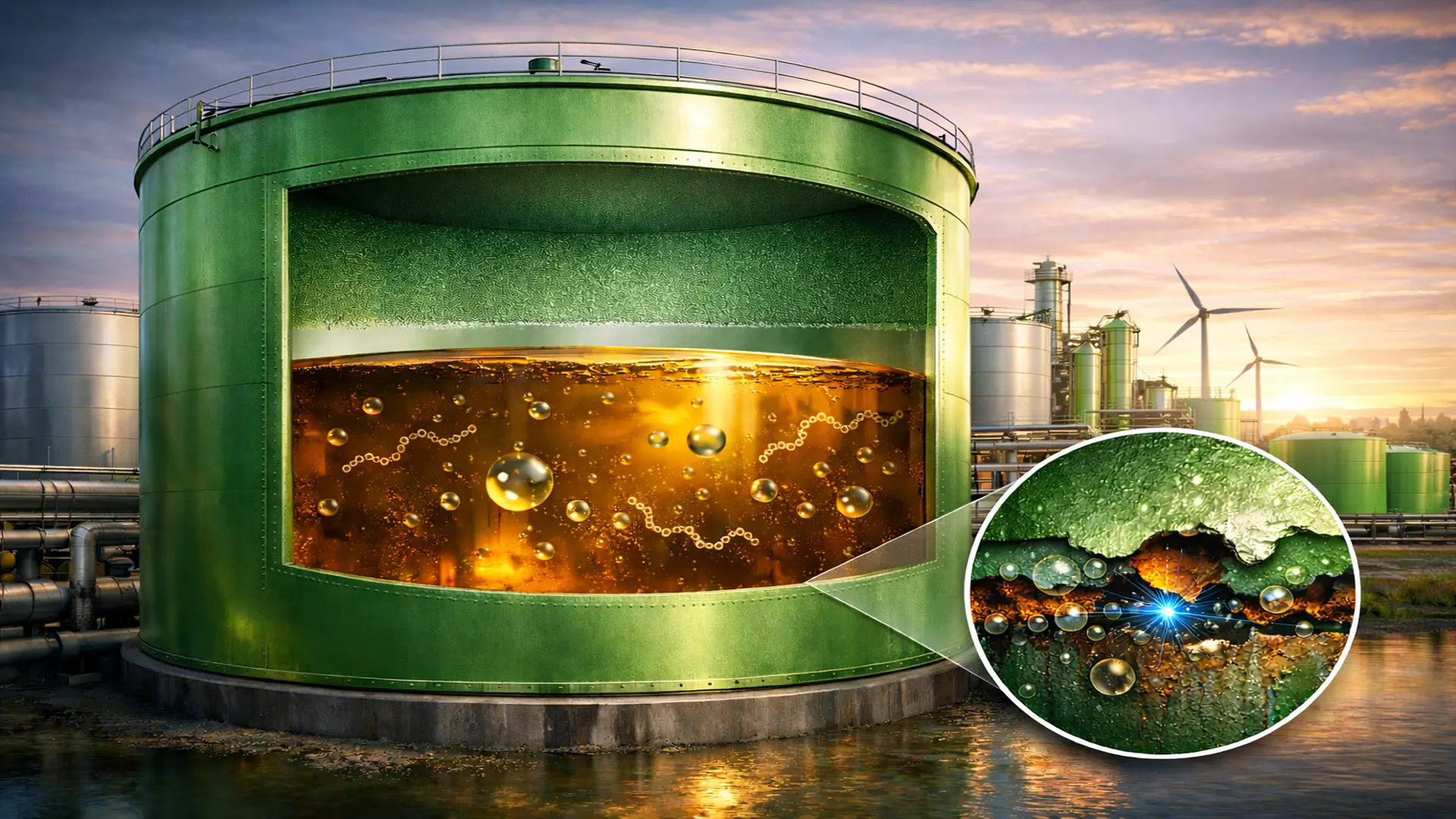
The energy transition is substantially modifying the deterioration mechanisms in industrial storage systems. The growth of biodiesel, renewable diesel, and fuels produced from used oils has transformed the chemical nature of stored fluids, creating new conditions for corrosion in biofuel tanks. In this context, the selection of anticorrosive coatings in biofuels is no longer a decision based on previous experience with fossil hydrocarbons and becomes a technical process grounded in the analysis of electrochemical mechanisms, chemical degradation, and polymer compatibility.
Anti-corrosion coatings in biofuels for biodiesel tanks must respond not only to traditional barrier protection, but also to a more chemically complex environment characterized by higher polarity, the presence of free fatty acids (FFA), variable water content, and oxidation products. These factors not only degrade the protective polymer, but can also activate localized corrosion processes under the coating, compromising the structural integrity of the asset.
Chemical changes in storage
The storage of biofuels represents a substantial change compared to traditional fossil diesel storage. Conventional hydrocarbons are predominantly nonpolar and have low electrical conductivity, limiting the formation of internal electrochemical cells. In contrast, B100 biodiesel and fuels derived from used oils contain higher levels of oxygenated compounds, traces of water, and polar fractions that alter interactions with metallic surfaces.
This compositional difference increases the likelihood of aqueous film formation at the metal-coating interface, especially in the presence of internal condensation. When a persistent aqueous phase forms, the system ceases to behave as a relatively inert organic environment and allows the development of classic electrochemical processes, including anodic dissolution of steel and cathodic reduction of dissolved oxygen.
The selection of anticorrosive coatings in this scenario must consider not only the chemical resistance of the polymer but also its ability to prevent the formation of microenvironments that favor under-coating corrosion.
Induced corrosion mechanisms
Corrosion in biofuel tanks can develop through several interrelated mechanisms. First, the presence of free or emulsified water enables the activation of electrochemical cells in areas where the coating presents microscopic defects or residual porosity. These discontinuities act as initiation points for localized corrosion.
Second, free fatty acids can react with the metal surface, forming metallic soaps that alter coating adhesion. This chemical interaction modifies interfacial stability and facilitates progressive delamination. Delamination creates confined spaces where moisture accumulates, increasing the concentration of corrosive species and accelerating steel thickness loss.
A third relevant mechanism is osmotic blistering-induced under-coating corrosion. When the coating allows water diffusion but retains salts or soluble compounds at the interface, internal pressures develop that lift the protective film. Localized coating failure exposes the steel to a more conductive environment, promoting pitting propagation.
The simultaneous interaction of these mechanisms explains why corrosion in biofuel tanks can progress faster than in conventional hydrocarbon storage.
Impact of free fatty acids
Free fatty acids represent one of the main factors affecting the stability of coatings for biodiesel tanks. At the molecular level, the polar carboxylic group of FFAs can interact with residual reactive sites in the polymer network, especially in epoxy systems with incomplete crosslinking or exposed hydroxyl groups.
This interaction can induce material plasticization, reducing its glass transition temperature and increasing polymer chain mobility. At the macroscopic level, this results in decreased elastic modulus, loss of surface hardness, and susceptibility to microcracking. When the acid number is high, chemical degradation can progress even without significant dissolved oxygen, indicating that the mechanism is not exclusively electrochemical but also chemical-structural.
For this reason, technical coating specifications must include the product’s acid number, expressed in mg KOH per gram, along with the FFA percentage. Ignoring this variable significantly increases the risk of premature failure.
Water content and corrosion
Water content in biodiesel is a critical variable in corrosion within biofuel tanks. Water can be emulsified or exist as a free phase accumulated at the tank bottom. Each form has distinct implications for coating degradation.
From a physical standpoint, water has higher diffusion capacity than hydrocarbon components. When the coating’s water vapor permeability is high, migration toward the metal-coating interface is facilitated. There, water can react with soluble contaminants trapped during application, generating osmotic gradients responsible for blistering. This phase creates an environment more conductive than the organic fuel and promotes uniform or localized steel corrosion if the coating has defects. Additionally, the water-biodiesel interface becomes a critical zone where impurities and oxidation products concentrate.
When the coating has high water vapor permeability, diffusion toward the interface can generate osmotic blistering. This phenomenon is not only an aesthetic issue but also a precursor to under-coating corrosion. The combination of water and FFA increases medium conductivity and favors hydrolysis reactions in susceptible systems. Under elevated thermal conditions, diffusion accelerates exponentially, reducing the time for visible defects to appear.
In this context, the selection of coatings for biofuel storage should prioritize systems with low water absorption and high stability against polar media.
Temperature and electrochemical kinetics
Temperature directly influences degradation kinetics. The combination of high temperature and water presence can double or triple the rate of certain chemical reactions, and consequently the corrosion rate at coating defects, following thermodynamic activation energy principles, accelerating chemical degradation of the coating. In biofuel storage, where heating may be necessary to maintain product fluidity, this variable must be critically controlled.
Residence time of the fuel in the tank also modifies the scenario. In fast-turnover systems, continuous exposure may be less than in prolonged storage tanks, where the coating remains in contact with the aggressive medium for months. The combination of high temperature, elevated FFA, and water presence creates an environment where degradation becomes nonlinear and accelerates.
Failure to control these factors can contribute to FFA-induced plasticization, reducing polymer rigidity and facilitating microcrack propagation from differential thermal stresses between steel and coating. Prolonged exposure exacerbates these effects, particularly in slow-turnover tanks where continuous contact with the aggressive medium is constant. In tanks operating between 40–60 °C, molecular mobility increases, and water and FFA diffusion through the protective film intensifies.
Compatibility evaluation should not rely solely on short exposures or standard lab conditions but on simulations that replicate actual service conditions.
Comparison of anticorrosive systems
Among the options for coatings in biofuel storage tanks, novolac phenolic epoxy systems offer advantages due to high crosslink density and low permeability. Their closed 3D structure limits polar molecule diffusion and provides greater resistance to FFA and water content in biodiesel.
However, these systems require strict application controls. Mixing or curing deficiencies can generate incomplete crosslinking zones, compromising overall chemical resistance. High-build conventional epoxies offer advantages in ease of application and cost but may be compromised under high acid numbers. FFA-induced plasticization and water absorption can reduce their service life in prolonged storage.
Vinyl ester systems provide excellent chemical resistance to acidic media and lower susceptibility to hydrolysis. Their structural stability, based on unsaturated resins, confers higher chemical stability in aggressive environments. However, application demands rigorous catalysis and environmental control, increasing operational complexity.
The selection of anticorrosive coatings must consider chemical resistance, permeability, and performance against localized defects.
Methodology for technical specification
Selection of coatings in biofuels must be structured as a systematic process. First, chemical characterization of the product is essential, determining acid number, water content, and general composition. Subsequently, operational conditions must be evaluated, including maximum real temperature and storage duration.
Based on this information, a preliminary selection of compatible chemistry is made, prioritizing systems with low permeability and high FFA stability when the acid number is elevated. Validation should be conducted through immersion tests in real product at service temperature, evaluating changes in mechanical properties and adhesion.
Only through this structured approach can the risk of premature failure be minimized and the integrity of biofuel assets ensured.
Validation through immersion testing
Technical specification requires experimental validation. Immersion tests must be conducted in real or representative product at service temperature, over periods sufficient to observe significant changes in mechanical properties.
Evaluation should include hardness measurements, mass changes, adhesion tests, and glass transition temperature analysis. Microscopic observation may reveal microcracks or superficial degradation not visible to the naked eye.
Without specific testing, selection of coatings for biofuel storage relies on extrapolations that may be insufficient given the real chemical variability of the product.
Failure modes of anti-corrosion coatings in biofuels
Corrosion in biofuel tanks often begins as coating deterioration before evolving into metal attack. Osmotic blistering at the tank bottom is one of the first indicators of chemical incompatibility. This phenomenon is associated with water accumulation and soluble species at the interface.
Delamination in the vapor-liquid transition zone is another common pattern, favored by repeated condensation-evaporation cycles. At more advanced stages, thermal microcracks may develop due to differential stresses between the substrate and plasticized coating. The vapor-liquid transition zone is particularly vulnerable due to intermittent aqueous film formation cycles.
If not detected early, the process can evolve into localized perforation and loss of containment. Over time, delamination allows lateral expansion of under-coating corrosion, reducing effective steel thickness.
Loss of adhesion eventually leads to under-coating corrosion, compromising tank structural integrity and generating environmental risks.
Conversion and operational risk
Converting tanks designed for fossil hydrocarbons to biodiesel storage involves a substantial change in the corrosive environment. A previously stable anticorrosive system may not withstand the combination of water, FFA, and elevated temperature.
Before changing service, it is essential to perform compatibility evaluation, detailed inspection of the existing coating, and risk analysis. Prevention is significantly more cost-effective than repair after structural failure.
Conclusions
Corrosion in biofuel tanks results from the complex interaction of water, free fatty acids, and temperature. These factors modify both coating stability and electrochemical conditions at the metal-polymer interface.
Selection of anticorrosive coatings in biofuels must be based on chemical analysis of the product, evaluation of degradation mechanisms, and experimental validation under real service conditions. In the current energy transition context, corrosion protection in biofuel storage is not an accessory component but a strategic element to preserve structural integrity, environmental safety, and operational reliability.
Inspenet invites you to the AMPP 2026 Annual Convention, where advances and challenges in anticorrosive coatings in biofuels will be discussed, sharing strategies and best practices to effectively protect industrial assets.
References
- American Society for Testing and Materials. (2023). ASTM D6751-23: Standard specification for biodiesel fuel blend stock (B100) for middle distillate fuels. ASTM International.
- Association for Materials Protection and Performance (AMPP). (2022). SSPC-PA 2: Procedure for determining conformance to dry coating thickness requirements. AMPP.
- Knothe, G., Van Gerpen, J., & Krahl, J. (2015). The biodiesel handbook (2nd ed.). AOCS Press.