

Corrosion in the aerospace industry constitutes one of the most significant technical and economic challenges for defense and aviation systems. Advanced techniques to mitigate corrosion, according to estimates published by AMPP (Association for Materials Protection and Performance), may represent a valid strategy to regulate the annual cost of corrosion in United States defense and aviation systems. This cost exceeds thirteen billion dollars, a figure that does not include indirect consequences in terms of operational availability, mission delays, and risks to crew safety.
In extreme environments such as the launch platforms at NASA’s Kennedy Space Center (KSC), recognized by ASM International as one of the most corrosive atmospheric environments in the country, the electrochemical degradation of structural materials is not occasional: it is a continuous phenomenon that must be managed through advanced mitigation techniques.
For decades, the protection of aerospace aluminum alloys such as AA2024-T3 and AA7075 relied on inhibitors based on hexavalent chromate Cr(VI). Their electrochemical effectiveness is indisputable, but their carcinogenic toxicity and the regulatory restrictions imposed by EPA, OSHA, and REACH have driven a technological transition toward environmentally sustainable and scientifically equivalent solutions.
Smart and self healing coatings
One of the advanced techniques to mitigate aerospace corrosion is the development of smart, stimulus-responsive coatings.
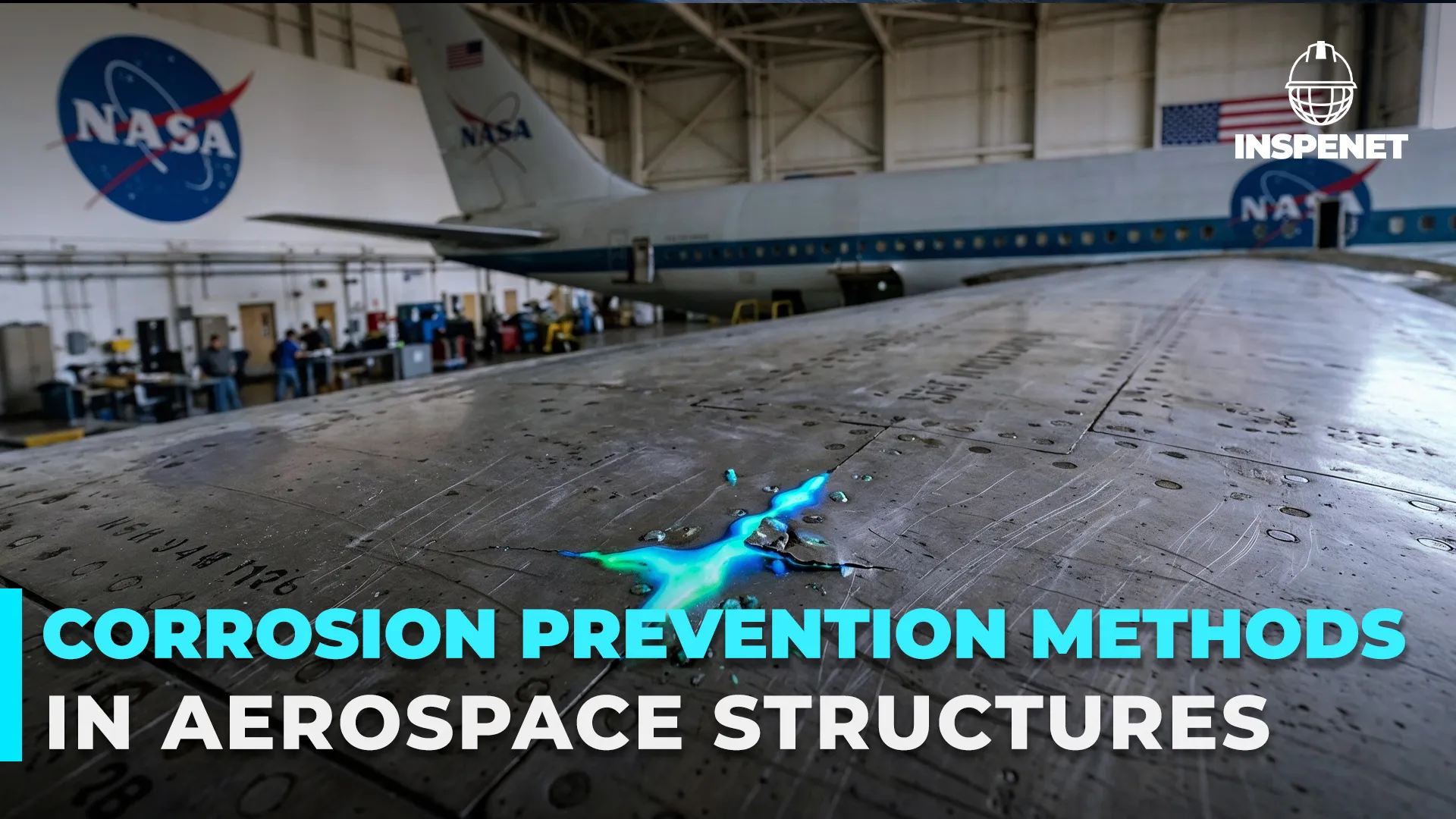
The Corrosion Technology Laboratory at the Kennedy Space Center has developed systems based on controlled-release microcapsules integrated into polymeric matrices. These microcapsules contain inhibitors, colorimetric indicators, and self-healing agents that remain inactive until they detect an electrochemical signal associated with the onset of the anodic process.
When the pH decreases at the metal–coating interface, a characteristic condition of anodic dissolution, the system selectively releases the inhibitor onto the affected area. This mechanism transforms the coating into an active protection system, rather than merely a passive barrier.
In recent literature (Advanced Materials Technologies, 2025), these systems are classified as intelligent anticorrosion coatings sensitive to pH, temperature, or redox potential, including solid–liquid transition mechanisms for sealing microcracks induced by impact or abrasion.
Chromate free inhibitors: Rare earths and ionic liquids
The replacement of Cr(VI) has driven a convergence between inorganic chemistry, nanotechnology, and advanced electrochemistry.
Among the most promising alternatives are rare earth-based coatings, particularly cerium (Ce) and praseodymium (Pr). Conversion systems using cerium salts have demonstrated performance comparable to chromate in AA2024 and AA7075 alloys during ASTM B-117 testing (2,000 hours of salt spray).
The cerium mechanism is based on the precipitation of Ce(OH)₃ and CeO₂ at cathodic sites where oxygen reduction occurs, thereby blocking the electrochemical cycle.
In parallel, imidazolium-based ionic liquids represent a highly sophisticated line of electrochemical research. Experimental studies in 3.5% NaCl solution have shown inhibition efficiencies greater than 90%, evaluated through electrochemical impedance spectroscopy (EIS) and potentiodynamic polarization (PDP). These inhibitors act through controlled adsorption and the formation of stable nanometric protective films.
Predictive modeling with Artificial Intelligence
One of the most disruptive advances in aerospace corrosion science during the 2023–2025 period is the integration of machine learning (ML) algorithms and artificial neural networks (ANN) into the predictive modeling of the electrochemical behavior of materials under complex operational conditions.
In July 2025 (Coatings, MDPI), researchers published a study developing an ML framework to predict atmospheric corrosion rates by incorporating environmental and material parameters: the Gradient Boosting model achieved a validated R² of 0.835 with an RMSE of 98.99 μm/year, statistically outperforming Random Forest and Linear Regression models.
The presentation at the AMPP Annual Conference + Expo 2024 (New Orleans) of the work titled Development of corrosion severity assessment algorithms using environmental monitoring sensors in naval aviation environments illustrates the operational maturity of this approach.
The study deployed sensors measuring temperature, relative humidity, and solution conductivity at 30-minute intervals across 26 naval aviation-relevant locations over two years. Algorithms trained with these engineering features achieved 77% accuracy in classifying site corrosion severity, based on mass loss of high-strength Aermet 100 steel (a landing gear steel), using leave-one-out cross-validation. Leave-one-out cross-validation, or LOOCV, is used to estimate the predictive performance of a model.
Environmental Severity Classification (ESC)
The rational management of corrosion in aerospace assets requires, as a first step, the quantitative and continuous characterization of environmental aggressiveness. Researchers from Luna Labs, in collaboration with Georgia Tech University and industrial partners such as QTEC Aerospace, Lockheed Martin, and Sikorsky, published in AMPP’s Materials Performance journal (January 2024) a framework for Environmental Severity Classification (ESC) that uses Acuity LS devices to measure in real time temperature, humidity, chloride deposition, and atmospheric conductivity.
The obtained metrics are mapped to the six categories of the international standard ISO 9223:2019 for atmospheric corrosivity, enabling the binning of each geographic location and directly informing the selection of materials, coatings, and preventive maintenance frequencies for each operating base, launch platform, or logistics depot.
The strength of this approach lies in its ability to capture the temporal variability of corrosivity at a minute-scale resolution: diurnal relative humidity cycles, short-duration coastal salt fog events, and seasonal temperature peaks (all factors that annual average models ignore) are recorded with sufficient temporal resolution to identify windows of maximum electrochemical vulnerability.
From the perspective of technical standards, the AMPP TM21449-2021 test method provides the reference protocol for electrochemical measurements in the monitoring of aerospace coatings under atmospheric corrosion conditions, while ISO 22858 specifies electrochemical measurement methods for atmospheric corrosion monitoring.
Digital twin and condition based maintenance
The future of advanced techniques to mitigate aerospace corrosion converges on the concept of the structural digital twin.
Each critical component, wing, fuselage, landing gear, can be represented by a computational model integrating electrochemical sensor data, operational history, and environmental parameters.
The system projects the remaining time to intervention, eliminating maintenance schemes based exclusively on fixed intervals.
In this integrated paradigm, smart coatings, chromate-free inhibitors, and AI-based modeling cease to be isolated technologies and become part of a predictive integrity management ecosystem.
The following video shows the synergy between digital models and environmental parameters to optimize structural integrity and mitigate corrosion in the aerospace industry.
Conclusions
Advanced techniques to mitigate aerospace corrosion are redefining structural integrity engineering. The transition from toxic inhibitors to intelligent systems, the use of rare earths and ionic liquids, high-resolution environmental classification, and the incorporation of artificial intelligence enable the transformation of corrosion from a reactive phenomenon into a controlled variable.
In a sector where safety, reliability, and operational performance are critical, advanced corrosion mitigation is no longer an incremental improvement: it is a structural requirement of contemporary professional practice.
References
- Riello UPS. (n.d.). Galvanic isolation in power systems. Riello UPS Technical Documentation. https://www.riello-ups.com
- Wikipedia contributors. (2024). Galvanic isolation. In Wikipedia, The Free Encyclopedia. https://en.wikipedia.org/wiki/Galvanic_isolation
- Peabody, A. W. (2001). Control of pipeline corrosion (2nd ed.). NACE International.