
Table of Contents
- Susceptible zones to corrosion in Internal Floating Roofs (IFR)
- Predominant corrosion mechanisms
- Operational factors influencing corrosion
- Predictive control applied to IFR corrosion
- Monitoring and digitalization technologies
- Data driven mitigation strategies
- Towards proactive corrosion management
- Conclusions
- References
- Frequently Asked Questions (FAQs)
Corrosion in storage tanks with Internal Floating Roofs (IFR) represents one of the most significant challenges in asset integrity management in the oil and gas industry. Although these systems are designed to reduce evaporative emissions and minimize product losses, their operational configuration introduces conditions conducive to various corrosion mechanisms.
Traditionally, corrosion management in these systems has been predominantly reactive, based on periodic inspections and corrective maintenance. However, this approach proves limited against the dynamics and evolution of corrosive processes in service. In this sense, predictive corrosion control emerges as a paradigm shift, allowing failures to be anticipated before they manifest critically. Through the use of sensors, real-time data acquisition, and advanced analytics, it is possible to identify trends, correlate operational variables, and estimate corrosion rates with greater accuracy, thus optimizing decision-making.
In this context, the traditional approach based on periodic inspections has proven insufficient to anticipate failures. The shift towards predictive control strategies allows for identifying degradation patterns, estimating corrosion rates, and optimizing maintenance decision-making.
Susceptible zones to corrosion in Internal Floating Roofs (IFR)
To understand what an internal floating roof is and how it works, you can watch this explanatory video: What is an internal floating roof?

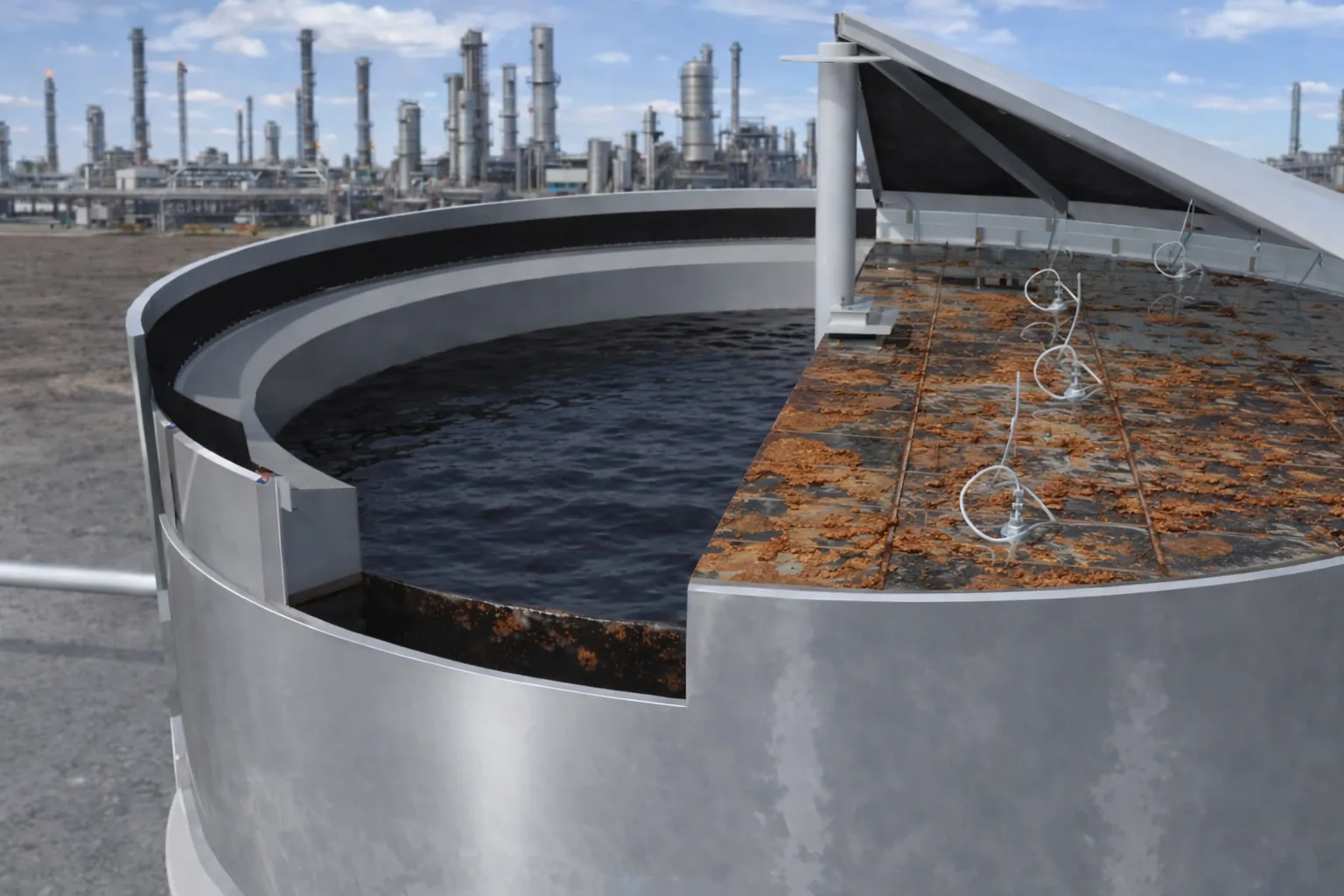
Internal floating roofs for storage tanks.
Tanks with IFR present areas particularly susceptible to corrosion due to the interaction between the liquid, vapors, and variable environmental conditions.
Among the most critical zones are: Rim Space, Roof Supports (legs), Product Contact Zone, and the upper part of the tank shell, which are summarized in the following table.
Table 1. Critical Corrosion Zones in IFR
| Critical Zone | Main Risk | Visual Explanation |
|---|---|---|
| Rim Space | Corrosive condensates | Perimeter seals exposed to vapors rich in aggressive compounds; condensate accumulation creates a highly corrosive environment. |
| Roof Supports (legs) | Localized corrosion | Points of stress concentration and moisture retention; favors pitting corrosion. |
| Product Contact Zone | Deposits and emulsions | The interface between the floating roof and the liquid forms emulsions and sediments that accelerate metal wear. |
| Upper Part of the Tank Shell | Condensation corrosion | Condensed vapors, combined with H₂S and CO₂, form liquid films that intensify general corrosion. |
Identifying these critical zones is fundamental to implementing predictive corrosion control strategies, extending the tank’s service life, and ensuring operational safety.
Predominant corrosion mechanisms
In IFR systems, corrosion does not respond to a single mechanism but to the interaction of multiple physicochemical processes.
Condensation corrosion is one of the most frequent mechanisms. It occurs when vapors cool and condense on metallic surfaces, generating aqueous solutions with acidic compounds.
Microbiologically induced corrosion (MIC) also plays an important role, especially in the presence of free water. Sulfate-reducing bacteria can generate sulfides that accelerate material deterioration.
Another relevant mechanism is under-deposit corrosion, where sediments or organic residues create microenvironments favoring the formation of electrochemical cells.
Finally, air–product interface corrosion is critical due to the high availability of oxygen, which intensifies oxidation reactions.
Operational factors influencing corrosion
Corrosion in internal floating roofs (IFR) is a multifactorial phenomenon whose complexity lies in the simultaneous interaction between physicochemical variables, operational conditions, and material characteristics. Factors such as the presence of corrosive vapors, condensate formation, temperature variations, and the composition of the stored product create highly aggressive microenvironments that favor both general and localized corrosion mechanisms. In this context, a detailed understanding of degradation mechanisms—including under-deposit corrosion, condensation corrosion, and possible microbiological contributions—is essential to design effective and sustainable control strategies.
The behavior of corrosion in IFR is strongly conditioned by operational variables. Filling and emptying cycles generate changes in the roof’s position, exposing different areas to corrosive environments. The composition of the stored product is critical. Crudes with high sulfur content, water, or acidic compounds increase the corrosion risk. Tank temperature and ventilation influence condensate formation, while the presence of free water acts as an electrolyte, facilitating electrochemical reactions.
Predictive control applied to IFR corrosion
Predictive control represents a paradigm shift in corrosion management. Unlike reactive approaches, it is based on continuous data analysis to anticipate failures.
The implementation of sensors allows monitoring variables such as thickness, humidity, temperature, and chemical composition. These data feed models that estimate corrosion rates and predict damage evolution.
Predictive models can be based on:
- Statistical analysis of historical data
- Physicochemical corrosion models
- Machine learning algorithms
Statistical analysis of historical data
Statistical analysis of historical data constitutes the foundation for understanding corrosion behavior in internal floating roofs over time. Based on inspection records, thickness measurements, corrosion rates, operational conditions, and environmental variables, it is possible to identify patterns, trends, and correlations not evident at first glance.
The use of statistical tools allows assessing data dispersion, detecting anomalies, and establishing confidence intervals in material degradation. Techniques such as linear regression, multivariable analysis, and time series facilitate estimating the remaining useful life (RUL) of critical components, especially in zones such as the rim space or roof supports.
Moreover, this approach allows transforming historical data into actionable information, serving as a starting point for more advanced predictive models and evidence-based decision-making.
Physicochemical corrosion models
Physicochemical models allow describing and quantifying the fundamental mechanisms governing corrosion in environments associated with internal floating roofs. These models integrate variables such as product chemical composition, presence of corrosive species (H₂S, CO₂, oxygen), pH, temperature, and condensation dynamics.
Through thermodynamic and kinetic equations, it is possible to simulate processes such as electrolytic film formation, metal dissolution, and corrosion product generation. This is especially relevant in areas where condensation plays a key role, such as the upper part of the tank shell.
The value of these models lies in their ability to explain the “why” of the corrosive phenomenon, allowing the design of more effective mitigation strategies, such as material selection, inhibitor use, or system design improvements.
Machine learning algorithms
Machine learning algorithms represent a significant evolution in predictive corrosion management, enabling the analysis of large volumes of data and the discovery of complex relationships between operational variables and degradation rates.
Through supervised and unsupervised machine learning techniques, it is possible to develop models capable of predicting corrosion evolution based on multiple factors, including operating conditions, tank history, and environmental variables. These algorithms can identify nonlinear patterns and continuously adapt to new data, improving accuracy over time.
Their implementation allows moving from a reactive or basic predictive approach to an intelligent decision-making system, where inspections are prioritized, maintenance plans optimized, and operational risks reduced. In combination with sensors and real-time monitoring, machine learning models form the core of digitalization in corrosion management.
Integration with methodologies such as Risk-Based Inspection (RBI) allows prioritizing interventions based on risk, optimizing resources, and improving reliability.
Monitoring and digitalization technologies
Asset digitalization has transformed corrosion management in internal floating roofs, enabling the evolution from periodic inspection-based schemes to real-time continuous monitoring systems. The incorporation of wireless sensors, in-line thickness measurement devices, electrochemical probes, and remote inspection technologies (such as drones or robots) facilitates data capture in critical areas difficult to access, such as the rim space or the upper tank shell.
These systems generate large volumes of information that, integrated into digital platforms, allow visualizing asset condition, detecting operational deviations, and generating early alerts. Connectivity and cloud-based platforms enable centralized data analysis even across geographically dispersed facilities.
A key advancement in this context is the use of digital twins, which virtually replicate the tank’s behavior based on its real operating conditions. These models allow simulating corrosion scenarios under different variables, such as changes in product composition, temperature, or environmental conditions, and evaluating the effectiveness of mitigation strategies before field implementation.
Together, these technologies not only improve early detection of degradation mechanisms but also optimize maintenance planning, reduce operational uncertainty, and enable more efficient asset lifecycle management.
Data driven mitigation strategies
The predictive approach to corrosion is not limited to identifying risks but enables defining more precise, adaptive, and cost-effective mitigation strategies based on real operational data. Among the most relevant solutions are specialized internal coatings, designed to withstand specific conditions such as H₂S-rich environments, the presence of water, or condensate formation. Selecting the appropriate coating system, considering chemical compatibility, adhesion, and permeation resistance, is essential to prolong the IFR’s service life.
Likewise, material selection for floating roof components (aluminum, stainless steel, or combinations) should be based on understanding the corrosive environment, minimizing galvanic corrosion or localized degradation risks. The use of corrosion inhibitors can also be significantly optimized through predictive models, adjusting type and dosage according to variables such as water content, temperature, and chemical composition. This maximizes effectiveness and reduces costs associated with overdosing.
Moreover, the design, inspection, and maintenance of efficient perimeter seals play a critical role in mitigation, limiting oxygen entry and condensate formation in the rim space. Proper management of these elements directly contributes to reducing the severity of the corrosive environment. In this context, integrating operational data with engineering strategies allows moving from generic solutions to highly focused and effective interventions.
Towards proactive corrosion management
Adopting predictive models in IFR corrosion management represents a structural shift toward a proactive, intelligent, and reliability-oriented approach. Instead of reacting to failures or relying solely on scheduled inspections, organizations can anticipate degradation and act promptly.
This approach allows not only estimating when a failure may occur but also understanding why it happens, identifying the variables driving it. This advanced diagnostic capability facilitates implementing more robust and sustainable solutions over time, aligned with actual operating conditions.
From an economic standpoint, proactive management contributes to reducing operating costs by minimizing unplanned shutdowns, optimizing maintenance resources, and extending asset service life. Regarding safety, it decreases the likelihood of incidents associated with structural failures or containment loss.
Additionally, in a context of increasing regulatory pressure and sustainability commitment, this approach improves environmental management, reducing fugitive emissions and optimizing storage system performance.
Ultimately, moving towards proactive corrosion management involves integrating technology, data, and engineering knowledge to transform uncertainty into evidence-based strategic decisions, strengthening the long-term integrity and reliability of storage tanks.
Conclusions
The incorporation of digital tools such as predictive models, data analytics, and even machine learning techniques enables the evolution toward Condition-Based Maintenance (CBM). This approach not only improves maintenance efficiency but also reduces costs associated with unplanned downtime and minimizes operational risks. It also facilitates prioritizing interventions in critical areas such as the rim space, roof supports, and condensation zones, where the probability of damage is significantly higher.
In an industrial environment characterized by stricter regulatory requirements, pressure to reduce emissions, and the need to maximize asset availability, integrating continuous monitoring, predictive modeling, and mitigation strategies (such as advanced coatings, chemical control, and design improvements) becomes key. This comprehensive approach strengthens the mechanical integrity of storage tanks and contributes to improving operational safety, sustainability, and long-term reliability of facilities.
Ultimately, the future of corrosion management in internal floating roofs lies not only in better inspections but in anticipating, modeling, and intelligently managing risk, transforming data into strategic decisions.
References
- American Petroleum Institute. (2020). API 650: Welded Tanks for Oil Storage. API Publishing.
- American Petroleum Institute. (2014). API 653: Tank Inspection, Repair, Alteration, and Reconstruction. API Publishing.
- Roberge, P. R. (2008). Corrosion engineering: Principles and practice. McGraw-Hill.
Frequently Asked Questions (FAQs)
Why are internal floating roofs susceptible to corrosion?
Because they create zones with condensation, presence of corrosive vapors, and water accumulation, which favor different corrosion mechanisms.
What is predictive corrosion control?
It is an approach that uses data, sensors, and models to anticipate degradation and make decisions before failures occur.
What is the most critical zone in an IFR?
The rim space, due to the accumulation of vapors and condensates.
How can corrosion be reduced in these systems?
Through continuous monitoring, use of appropriate coatings, control of operational conditions, and application of predictive models.