Non-Destructive Testing (NDT) comprises methods designed to assess the condition of materials, components, and equipment without affecting their serviceability. Its function is to identify discontinuities, degradation, and early damage mechanisms to determine service fitness and remaining life.
In the energy sector, NDT is a cornerstone of integrity management, supporting maintenance decisions, reducing unplanned failures, and optimizing availability. The evolution toward advanced techniques, digitalization, and remote inspection drives its growth in the U.S., Europe, and LATAM.
Main topics
This section gathers technical content aimed at professionals requiring a precise and applied view of NDT technologies.
Key topics include:
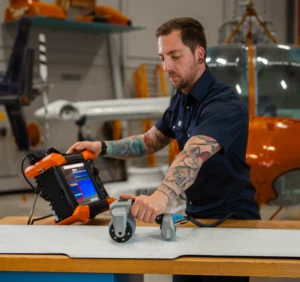
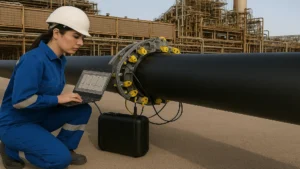
- Volumetric testing (UT, PAUT, TOFD)
- Surface techniques (MT, PT, VT)
- Digital and computed radiography
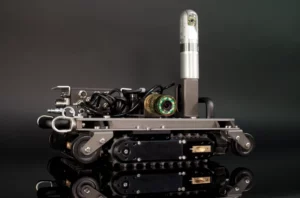
- Remote inspection and robotics
- Defect evaluation and remaining life assessment
- ASNT, ISO, API, and SNT-TC-1A standards
- Applications in O&G, petrochemical, energy, and mining
NDT is essential to ensure structural integrity and operational continuity of critical assets. Technical challenges include qualifications of techniques, accurate interpretation of indications, inspection in complex geometries, and adoption of advanced technologies.