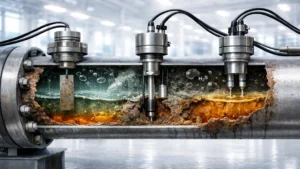
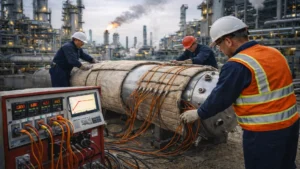
Corrosion is an electrochemical process that degrades metallic materials and affects the performance of equipment and structures in the energy industry. Understanding its mechanisms, kinetics, and environmental variables is essential for material selection and designing mitigation measures.
This field integrates chemistry, metallurgy, mechanical integrity, and operations. Globally, corrosion generates significant costs and operational risks, driving technologies such as monitoring, coatings, inhibitors, and alloy selection in the U.S., Europe, and LATAM.
Main topics
This section gathers technical content for professionals requiring a comprehensive view of material degradation and performance.
Key topics include:
- Corrosion mechanisms (uniform, localized, MIC, SCC)
- Material selection and applied metallurgy
- Coatings, inhibitors, and cathodic protection
- Integrity and remaining life assessment
- Corrosion monitoring
- NACE/AMPP, API, and ISO standards
- Alloy performance in severe environments
Corrosion represents one of the major technical and economic challenges in the energy sector. Its complex behavior and dependence on operational conditions require specialized knowledge.