
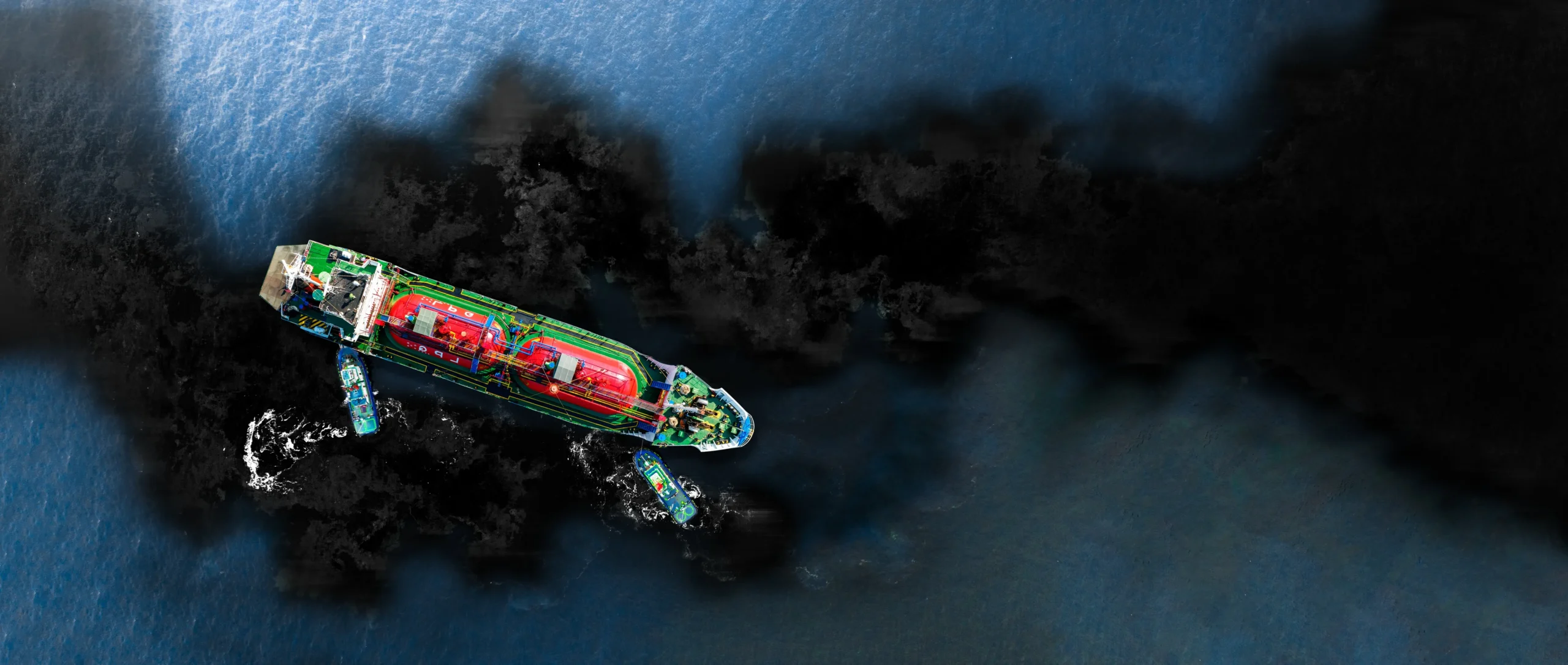
Oil spills continue to pose a significant threat to maritime safety, the operational integrity of terminals and vessels, and the environmental stability of coastal areas and sensitive ecosystems. Despite advances in automation, predictive analytics, and risk-based inspection, the occurrence of these incidents shows that high-volume operations, aging assets, and extreme environmental conditions remain an inherent risk. This scenario requires the integration of industrial preparedness, international technical cooperation, and response technologies capable of acting immediately to contain and mitigate the impact.
What are the causes of oil spills?
Oil spills are caused by operational and structural failures due to multiple factors, and their detailed analysis allows for the establishment of more robust control mechanisms. Among the most common are:
- Human error during critical operations: Crude oil transfer maneuvers, valve management, pressure control, and navigation operations present inherent risks. Operational fatigue, procedural failures, and communication deficiencies can trigger unwanted hydrocarbon release events.
- Mechanical failures in equipment and infrastructure: Pumps, pipes, marine hoses, transfer lines, and valves can fail due to corrosion, fatigue, or inadequate inspection. In facilities with advanced service life, these mechanisms of deterioration increase their probability of occurrence.
- Maritime accidents: Collisions, groundings, mooring breakages, and loss of control during maneuvers are historical causes associated with spills that have had significant impacts on coastal areas and shipping routes.
- Extreme natural phenomena: Storms, storm surges, hurricanes, and severe ocean variations affect terminals, single buoys, docks, and submarine pipelines. These conditions increase structural risk and limit immediate containment capacity.
- Structural degradation due to lack of adequate maintenance: Facilities with insufficient inspection or reduced integrity due to internal or external corrosion create persistent operational vulnerabilities. This scenario is common in infrastructure with extended operational life.
By clearly understanding the causes and factors that lead to oil spills, technical strategies can be developed that focus on maintenance, inspection, continuous monitoring, and operational management with a preventive approach.
International technical cooperation
When the magnitude of the spill exceeds local capacity, international technical cooperation becomes an indispensable component of the global response system. Organizations such as OSRL and the Global Response Network operate under unified standards and have mobilization centers capable of deploying specialists, containment equipment, and recovery systems in a timely manner compatible with the dynamics of the spill.
This model ensures that the industry has certified resources, integrated command protocols, and access to experts with direct experience in complex emergencies. In addition, these networks facilitate ongoing training in ocean scenarios, command exercises, offshore operations, and hazardous materials management, thereby enhancing the industrial preparedness of operators and strengthening interoperability between companies, authorities, and international organizations.
How does international technical cooperation work?
In incidents whose magnitude exceeds local capacity, international technical cooperation plays a decisive role. Networks such as Oil Spill Response Limited (OSRL), the Global Response Network (GRN), and other specialized organizations form systems that enable intervention in diverse regions through uniform protocols, consolidated logistical capabilities, and standardized resources.
These entities facilitate the transfer of operational knowledge, access to internationally certified equipment, and the application of methodologies that support multinational coordination during large-scale emergencies.
International organizations providing technical support in spill response
The following is a list of the requested organizations, written in a technical and objective manner. Each is presented in a paragraph of approximately five lines.
Oil Spill Response Limited (OSRL)
OSRL is an entity specializing in oil spill preparedness and response with global coverage. Its operational structure includes regional centers, trained technical personnel, and certified equipment for containment and recovery in onshore and offshore contexts. It maintains uniform protocols based on international standards and collaborates with operators through membership schemes. Its logistical capacity facilitates the rapid mobilization of ocean barriers, skimmers, aircraft, and engineering support during the early hours of an event. It also develops ongoing training programs focused on simulations and complex emergency scenarios.
Global Response Network (GRN)
The GRN is a network that integrates international organizations with proven experience in spill management. Its structure allows for the coordination of technical resources, specialized equipment, and common procedures under a model of collaboration between countries and private operators. The network acts as an operational exchange system based on compatible response standards, facilitating joint interventions in large-scale incidents. GRN also maintains communication systems that allow for the consolidation of critical information and coordination of multinational command centers. Its integration strengthens interoperability between teams from different jurisdictions.
International Tanker Owners Pollution Federation (ITOPF)
ITOPF provides technical assistance during marine pollution incidents associated with the transport of hydrocarbons. Its work includes damage assessment, containment recommendations, advice on dispersants, and environmental impact analysis. The organization deploys specialists who support authorities and operators in making decisions based on operational data and ocean conditions. In addition, ITOPF maintains historical records that allow for trend analysis and contribute to the design of evidence-based maritime policies. Its contribution facilitates alignment between regulators, insurers, and shipping companies during event management.
Regional Marine Pollution Emergency Response Center
The Regional Marine Pollution Emergency Response Center (REMPEC) operates within the Mediterranean system and supports States in the prevention and control of oil pollution. Its role includes technical assistance, preparedness exercises, development of national plans, and direct support in incidents requiring multinational coordination. It maintains regional databases, operational manuals, and communication platforms for decision-making during emergencies. In addition, it facilitates agreements between coastal countries for the sharing of equipment and response procedures. Its approach allows for consistent incident management in one of the world’s busiest shipping lanes.
Advanced technologies in response to spills
Technological advances have transformed the way oil spills are assessed and contained, enabling data-driven decisions and faster execution times. Oceanographic modeling tools predict the behavior of the slick using calculations that integrate currents, wind, and thermal variations, allowing barriers and equipment to be positioned in strategic areas.
Surveillance using drones and unmanned aircraft provides real-time images that facilitate volumetric assessment and dynamic monitoring of the spill. Similarly, modern skimmers increase recovery efficiency even in moderate wave conditions, while state-of-the-art barriers offer resistance to extreme environments and allow operation in deep waters. Interoperable operational platforms integrate field information, meteorological data, and communications between teams, creating a unified control environment that improves tactical coordination among the actors involved.
Conclusion
Oil spills will continue to be an inherent risk to maritime and energy operations. However, a thorough understanding of their causes, strengthening industrial preparedness, adopting response technologies, and actively participating in international technical cooperation networks such as OSRL and GRN enable the industry to achieve higher levels of resilience. Response capacity depends on robust operational structures, unified communication systems, and an environmental mitigation strategy aligned with global standards. The combination of these elements ensures faster, more accurate, and more effective interventions, reducing the impact on ecosystems, coastal communities, and critical infrastructure.
References
1.American Psychological Association. (2010). El derrame de petróleo en el Golfo. https://www.apa.org/topics/disasters-response/derrame-petroleo.