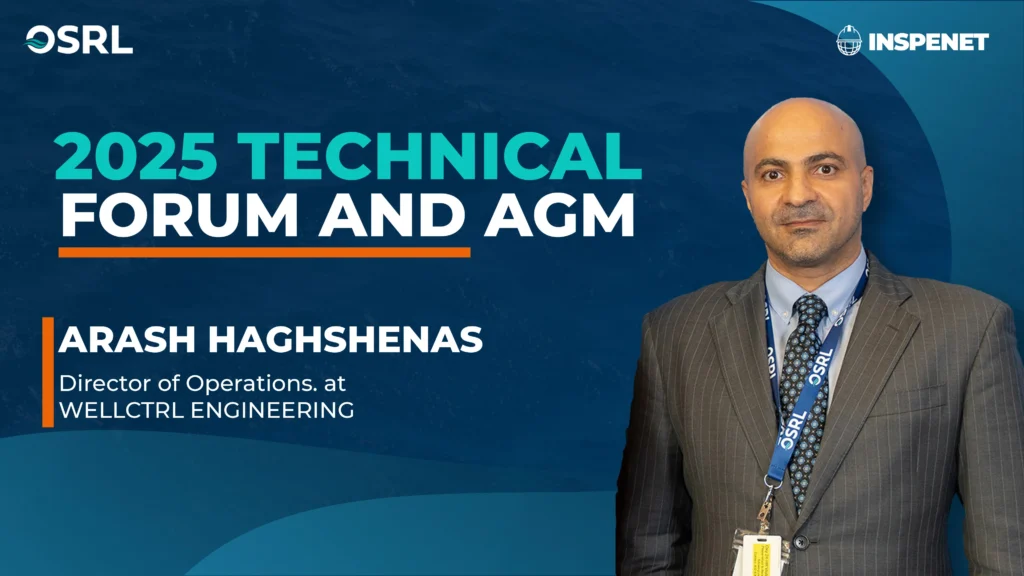
As part of the OSRL 2025 event, Arash Haghshenas, PhD and COO of WellCTRL Engineering, shared technical and human insights on recent advances in well control engineering. With a track record of more than two decades, his participation put the focus on precision, collaborative working and the digital transformation as pillars of an effective response.
In the face of a well control incident, the pressure is not just coming from underground; regulatory authorities, media and operators are watching every technical decision. For Haghshenas, maintaining the balance between detailed analysis and timely action is crucial, "If you just analyze the data endlessly, the response is delayed, but if you act without a technical basis, you can make the situation worse."
Therefore, well control engineering requires identifying critical data, updating them in real time and making viable decisions that can be executed safely.
Effective response also depends on partnerships established prior to the incident. For WellCTRL,
These relationships accelerate the flow of information and activate networks of experts who have already worked together in simulations or real operations. Familiarity with the equipment and operating systems of other organizations is, according to Haghshenas, a decisive advantage.
One of the biggest challenges when working with multiple companies is the diversity of internal processes. Different forms, acronyms and operating cultures can lead to delays or misunderstandings. To address this, organizations such as OSRL standardize structures, flows and hierarchies.
"Simulations help train these shared procedures. By the third time you do a drill, you know exactly who to talk to and how to act, that reduces critical times when a real event occurs."
Haghshenas clarified.

One of WellCTRL's most innovative contributions is the application of digital twins in well control engineering. This technology allows to digitally replicate a well, its conditions and possible scenarios, to anticipate system behavior and improve decision making.
From real-time data, fluid flow, pressure and dispersion are simulated, allowing us to identify anomalous patterns, validate assumptions and adjust intervention strategies. "If it used to take days to make a critical decision, now we can do it in hours with greater accuracy."
In addition to innovating, WellCTRL has consolidated an internal training culture based on progressive simulations. Junior engineers observe, then actively participate and finally lead sections. This methodology ensures that operational knowledge is kept alive and transferred effectively.
"We want our young engineers to grow within the system. That they go through different levels and end up leading with confidence and preparation."
Haghshenas explains.
The OSRL 2025 forum was, for WellCTRL, an opportunity to listen, learn and build new collaborations. "We know half of the organizations present, seeing their progress, sharing ours and working on joint solutions is vital to improving the industry."
From plume modeling to digital twin integration, well control engineering is evolving rapidly. And along the way, the combination of data, expertise and collaboration is becoming the new standard.
For more content about OSRL 2025, please visit our LinkedIn profile.
Source: Inspenet.