From the exhibit space at OSRL 2025, Desmond Greene, Project Manager of GRi Simulations Inc. presented the VROV simulator, a high-tech tool designed to train underwater vehicle operators and plan offshore operations.
Developed by GRi Simulations Inc., the VROV (Virtual Remotely Operated Vehicle) simulator is a simulation platform that accurately reproduces the operation of underwater vehicles (ROVs) and their interaction with complex structures. This system allows operators to be trained, real interventions to be rehearsed, and procedures to be validated before they are executed at sea.
The tool is powered by three-dimensional models based on engineering and design (CAD) data provided by equipment manufacturers, ensuring a realistic and accurate simulation experience. In addition, it is compatible with real controls or portable versions used in training environments.
The VROV simulator was initially designed as a training platform for ROV pilots. However, over time it evolved into a multifunctional tool that also allows for operational validation and mission planning. Offshore companies contract the system to simulate specific tasks in real projects, such as the installation of oilfield equipment.
One example cited by Greene was the Atlantis project in the Gulf of Mexico for BP, where GRi simulated the installation and operation of all subsea equipment, allowing testing prior to the actual intervention.
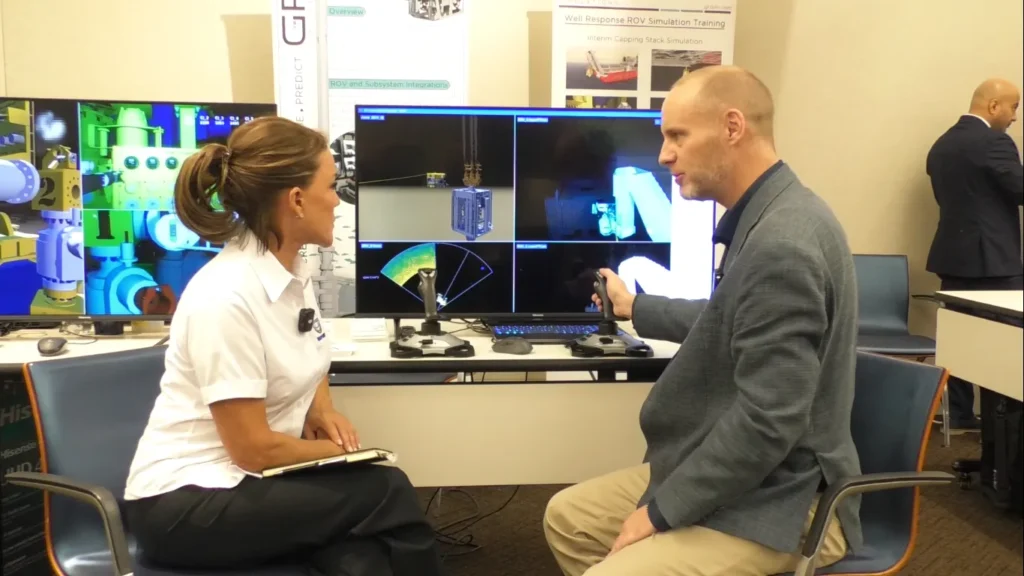
One of the advantages of the simulator is its ability to adapt to specific projects. The system integrates digital models of real ROVs, as well as subsea structures such as BOPs and capping stacks, allowing to replicate exactly the operation to be performed in the field.
The simulation also takes into account environmental variables such as underwater visibility; in areas with high turbidity, operators can train to navigate using sensors such as sonar, complementing the view provided by cameras. The tool allows users to switch between overhead views, low-light cameras, and proximity sensors to improve navigation in adverse conditions.
The use of the VROV simulator significantly reduces the time and costs associated with subsea operations. By allowing repeated trials before a real intervention, operators arrive better prepared, which reduces errors, increases safety and optimizes the time of use of vessels, whose daily cost in offshore operations is high.
It is also commonly used onboard vessels while waiting for an operational window. In this way, pilots can rehearse the mission they are about to execute in the same working environment, gaining familiarity with specific controls and equipment.
The training process in the simulator begins with basic tasks such as moving the ROV and the use of sensors. Then, manipulator arms, hydraulic tools and scenarios that require teamwork are incorporated. In complex cases, operations are simulated with pilot and co-pilot, which reinforces operational coordination.
The level of detail and realism allows experience to be gained in situations that would be costly or risky to replicate at sea, making the VROV a highly effective training and testing platform.
With more than three decades of experience in marine simulation, GRi Simulations Inc. has positioned the VROV simulator as a versatile, robust and adaptive solution for the energy and subsea services sector. Its application goes beyond training, allowing to validate strategies, reduce uncertainty and increase mission effectiveness.
For more content about OSRL 2025, please visit our LinkedIn profile.
Source: Inspenet.