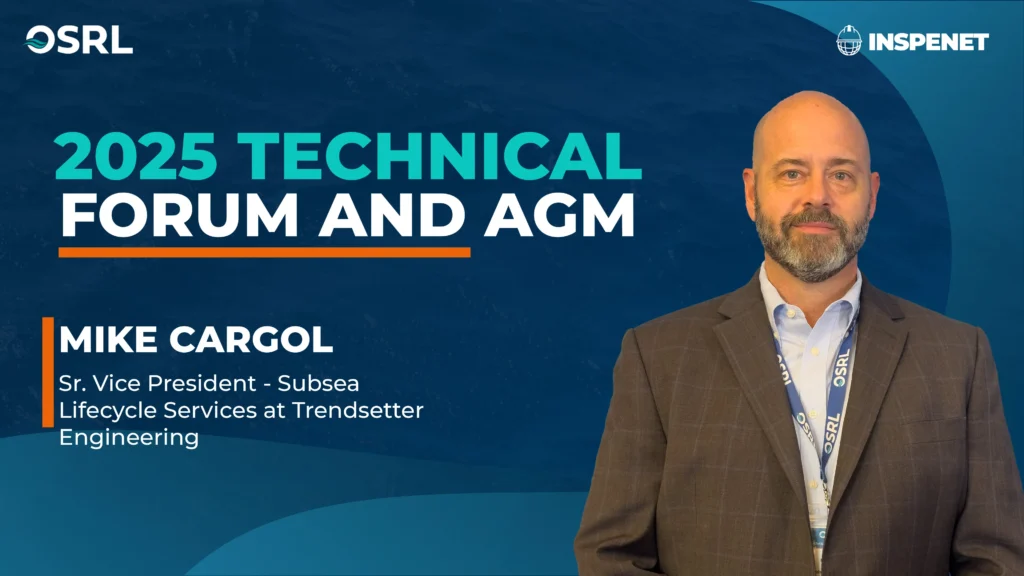
Since the Macondo incident in 2010 marked a before and after in the offshore industry, few companies have played as decisive a role as Trendsetter Engineering, its transformation from a technical consultancy to a global benchmark in subsea well control has been driven in large part by its strategic collaboration with Oil Spill Response Limited (OSRL). This was explained by Mike Cargol, the company's Senior Vice President of Subsea Lifecycle Services, during his participation in OSRL 2025.
Founded in 1996 in Houston, Texas, Trendsetter began as a consulting firm focused on subsea services. However, following the Macondo disaster, the company channeled its production expertise to address a critical need: the design and delivery of subsea plugging systems.
It was the first organization to provide a dedicated containment system to Marine Well Containment Company, enabling exploration in the Gulf of Mexico to resume. Since then, Trendsetter has supplied nearly 95% of the global subsea plugging equipment, maintaining it for strategic consortia worldwide.
The relationship with OSRL has been important in this evolution. Far from a traditional client-supplier relationship, this is a deep technical collaboration that has helped to break down barriers between for-profit companies and not-for-profit consortia.
This structure has been essential for Trendsetter to access strategic information on global operators and the regulatory frameworks that govern them. As a result, they have been able to develop new methodologies, optimize equipment operation and align their systems to the real needs of the sector.
One of the biggest post-Macondo challenges was the divergence in terminology and procedures between regions. While the Gulf of Mexico spoke of "flowback", other countries used "containment".
Trendsetter, together with OSRL, led an effort to homogenize nomenclatures, protocols and training, which facilitated collaboration between technicians from different countries. This work was channeled through IOGP (International Association of Oil & Gas Producers), establishing globally adopted standards.
Likewise, knowledge management and training systems have been developed to train local teams, replicating good practices in different continents. Some of these standards are even being reintroduced to the Gulf of Mexico itself.

Contrary to popular belief, innovation in this field is not focused on artificial intelligence. The most transformative, according to Cargol, is happening in areas such as:
These advances shorten logistics times and ensure greater efficiency in emergency situations. In the long term, they also optimize maintenance routines, extending equipment life and reducing operational risk.
One of the most striking achievements of this alliance is the reduction in response time. Before Macondo, a capping operation could take between 4 and 8 weeks; today, thanks to standardized protocols and simultaneous activation of systems, a well can be plugged in less than 14 days.
Trendsetter and OSRL have established a protocol where, upon incident notification, two systems are mobilized in parallel (one main and one backup). This model ensures redundancy and greater efficiency, regardless of the geographical location of the incident.
The experience of Trendsetter Engineering demonstrates that subsea well control depends not only on cutting-edge technology, but on collaboration, standardization and long-term vision. Its alliance with OSRL has been key to transforming a painful lesson into a robust, global operational capability, as Cargol aptly put it: "We hope that an event like Macondo will not happen again, but if it does, we will be much better prepared to deal with it.
For more content about OSRL 2025, visit our LinkedIn profile.
Source: Inspenet.