During the NISTM 2025 event, one of the most talked-about proposals was that of Re-Gen Robotics, a company specializing in cleaning crude oil tanks remotely operated robots. Representing the firm was Chris Platt, Senior Vice President and Commercial Director, who explained how their solution eliminates the need to expose human operators to highly dangerous tasks.
The technology presented improves operational efficiency and offers a new way of thinking about industrial safety in confined environments.
Re-Gen Robotics is part of the Re-Gen Group, an industrial conglomerate with a strong focus on engineering and automated solutions. The company was founded after identifying that traditional crude oil storage tank cleaning (with operators entering in airtight suits and respirators) was an obsolete, risky, and physically extreme practice.
Headquartered in the United Kingdom and operating throughout Europe, Re-Gen Robotics became the first company to offer cleaning robots certified to operate in areas classified as hazardous (Zone 0, Class 1 Div 1). Its purpose is to create safer, smarter, and more efficient work environments by completely isolating humans from toxic waste and the flammable environment of tanks.
At the heart of Re-Gen Robotics' proposal is its tank cleaning robot, a remotely operated vehicle designed to enter oil storage tanks through standard 24-inch manholes.
Once inside, the robot performs a complete cleaning of the tank without the need for human intervention inside.
"Our customers don't have to put anyone inside the tank; that's the key change we're proposing,"
Explained Chris Platt.
Although the company works with a standard model, each robot can be adapted to suit individual cases. Its tracks, suction heads, and hoses are modified according to the viscosity of the residue or the volume contained in the tank.
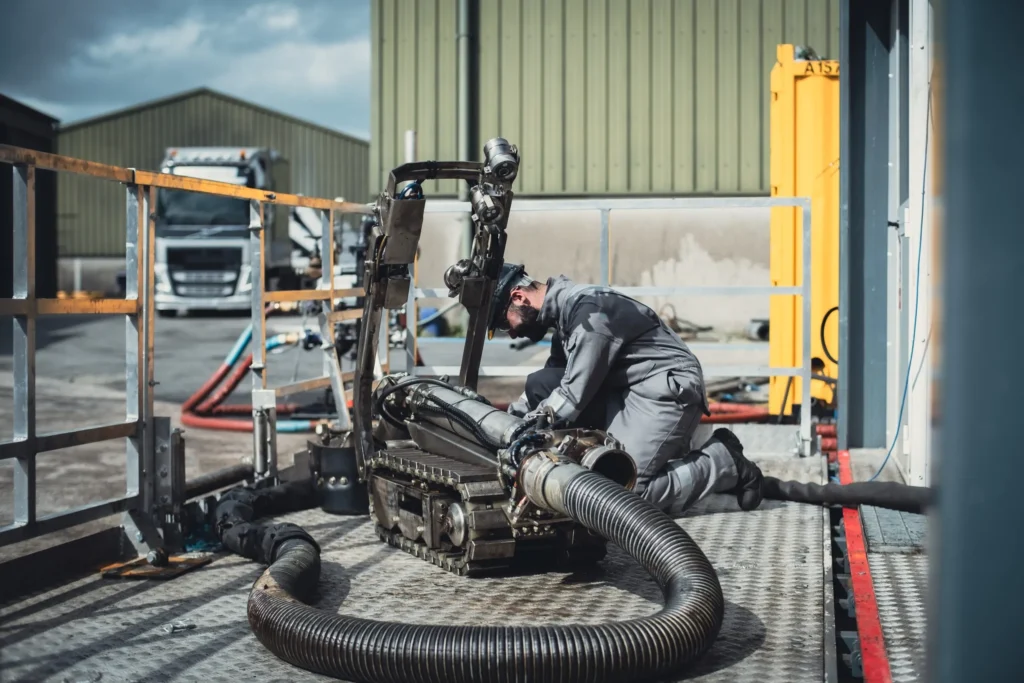
Cleaning crude oil tanks is a critical and complex activity. Until recently, this involved weeks of work with crews exposed to gases, toxic products, and explosive atmospheres. Re-Gen Robotics proposes to eliminate this risk entirely.
In addition to its most obvious advantage (eliminating human entry into confined spaces), the robot has a video recording system that documents the entire process. Internal images of the tank, captured by integrated cameras, are delivered to the customer as visual backup of the cleaning performed. Although this function is not equivalent to a formal technical inspection, it does provide valuable information for future maintenance decisions.
Another highlight is the operational continuity of the equipment. Thanks to recent improvements, the robot can work longer inside the tank and increase its performance, extracting larger volumes of sludge without interruption. This translates into less downtime for the customer and greater efficiency in the cleaning process.
One of the crucial challenges in developing a solution of this type is maintaining a balance between mechanical robustness and operational precision. According to Chris Platt, in recent years the engineering team has focused on improving the robot's reliability and operational performance.
The adaptations have been mainly mechanical, aimed at withstanding the extreme conditions inside the tanks and allowing for greater residue suction capacity. These improvements allow the robots to operate longer without the need for external intervention, further reducing risks and speeding up the return to normal tank activity.
Although its robots are currently focused exclusively on cleaning, Re-Gen Robotics is evaluating incorporating inspection capabilities in future versions or through strategic alliances with companies specializing in this type of service.
"We are looking at the whole picture of cleaning and inspection. There are opportunities to collaborate or expand capabilities,"
Platt commented.
This would open a new phase, in which robots would perform operational tasks and also provide structural and technical data directly from inside the tanks.
This vision fits with the industry trend toward automating high-risk operations and generating data to support real-time decisions.
Re-Gen Robotics' proposal represents a profound change in the way critical tasks such as crude oil tank cleaning are performed. Eliminating human exposure, reducing downtime, and providing visual records are aspects that are already generating interest in refineries and storage terminals around the world.
Furthermore, its participation in NISTM 2025 reinforces its position as a technological benchmark within the industrial segment, where safety is no longer an option but an expected standard.
Thanks to its focus on applied engineering, operational customization, and continuous improvement, Re-Gen Robotics demonstrates that it is possible to optimize productivity without putting human capital at risk.
For more content on NISTM 2025, visit our LinkedIn profile.
Source: Inspenet.