At AMPP Annual Conference + Expo 2026, the focus has shifted toward the evolution of industrial abrasives in response to new operational demands. Moving away from traditional materials such as sand or coal slag, companies are incorporating solutions that prioritize greater process control, better finishes, and safer working conditions.
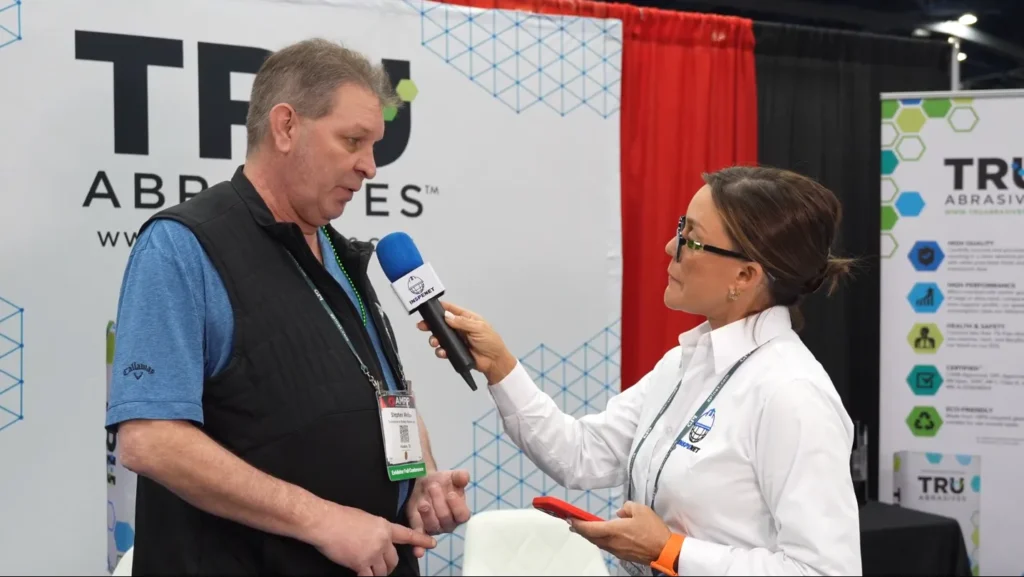
In this context, Stephen Mellon, National Customer Service and Sales Manager at TruAbrasives, explains how the sector is leaving behind traditional solutions to advance toward more efficient and controlled media. According to him, this evolution responds not only to technical criteria but also to new regulatory and operational requirements.
Conventional abrasives have presented significant limitations for years. Sand, for example, contains free silica, an element that poses a health risk to workers. Likewise, other materials such as coal slag incorporate heavy metals that can contaminate treated surfaces.
Faced with this scenario, the use of crushed glass introduces a more controlled alternative. As Mellon points out, the thermal process that transforms sand into glass eliminates free silica, which reduces risks during blasting. Additionally, by not containing metallic contaminants, it avoids problems in finishes and subsequent treatments.
Thus, glass-based industrial abrasives enable cleaner and more homogeneous surfaces, facilitating the detection of imperfections and improving the final quality of the work.
Another crucial aspect in the evolution of industrial abrasives is safety. In this regard, recycled glass provides relevant advantages for both the operator and the work environment.
For example, being a material free of active silica, risks associated with particle inhalation are minimized. Likewise, the absence of toxic substances reduces the need for special treatments in waste management.
At the same time, the product's origin reinforces its value within the circular economy. TruAbrasives manufactures its materials from recycled glass, primarily bottles, which would otherwise end up in landfills.
As a result, companies that adopt this type of industrial abrasives can optimize their processes without increasing environmental burden or costs associated with hazardous waste management.
Regarding field use, glass abrasives have demonstrated high adaptability. From automotive restoration to treatment of wooden structures or applications in the marine sector, their versatility allows them to meet multiple needs.
According to Mellon, one of the important factors is the availability of different particle sizes, which allows the product to be adjusted to each application. This way, it is possible to replace other media such as aluminum oxide, walnut shells, or even soda blasting.
Additionally, controlling variables such as pressure or nozzle size allows work on delicate surfaces without generating deformation. This has favored its adoption in sectors where the final finish is critical.
Beyond the product itself, another differentiating element is technical support. TruAbrasives operates under a distributor-based model but maintains a direct relationship with the end customer through specialized consulting.
In this regard, Mellon emphasizes that knowledge about usage parameters is crucial for obtaining good results. Aspects such as proper pressure or mesh size selection directly influence process efficiency.
Thus, the value proposition is not limited to supplying industrial abrasives but includes ongoing support to ensure proper application. This approach helps build trust and long-term relationships with customers and distributors.
Overall, the surface preparation sector is experiencing a clear transition. Demand for industrial abrasives that combine performance, safety, and lower environmental impact continues to increase.
In this scenario, solutions such as recycled glass are gaining prominence by simultaneously addressing multiple needs. Regulatory pressure, along with greater operational awareness, is accelerating this adoption across different industrial segments.
Likewise, events such as AMPP 2026 reflect how innovation in materials has become a strategic axis for companies in the sector. The ability to adapt to these new requirements will make the difference in an increasingly competitive market.
For more content about AMPP 2026, please visit our LinkedIn profile.
Source: Inspenet.