Geotechnical engineering in the energy and industrial sectors is essential to ensure the stability of storage tanks, whose performance depends directly on soil conditions. Steven Pirih, Pre-Construction Director at Keller Group, shared in an interview how the world's leading geotechnical solutions company addresses foundation and maintenance challenges in critical facilities. With a presence on five continents and more than 10,000 employees, Keller has established itself as a benchmark in geotechnical engineering, offering technical alternatives that combine safety, efficiency, and reduced environmental impact.
The interview with Steven Pirih confirms Keller's role as a leader in geotechnical engineering applied to the energy industry. Its ability to offer solutions adapted to each terrain, reduce environmental impact, and handle remediation projects makes the company a strategic partner for terminals and industrial parks. With a vision that combines technical innovation and environmental responsibility, Keller remains at the forefront of storage tank construction and maintenance.
Keller Group is a contractor specializing in geotechnical engineering that participates in more than 5,500 projects per year. Its model combines local knowledge with global experience, allowing it to design and execute solutions tailored to each terrain. The company is ranked number one in North America in deep foundations according to Engineering News Record. With 1,650 engineers and 1,100 drilling rigs, Keller is involved from the beginning of the construction cycle, ensuring that the works have solid and safe foundations.
Steven Pirih explained that Keller offers up to ten different techniques to support storage tanks, depending on soil conditions. The process begins with studies by external consultants who carry out drilling and analysis. Based on these reports, Keller proposes solutions ranging from soil improvements to deep foundations.
In highly variable terrain, such as the fill soils in the Houston Canal, the company applies improvement methods to prevent differential settlement. When the soil is too compressible, deep foundations are used to reach more competent layers. The key is to adapt the technique to the geology and requirements of each project.
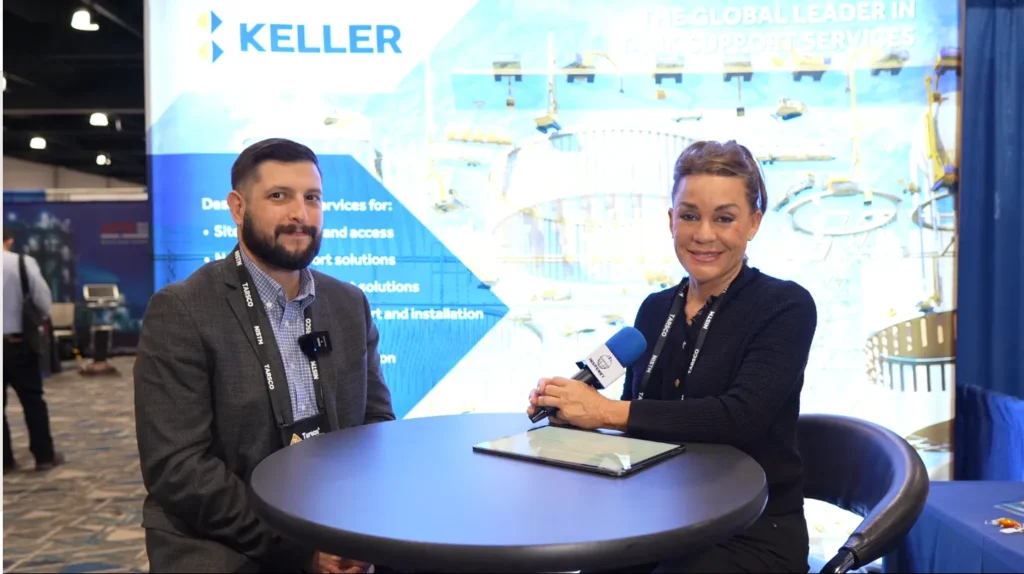
In addition to technical challenges, geotechnical engineering must also comply with strict environmental regulations. Keller has a team specializing in health, safety, environment, and quality (HSEQ). According to Pirih, in recent years the company has strengthened its focus on solutions with a lower carbon footprint.
One example is the replacement of concrete piles with compacted stone columns. While piles require large volumes of cement and truck transport, columns significantly reduce material and fuel consumption. Keller uses carbon calculators to compare alternatives and show customers how they can reduce costs and emissions. The company also promotes value engineering, proposing more efficient designs that meet environmental and technical standards.
Pirih pointed out that working in an active terminal involves greater safety requirements, with teams having to comply with training programs, respect access routes, and coordinate with ongoing operations. In contrast, projects in open areas offer greater flexibility, although they are sometimes carried out alongside operating facilities. Keller's experience in both scenarios ensures that work is carried out without affecting the continuity of industrial operations.
The interview also addressed Keller's role in the remediation of existing tanks. Often, facilities built decades ago exhibit differential settlement that compromises their operation. Keller offers solutions such as jet grouting, compaction grouting, or even the replacement of foundation rings.
The process begins with third-party inspection reports. Based on this data, Keller designs a remediation strategy, which may include lifting structures and treating the underlying soil. These techniques extend the service life of tanks and ensure their operational safety.
For more content on NISTM 2025, visit our LinkedIn profile.
Source: Inspenet.