At the AMPP Annual Conference + Expo 2026, Ludger Wahlers, Managing Director of ERICHSEN, addressed one of the most relevant topics for the industry: the reliability of laboratory corrosion testing. Drawing from his experience, he explained how current testing systems seek to ensure controlled and repeatable conditions, especially in parameters such as temperature, humidity, and sample preparation.
He also emphasized that repeatability is an essential requirement for any laboratory operating under ASTM and ISO standards. Without this control, results lose validity and comparability between different facilities.
First, corrosion testing allows anticipating the behavior of coatings when exposed to aggressive environments. Sectors such as automotive, energy, and heavy industry rely on these tests to validate materials before implementation.
On the other hand, standards such as ASTM B117 have established widely used methodologies, such as the well-known salt spray test. This type of test provides a common basis for comparing results between different laboratories and manufacturers.
However, this standardization also introduces limitations when attempting to extrapolate data to real-world environments.
In this context, Wahlers was clear in pointing out the main problem with corrosion testing: the lack of direct correlation with field performance. Real conditions vary significantly depending on geographic location, climate, and environmental factors.
In fact, he stated that "there is no universal correlation" between accelerated tests and actual performance. A clear example is the use of 1,500 hours in the ASTM B117 test, which in many cases is interpreted as a direct indicator of durability, when in reality it is not.
Likewise, this disconnect generates misunderstandings in the industry, where there is a tendency to simplify complex results into seemingly comparable metrics. This can lead to imprecise technical decisions.
Given these limitations, cyclic corrosion testing has gained relevance in recent decades.
These methods introduce controlled variations in test conditions, simulating real environmental changes more closely.
Wahlers explained
Unlike the salt spray test, which maintains constant conditions, cyclic tests combine phases of humidity, drying, and salt exposure. This allows observing how coatings react to fluctuations more representative of the environment.
As a result, although no exact correlation exists, the behavior observed in the laboratory better approximates field performance.
In technical terms, corrosion testing depends on several critical factors. First, temperature directly influences the rate of chemical reactions.
Second, humidity plays a determining role in the formation of corrosive processes. High levels can significantly accelerate material deterioration.
Finally, the presence of salt, especially in the form of salt spray, acts as a catalyst that intensifies corrosion. The combination of these elements defines the aggressiveness of the test environment.
Likewise, precise control of these parameters is essential to obtain reliable and reproducible results.
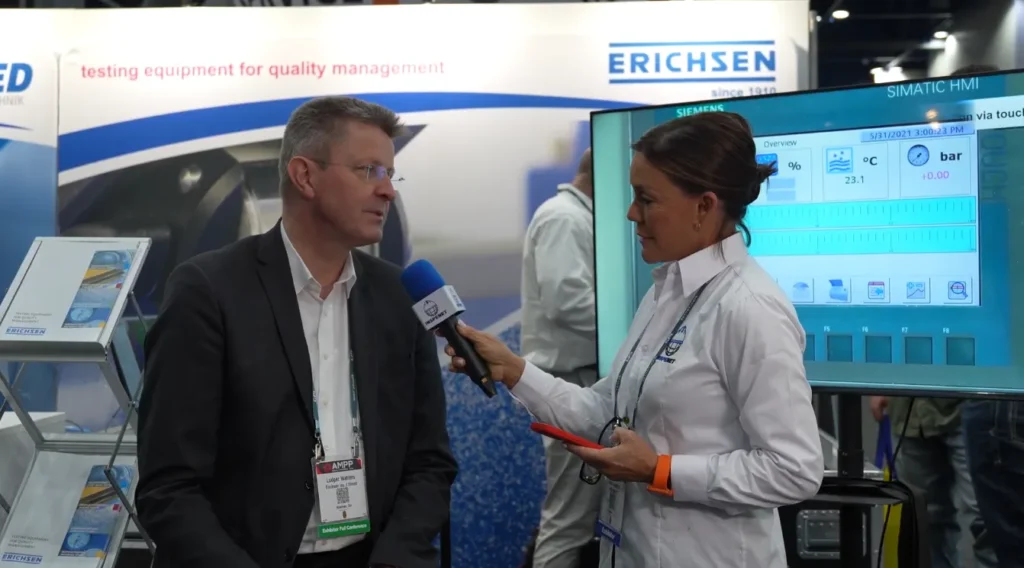
To ensure the validity of results, laboratories must have equipment capable of maintaining stable and repeatable conditions. In this regard, ERICHSEN focuses its offering on testing systems that ensure a high level of control over each variable.
Additionally, global equipment maintenance and service is another crucial aspect.
Ensuring that test chambers are maintained in optimal condition is essential to avoid deviations in results.
According to Wahlers.
Thus, the combination of technology and technical support enables laboratories to improve comparability between tests conducted in different parts of the world.
With over a century of experience, ERICHSEN has developed a solid knowledge base in the field of corrosion testing and materials testing. The company designs and manufactures equipment for multiple applications, including surface, materials, and coating testing.
Likewise, their approach focuses on understanding the specific needs of customers, which allows them to offer solutions adapted to different industrial environments. This accumulated experience translates into equipment that meets international precision standards.
For more content about AMPP 2026, please visit our LinkedIn profile.
Source: Inspenet.