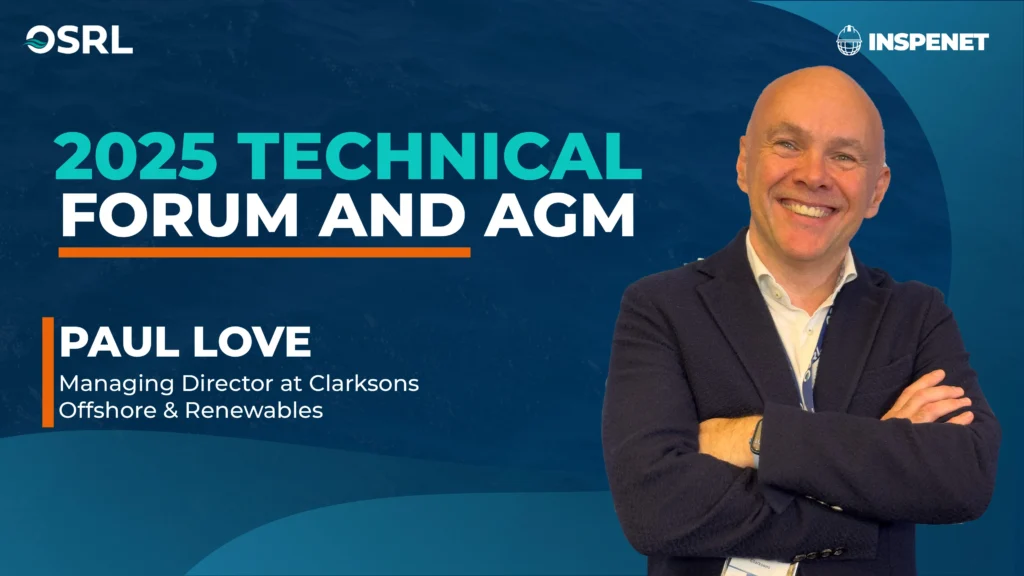
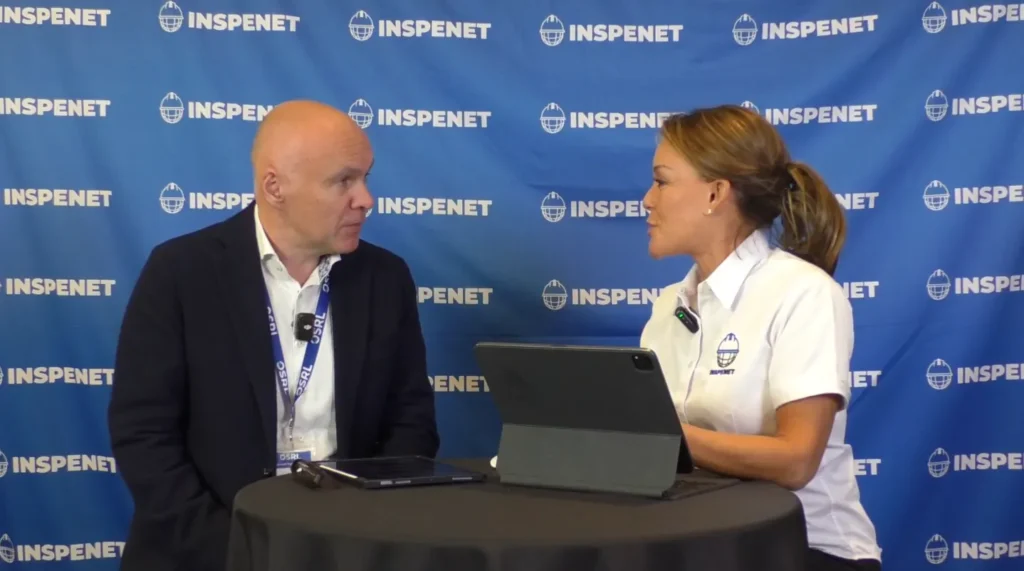
During his participation in the OSRL 2025 event, Paul Love, Managing Director of Clarksons Offshore & Renewables, offered strategic insight into the challenges facing maritime operations in emergency contexts. From vessel contracting to the use of artificial intelligence, the conversation addressed how proper "peacetime" preparedness can determine the effectiveness of an actual oil spill response.
According to Love, the vessels used in an emergency are not simply assets available on a map; they are specialized tools that must meet very precise technical requirements.
"It's not just dots on the screen. We care about the quality of the ship and that the equipment on board is exactly what the customer needs."
Said Paul Love
Clarksons has developed an application that identifies suitable vessels for critical operations. This platform contemplates more than 30 types of missions and 20 types of vessels, allowing a precise selection for each type of incident, this vision has allowed the company to integrate logistics planning with technology in a single value proposition.
One of the most sensitive issues addressed by Love was the change in contractual terms during critical situations. Although the company handles about 1,000 offshore vessel charters a year, most of these are under standard and predictable conditions, however, the reality changes dramatically during a real emergency, such as a major spill.
Love explained: "In what I call wartime at sea, contracts change. The risk is transferred from the shipowner to the event responder," this situation creates both legal and operational uncertainty. In the absence of recent large-scale precedents, it is unclear whether owners would be willing to assume the risks or whether insurers would back uncontrolled oilfield operations.
To anticipate these difficulties, Clarksons Offshore & Renewables relies on the use of advanced data. The company uses two satellite constellations to track vessels in real time, combining that information with its own operational database, which allows them to know critical characteristics such as crane type, ROV system installed or maneuverability.
Beyond current monitoring, the team applies analytical models to predict future vessel behavior.
"We know which projects they are assigned to, how long they will last and in which regions they will be available. This is how we help our customers calculate their response times."
Love said.
Although still at an early stage, Clarksons is already beginning to use artificial intelligence to interpret operational behavior. For example, if a vessel reports restricted maneuverability in an oil patch, the system can infer that it is performing a sensitive subsea operation.
This type of predictive analytics makes it possible to anticipate routes and, in turn, generate alerts about logistical constraints that could arise during an emergency. It is a further step towards intelligent automation of maritime logistics, especially in high-risk environments.
Clarksons found in Oil Spill Response Limited (OSRL) a strategic partner to scale its solution. The organization centralized subscriptions to the platform, enabling large oil companies to quickly adopt the tool.
"The relationship with OSRL opened up a direct path to market for us. We started working with some of the world's largest operators," Love noted. This collaboration also facilitated the integration of the maritime brokerage service as a complement to the software, offering an end-to-end solution.
From its position at the heart of global maritime brokerage, Clarksons Offshore & Renewables demonstrates how planning, data and technology can make a difference when it comes to protecting the seas and responding quickly to critical events. Its vision, expressed in OSRL 2025, makes it clear that contractual, logistical and technological challenges must be addressed before the next big spill arrives.
For more content about OSRL 2025, please visit our LinkedIn profile.
Source: Inspenet.